Canouan
Adonal Foyle left Canouan for the United States and became an NBA center for the Golden State Warriors. He also became a political activist, which makes a certain kind of sense for someone who grew up on an island where fresh water had to be delivered by boat from St. Vincent. Canouan is small -- 7.6 square kilometers, population roughly 1,700, one main settlement called Charlestown. It sits 40 kilometers south of St. Vincent in the Grenadine chain, a speck of volcanic rock wrapped in barrier reef on its Atlantic side and ringed by the kind of turquoise water that launches a thousand brochure photographs. What the brochures rarely mention is how recently this island got electricity, paved roads, or desalinated water -- and how much of that transformation was driven not by government but by resort developers with their own ideas about what Canouan should become.
Canoe People and Colonial Contest
Sometime before 200 B.C., the Arawaks reached Canouan in dugout canoes, bringing plants, animals, and the farming and fishing skills that sustained them for roughly 1,500 years. Then the Caribs arrived and displaced them. The pattern would repeat with European colonizers, though the Caribs held out longer here than almost anywhere else in the Caribbean -- the mountainous, heavily forested terrain of St. Vincent and its surrounding islands made conquest difficult. After the Caribs were defeated elsewhere, some joined people who had escaped enslavement on Barbados, following currents and trade winds westward. Their mixed descendants, known as the Black Caribs, proved formidable opponents to both French and British interests. France established a settlement in 1719 and brought enslaved people to work plantations. The 1748 Treaty of Aix-la-Chapelle declared the islands neutral territory, but colonial rivalry continued until Britain secured definitive control in 1814.
The Resort That Built the Roads
Until the early 1990s, Canouan had dirt tracks instead of roads, no reliable electricity, and no desalinated water. Fresh water arrived by boat from St. Vincent. Then the Canouan Resorts Development company secured leases on portions of the island and began building two hotels -- what would become the Raffles Resort site and the Tamarind Beach Hotel site. In the process, the development company did what the government had not: it paved roads across the island, installed electrical infrastructure, and built a desalination plant. The transformation was dramatic and deeply uneven. Locals not employed by the resort were forbidden from entering the property, though beaches remained legally open to the public. The resort changed hands repeatedly -- from Raffles to Carenage Bay Resort in 2010, then to Pink Sands Club in 2016, and in 2018 the newer section came under Mandarin Oriental management.
Mount Royal and the Barrier Reef
Canouan's geography packs considerable variety into a small area. Mount Royal, the island's highest point, anchors the interior, its slopes dropping to two bays -- Glossy and Friendship -- on the southern side. A barrier reef runs the full length of the Atlantic coast, absorbing the ocean's force and creating calmer waters in the island's lee. The reef system connects to the broader coral formations of the Southern Grenadines, part of a marine environment that includes the nearby Tobago Cays Marine Park. An 18-hole golf course designed by Jim Fazio now occupies part of the 1,200-acre resort estate, its manicured greens a striking contrast to the scrubby volcanic slopes that surround it. The juxtaposition captures Canouan's current identity: an island where the natural landscape and the luxury overlay exist in uneasy proximity, each making the other more visible.
The Jet Port at the End of the Chain
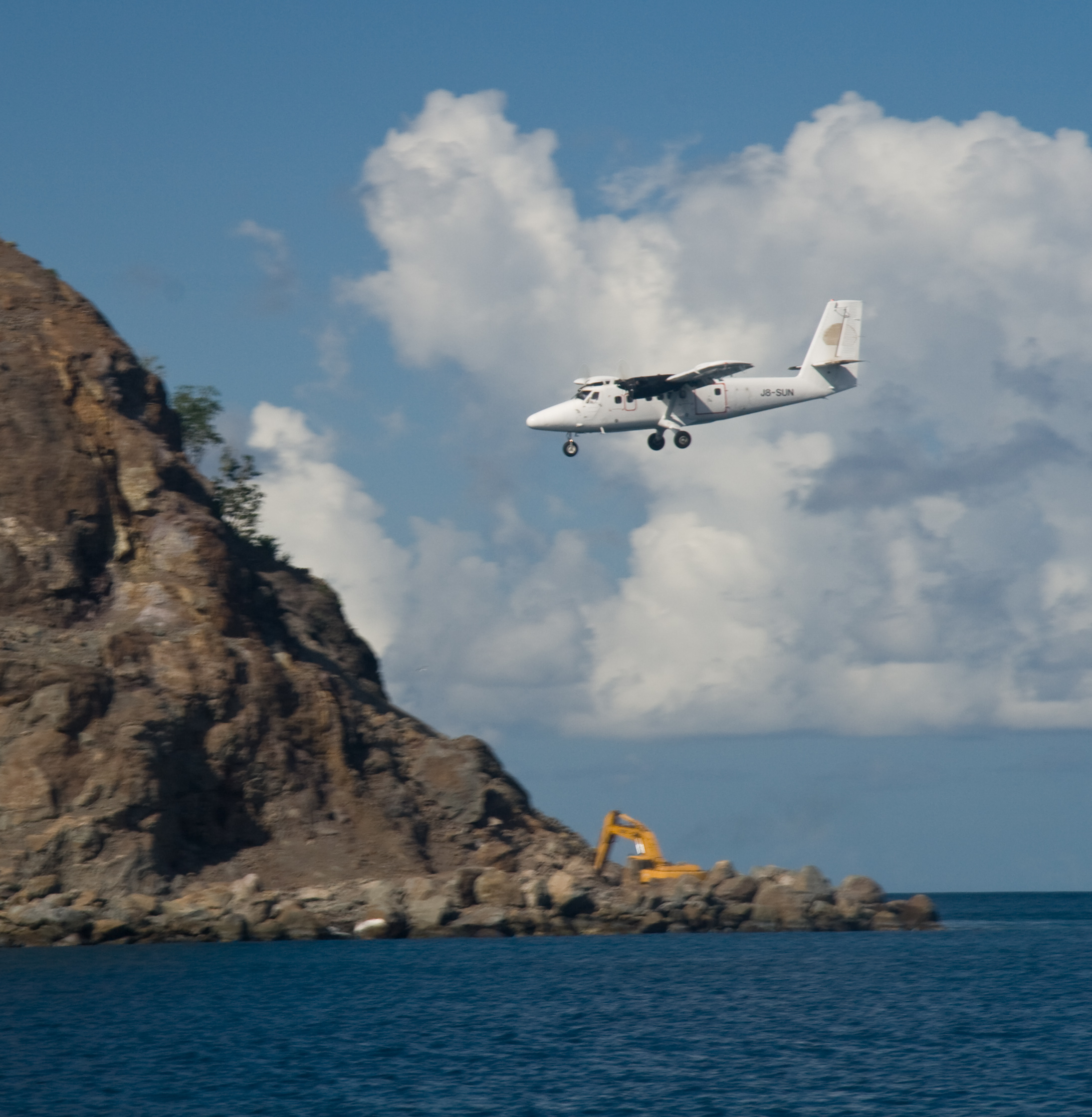
In 2008, the runway at Canouan Airport was extended to nearly 6,000 feet, long enough to accommodate private jets and making it the jet port for the Grenadines. The expansion was driven by resort demand -- wealthy guests expected to arrive directly rather than connecting through St. Vincent's larger but less convenient airport. Scheduled ferries still link Canouan to St. Vincent, Union Island, and Mayreau, serving the islanders who cannot afford air travel. The island now has two schools sharing a single building -- the government primary school at the bottom, a secondary school that opened in September 2019 at the top. Average daytime temperatures range around 24 degrees Celsius, the driest months running from December to May. Independence came in 1979 when Saint Vincent and the Grenadines became a sovereign state within the British Commonwealth, but on Canouan the more transformative date may have been the day the development company's bulldozers arrived.
From the Air
Canouan sits at 12.72N, 61.33W in the Grenadines chain. Canouan Airport (TVSC) has a runway of nearly 6,000 ft, the jet port for the Grenadines. The barrier reef along the Atlantic (eastern) coast is clearly visible from altitude. Look for the golf course greens on the resort estate as a color contrast against the volcanic terrain. Nearby: Tobago Cays to the southeast, Mayreau to the south, Mustique to the north. Recommended viewing altitude: 3,000-4,000 ft AGL.