Cantacuzino Castle
The inscription carved above the inner courtyard entrance says it plainly: "I, Gheorghe Grigore Cantacuzino, with my wife Ecaterina born Baleanu, built this castle in memory of my ancestors and for the shelter of the descendants." It was 1923 when those words were chiseled into stone, but the castle they adorned had already been standing for twelve years -- completed in 1911 on the site of an old hunting lodge in the mountain town of Busteni. The prince who commissioned it was nicknamed "Nababul," the Nabob, for his conspicuous wealth. What he built with that wealth was not merely a summer residence but a declaration, rendered in carved stone and Venetian glass, that the Cantacuzino name would endure.
The Nabob's Grand Design
Prince Gheorghe Grigore Cantacuzino engaged the architect Grigore Cerchez, one of the leading figures of the Neo-Romanian architectural movement, to design the castle. Cerchez specialized in blending traditional Romanian motifs with modern European forms, and the Cantacuzino commission gave him room to work on a grand scale. Construction took five years, with another year and a half devoted to furnishing. When the doors opened in 1911, the castle impressed visitors not only with its beauty but with its modernity: electricity, a sewerage system, and running drinking water, all unusual amenities for a mountain estate at the time. The building consists of four bodies arranged around a quadrilateral with the southern side open to views of the Bucegi Mountains and the Heroes' Cross on Caraiman Peak. A hunting tower stands in the inner courtyard on the east side, a reminder that the Cantacuzinos first came to this valley to hunt.
Rooms of Cordoba Leather and Gold Leaf
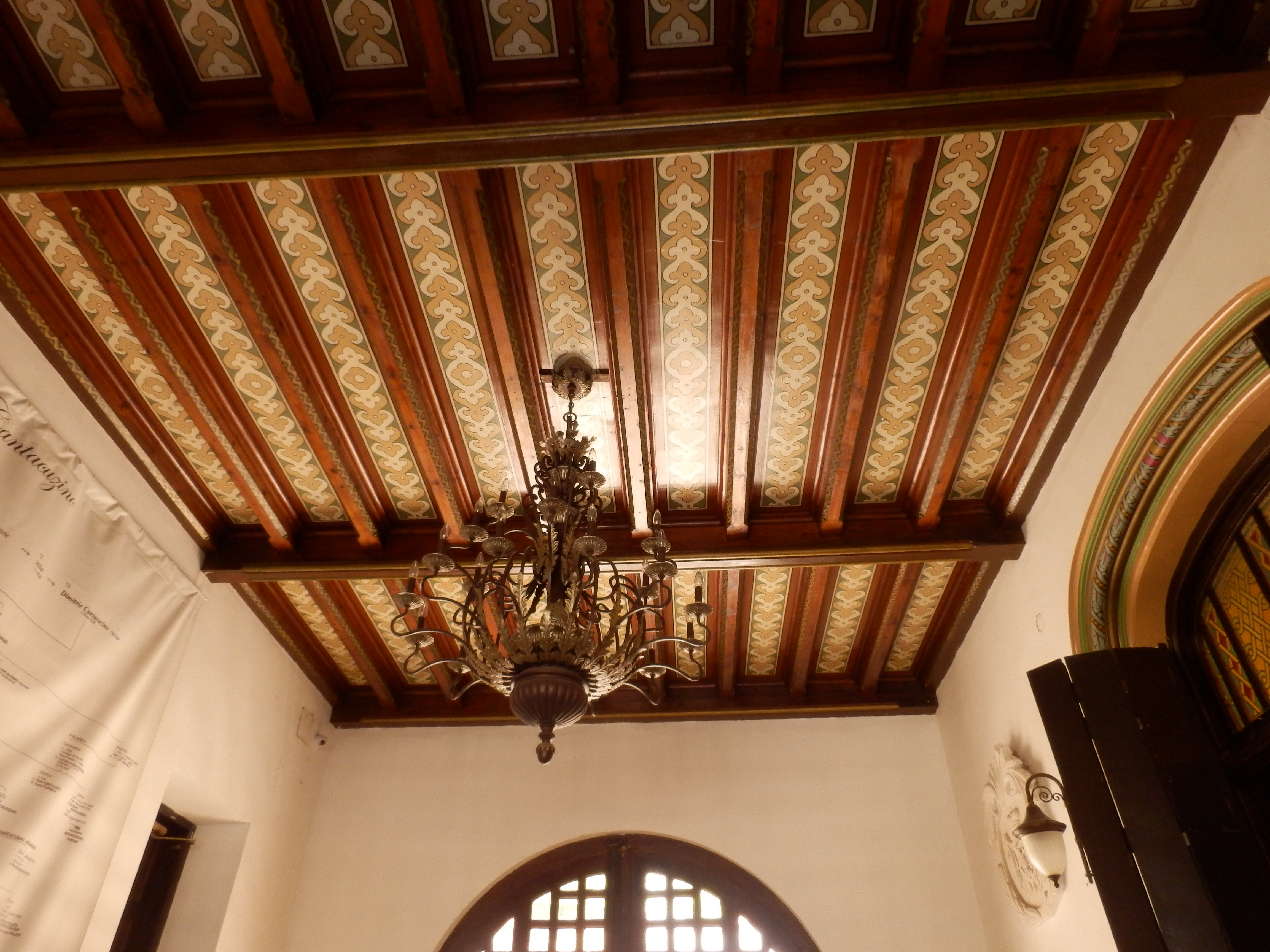
Inside, the castle is a catalog of European craftsmanship compressed into Carpathian mountain air. Roman mosaics line the first level. Venetian artists painted the murals. The stained glass came from Murano, the glazed pottery from Italian workshops, the bronze hardware from Paris. Fireplaces built from Albesti limestone are decorated with polychrome mosaic and gold leaf. The oak staircase is an engineering curiosity -- it rests entirely on the walls, with no central support column. Carrara marble stairs connect the floors. But the most remarkable feature is the gallery of mural paintings executed on Cordoba leather, unique in Romania, depicting twelve life-size portraits of the principal members of the Cantacuzino family's Wallachian branch. In the ballroom, 27 coats of arms represent the aristocratic families linked by marriage to the Cantacuzinos, a heraldic family tree spread across the walls.
Royal Guests and a Wooden Church
The castle's guest list included Romanian royalty. In 1928, Queen Maria, Princess Ileana, and Patriarch Miron Cristea attended the wedding of George Cantacuzino -- the Nabob's grandson and a distinguished archaeologist -- to Zoe Grecianu. They were photographed together in the first-floor lodge, a structure built in the Brancoveanu style with stone columns, carved capitals, and trilobate arches. Between 1935 and 1936, a small wooden church dedicated to Saint George the Conqueror was erected on the estate grounds. Queen Maria and Princess Ileana attended its consecration on September 13, 1936. The church stands on the exact spot where a previous wooden church, brought from the Maramures region by the Cantacuzino ancestors in the 18th century, had once stood. The estate's gardens, with their three fountains, aligned tree alleys, and an anthropic cave, follow the formal park traditions of major European capitals.
From Sanatorium to Netflix Set
The Cantacuzino family lost the castle in 1948 when the communist regime nationalized it. For decades it served as a sanatorium under the Ministry of Internal Affairs, during which the original murals were painted over with uniform coats of plain color. After the fall of communism, the castle was returned to Ioana Cantacuzino, the Nabob's great-granddaughter and direct heiress. A painstaking restoration began to uncover the original paintings buried beneath layers of institutional paint. The castle opened to the public in 2010 and has since drawn tens of thousands of visitors annually. An art gallery occupies the first floor, and the courtyard now hosts an adventure park and two restaurants. In 2022, the castle gained its widest audience yet when it served as a filming location for the Netflix series Wednesday, its Neo-Romanian towers and mountain backdrop providing exactly the kind of Gothic atmosphere the show required.
From the Air
Located at 45.41°N, 25.54°E in Busteni, Romania, in the Prahova Valley at the base of the Bucegi Mountains. The castle sits at approximately 800-900 m elevation. The Heroes' Cross on Caraiman Peak is visible above. Nearest airports: LRBS (Bucharest Baneasa, ~120 km south), LROP (Bucharest Henri Coanda, ~130 km south). Peles Castle in Sinaia is approximately 10 km south along the valley.