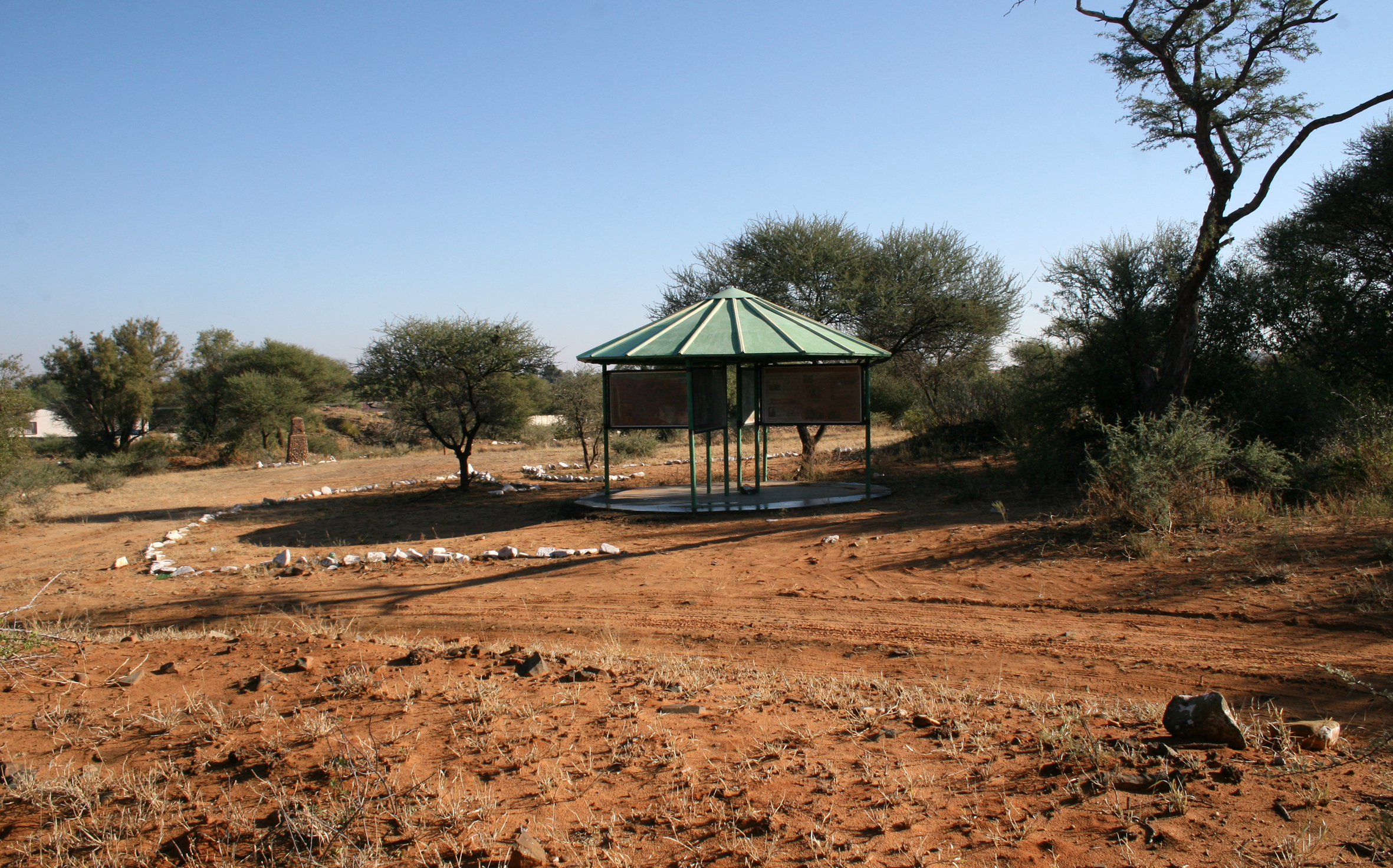
Canteen Kopje
In the 1940s, archaeologist Clarence Van Riet Lowe made a prediction about a scrubby hill outside the small Northern Cape town of Barkly West. "When the last diamond claim has been abandoned," he wrote, "archaeologists throughout the world will be interested in Canteen Kopje, in the Vaal River diggings, where lie the prehistoric remains of a million years of human evolution." He was wrong about only one thing: the diamonds have not been abandoned, and the archaeologists are already interested. Canteen Kopje is a place where two kinds of treasure overlap, literally stratified in the same gravels. The river-worn pebbles that nineteenth-century diggers shoveled aside to reach diamonds were themselves embedded with Acheulean hand-axes and stone tools spanning more than a million years, artifacts that researchers now date to as far back as 2.3 million years ago.
Pick, Shovel, and the Rush of 1870
The Vaal River curves past Canteen Kopje on its way west across the Northern Cape, and it was this river that brought the first diamond diggers in January 1870. Men from KwaZulu-Natal worked their way along the banks, finding stones in the gravels at Klipdrift, the old name for the settlement that would become Barkly West. Within months, both sides of the river were thronging with prospectors of every nationality. By year's end, five thousand people crowded Klipdrift alone. This was the first alluvial diamond digging in South Africa, as opposed to surface prospecting, and it triggered the diamond rush that would reshape the country's economy and demographics. The French prehistorian Henri Breuil visited in 1929 and again in the 1940s, marveling at the density of stone artifacts exposed in the mining pits. There were enough specimens, he observed, "to fill a museum to overflowing but to build it of them also." The diggers cared only for carbon crystals. They were standing on something far older.
Layers That Count in Millions
Canteen Kopje's archaeological richness lies in the relationship between river gravels and overlying sands. The Vaal cut and recut its channel over geological time, first to the north of the site and then to the southwest, depositing successive layers of gravel that trapped the stone tools of whatever human ancestors were present. The Earlier Stone Age sequence spans from roughly 500,000 years to at least 1.7 million years, and unpublished research from ongoing excavations suggests basal dates reaching 2.3 million years. Above the gravels, Hutton Sands contain younger material: Fauresmith, Middle Stone Age, Later Stone Age, and late Iron Age artifacts, along with evidence of contact between local communities and the colonial diamond diggers who arrived in the nineteenth century. A 7-meter excavation sequence through these layers, carried out between 2007 and 2009, revealed a distinct Victoria West Acheulean horizon in the upper gravels, named after the Karoo town where that tool style was first described. Below it lies simpler, older Acheulean technology, a record of human toolmaking evolving across immense stretches of time.
The Skull That Changed Its Story
In 1925, a diamond digger named Kenneth Kemp was working 2.4 meters down at an unrecorded spot near Canteen Kopje when he found fragments of a human skull. He gave them to the local magistrate, J.G. van Alphen, who donated them to the McGregor Museum in Kimberley. Paleontologist Robert Broom studied the fragments and published his findings in Nature in 1929, reconstructing a skull that he believed showed archaic features similar to the Boskop Man found near Johannesburg. For decades, the Canteen Kopje Skull was cited as evidence of an ancient and distinct human type. Then, in 2011 and 2012, X-ray computerized tomography scans carried out at the South African Nuclear Energy Corporation revealed a different reality. The skull falls within the normal range of variation of Khoe-San populations from the Holocene, the last 12,000 years. It is not archaic at all. Reexamination of the geological context also suggests it came from the Hutton Sands rather than the deeper Younger Gravels, further supporting a much more recent date. Broom's dramatic interpretation had persisted for more than 80 years before modern technology quietly corrected the record.
Preserved, Threatened, Preserved Again
The tension between diamonds and heritage has defined Canteen Kopje for more than a century. In 1948, a 10-morgen portion of the site was declared a National Monument, largely due to the efforts of Gideon Retief, Mining Commissioner of Barkly West, who created the first open-air exhibit on the grounds. The McGregor Museum erected information panels in 2000, refurbished them in 2016, and laid out a walking trail for visitors. But diamonds kept pulling. Pressure mounted in the 1990s to de-proclaim the heritage site and allow renewed mining. The local community, recognizing the site's value, joined the McGregor Museum and the National Monuments Council in resisting. Then, in 2016, the Department of Minerals issued a mining permit for part of the declared site without obtaining the required heritage permit from the South African Heritage Resources Agency. On 18 March 2016, mining began. An urgent interdict from the Northern Cape High Court halted operations the very next day, made final on 19 April. The site survived, but the episode was a stark reminder that what took millions of years to accumulate can be destroyed in a single morning's excavation.
From the Air
Coordinates: 28.54°S, 24.53°E. The site is on the south bank of the Vaal River just outside Barkly West, approximately 35 km northwest of Kimberley in the Northern Cape. From the air, the old diamond diggings appear as a scarred, pockmarked landscape of pits and tailings along the river. The Vaal River is the dominant landscape feature, meandering through semi-arid scrubland. Nearest airport: Kimberley (FAKM) approximately 20 nm southeast. The terrain is flat to gently rolling, typical of the Northern Cape interior. Hot, dry conditions prevail most of the year, with thunderstorms possible in summer.