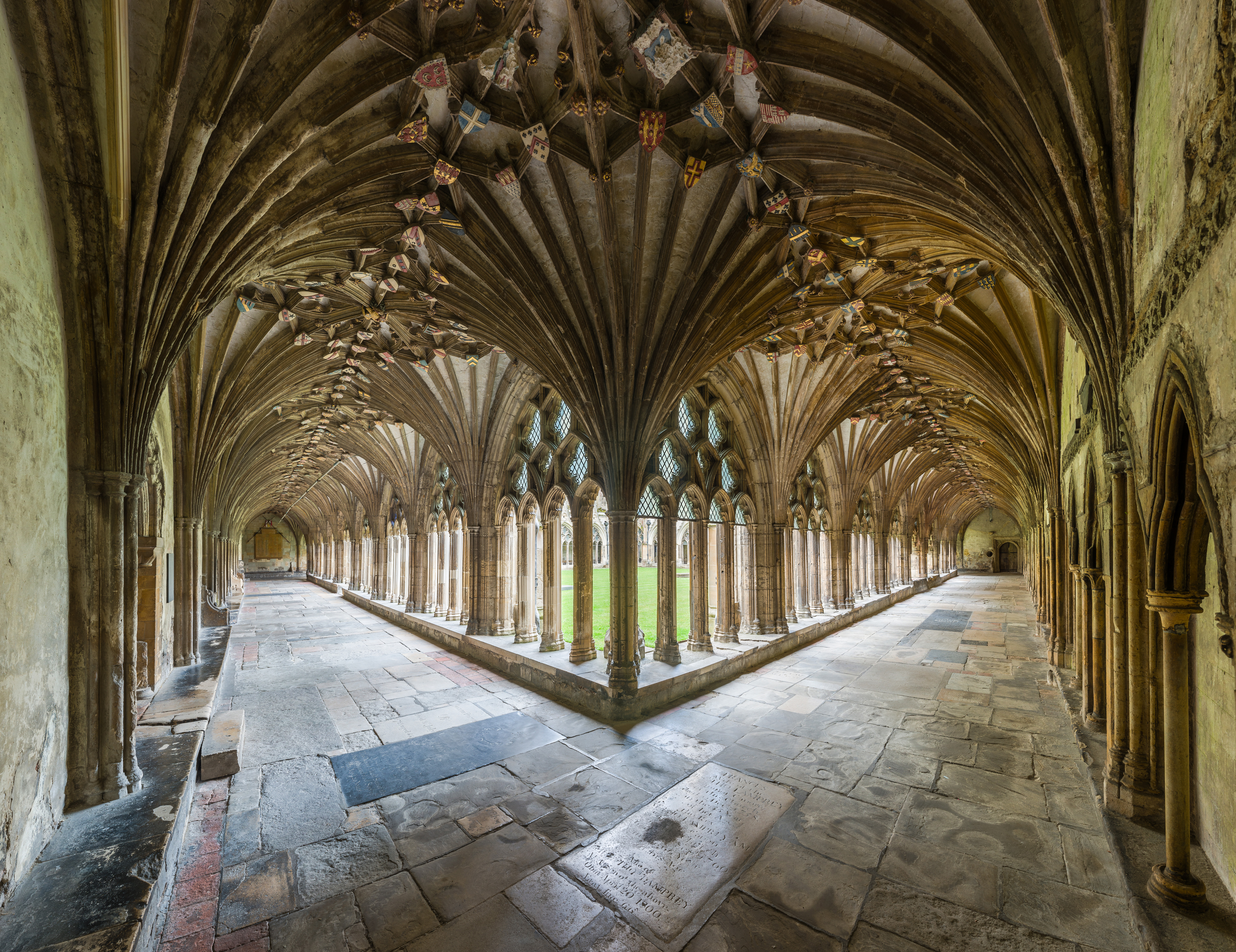
Canterbury Cathedral
Four knights rode into Canterbury on the evening of 29 December 1170, entered the cathedral through the cloister, and killed Thomas Becket with their swords. The Archbishop was struck so violently that the top of his skull was sliced off and his blood and brains spilled across the flagstones of the north transept. Within three years, Becket was declared a saint. Within a decade, Canterbury Cathedral had become the most important pilgrimage site in England. The murder was an act of political violence that transformed a church into a shrine and an English city into a destination that would draw millions of travelers over the next eight and a half centuries, including a fictional party of storytellers whose journey became one of the founding works of English literature.
Augustine's Foundation
Christianity arrived at Canterbury in AD 597, when Augustine of Canterbury was sent by Pope Gregory the Great to convert the Anglo-Saxon kingdom of Kent. King Ethelbert of Kent, whose wife Bertha was already a Christian Frankish princess, granted Augustine a church within the city walls. This became the first cathedral, and Canterbury has been the seat of the senior bishop of the Church of England ever since. The early Saxon church was rebuilt after a fire in 1067, and the Norman conquest brought wholesale reconstruction under Archbishop Lanfranc, who had been William the Conqueror's chief ecclesiastical advisor. Lanfranc demolished the damaged Saxon church and built a new cathedral in the Norman Romanesque style, establishing the basic footprint that would be expanded and elaborated over the following four centuries. The monastic community he founded grew to become one of the largest and wealthiest in medieval England, its cloisters, dormitories, refectories, and infirmaries forming a self-contained world within the cathedral precinct.
Murder in the Cathedral
Thomas Becket's quarrel with Henry II was, at its root, a dispute over whether the Church or the Crown held ultimate authority in England. Becket, once Henry's close friend and Lord Chancellor, became Archbishop of Canterbury in 1162 and immediately began defending the rights of the Church against royal encroachment. After years of escalating conflict and a period of exile in France, Becket returned to Canterbury in December 1170. Henry, exasperated, reportedly said words to the effect of 'Who will rid me of this turbulent priest?' Four of his knights -- Reginald FitzUrse, Hugh de Morville, William de Tracy, and Richard le Breton -- took the king at his word. They confronted Becket in the cathedral, first in the north transept and then before the altar of St Benedict, where he was killed. The murder shocked Christendom. Pope Alexander III canonized Becket in 1173, and the site of his martyrdom became a pilgrimage destination of European significance. A great shrine was built to house his remains, encrusted with gold, silver, and jewels donated by generations of pilgrims.
Chaucer's Road
Geoffrey Chaucer's Canterbury Tales, begun around 1387, imagines a group of pilgrims traveling from the Tabard Inn in Southwark to the shrine of Saint Thomas at Canterbury. The pilgrims represent a cross-section of 14th-century English society -- knight and miller, prioress and pardoner, wife of Bath and clerk of Oxford -- and the tales they tell each other on the road became the foundation of English narrative literature. Chaucer never finished the work, but what survives captures the messy, bawdy, devout, and contradictory spirit of medieval pilgrimage better than any historical document. The pilgrimage trade made Canterbury wealthy, and that wealth funded architectural ambition. After a fire in 1174, the choir was rebuilt by William of Sens in the Early Gothic style, introducing pointed arches and ribbed vaults that were revolutionary in England. The great perpendicular nave was constructed between 1391 and 1405, its soaring columns and vast windows representing the culmination of English Gothic architecture. Bell Harry Tower, the cathedral's iconic central tower, was completed around 1498.
Destruction and Endurance
Henry VIII's dissolution of the monasteries in 1538 brought the pilgrimage era to a violent end. Becket's shrine was dismantled, its treasures confiscated -- twenty-six wagons were reportedly needed to carry away the gold and jewels. The saint's bones were scattered or destroyed, though legends persist that monks secretly preserved them. The Puritans inflicted further damage during the English Civil War, smashing stained glass and statuary, but the cathedral's fabric survived. Successive restorations preserved and renewed the building through the 18th and 19th centuries. Today, Canterbury Cathedral is a UNESCO World Heritage Site, recognized alongside St Augustine's Abbey and St Martin's Church as part of a group of structures that represent the introduction of Christianity to the Anglo-Saxon kingdoms. It remains the mother church of the worldwide Anglican Communion, the seat of the Archbishop of Canterbury, and a place where the weight of fourteen centuries of worship, murder, pilgrimage, and literature presses down on every flagstone.
From the Air
Located at 51.28N, 1.08E in the center of Canterbury, Kent. The cathedral is visible from the air by its distinctive cruciform plan and the prominent Bell Harry Tower (central tower). Canterbury is approximately 55 nm east-southeast of London. Nearest airport: Lydd (EGMD), approximately 25 nm to the south; Rochester (EGTO), approximately 25 nm to the west. Best viewed at 2,000-3,000 ft AGL.