Canterbury Earthquake National Memorial
On the south bank of the Avon River, just downstream from the Montreal Street bridge, a marble wall curves along the water's edge. Inscribed on it are 185 names. No titles, no dates of birth, no nationalities -- just names, rendered equal by the disaster that took them. The Canterbury Earthquake National Memorial opened on February 22, 2017, exactly six years after a magnitude 6.3 earthquake killed 185 people in Christchurch and broke the city apart. Choosing what form this memorial should take -- and where to place it -- became its own long negotiation between grief, civic pride, and the practical realities of rebuilding a shattered downtown.
Before the Official Memorial, 185 Empty Chairs
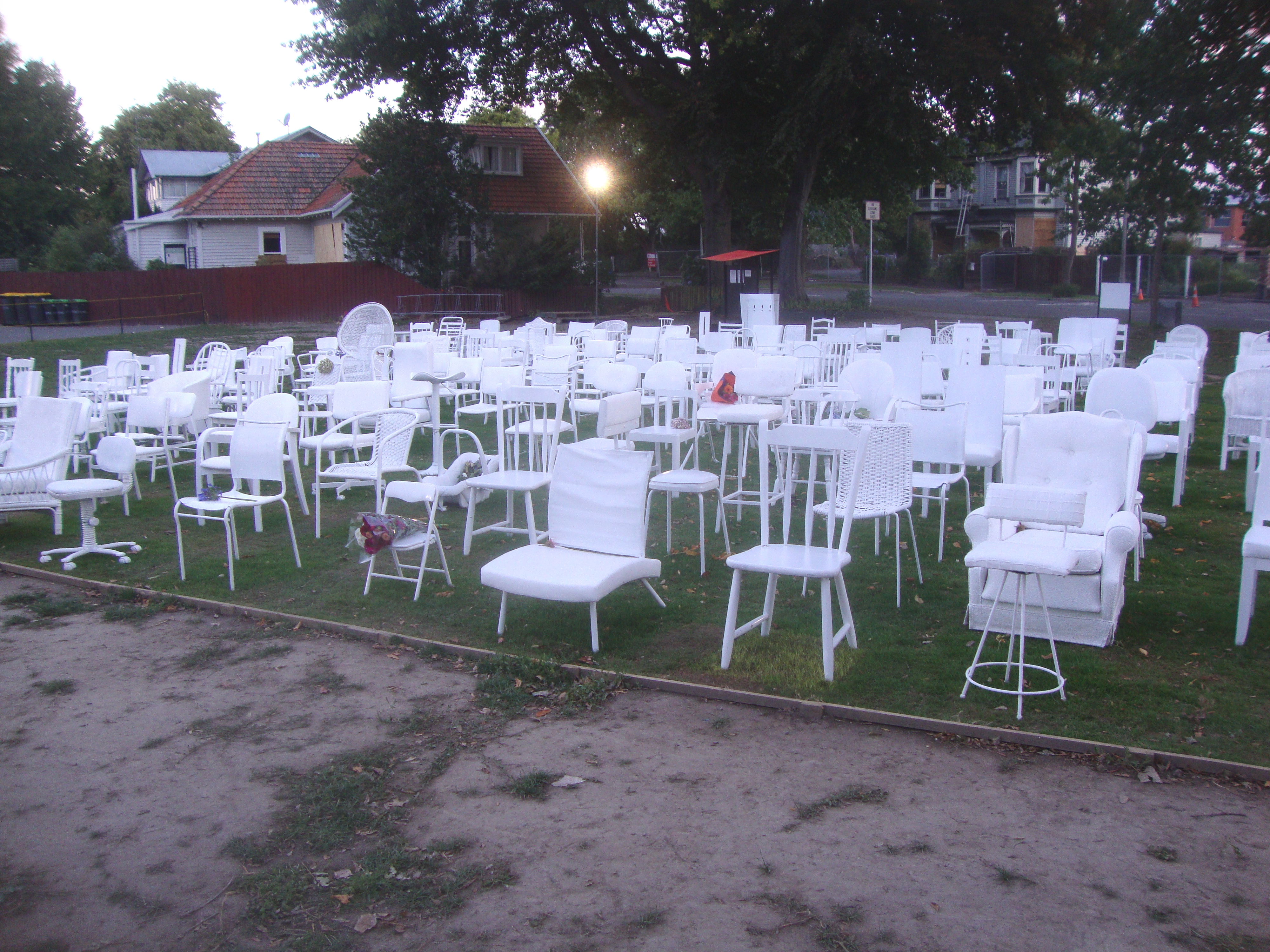
The first memorial appeared while the rubble was still being cleared. In February 2012, local artist Peter Majendie installed 185 white chairs on a vacant lot -- each one different, from office chairs to high chairs to wheelchairs, each representing a life lost. The installation was meant to be temporary, but it became one of the most visited sites in Christchurch, a raw and immediate expression of absence that formal design processes struggled to match. Families attached photos and messages. Tourists left flowers. The chairs sat exposed to Canterbury's winds and rain, slowly weathering in a way that felt honest -- grief is not tidy, and neither was this. The installation stood for years, outlasting every projected timeline for the official memorial, a quiet rebuke to the bureaucratic complexity of remembering on a national scale.
Designing Memory by Committee
The official memorial was identified as a priority project in the Christchurch Central Recovery Plan -- the Blueprint -- released in July 2012. The Ministry for Culture and Heritage led the project alongside the Canterbury Earthquake Recovery Authority, the Christchurch City Council, and Te Runanga o Ngai Tahu. The design brief, released in 2014, called for a memorial that would honor the dead, recognize the international rescue effort, and provide a space for both formal civic ceremonies and quiet individual reflection. The response was extraordinary: 330 design submissions from 37 countries. Six finalists were shortlisted. In a breach of the anonymous review process, The Press newspaper leaked the preliminary designs in December 2014 before families of the victims had finished providing feedback. The official public release came in February 2015, days before the fourth anniversary. Associate Earthquake Recovery Minister Nicky Wagner expressed hope the memorial would be "at least partially built" by the 2016 anniversary -- an acknowledgment that the original timeline had already slipped.
A River Runs Through It
The winning design placed the memorial on both banks of the Avon River, using the water as both a physical and symbolic element. On the south bank, a marble memorial wall carries the 185 names. On the north bank, a grove of trees provides a space for contemplation. The river itself -- the Otakaro, as Ngai Tahu know it -- becomes the central feature, connecting the two sides of the memorial as it connects the living and the dead. Part of Oxford Terrace, formerly a busy one-way street, was converted into a pedestrian precinct for the site. Construction began with a groundbreaking ceremony on November 12, 2015, attended by Prime Minister John Key, Earthquake Recovery Minister Gerry Brownlee, Mayor Lianne Dalziel, and Ngai Tahu chairperson Mark Solomon. During construction, the site flooded in May 2016 -- the Avon reclaiming its floodplain, as rivers do. A spokesman noted simply that it was "designed to cope with this." The memorial cost NZ$11 million, with $10 million from the government and $1 million from the Christchurch Earthquake Mayoral Relief Fund.
The River of Flowers
Each February 22, Christchurch gathers at the memorial for the River of Flowers ceremony. Members of the public drop blossoms into the Avon, and the current carries them downstream past the wall of names -- a simple, wordless act of remembrance that has become the city's most recognized ritual of grief. The ceremony draws thousands. At 12:51 p.m., the exact moment the earthquake struck, a minute's silence falls across the city. At the ten-year anniversary in 2021, attended by Mayor Lianne Dalziel, Governor-General Dame Patsy Reddy, and Prime Minister Jacinda Ardern, the names of all 185 victims were read aloud by Christchurch residents and first responders before a wreath-laying ceremony. The memorial is now registered as one of New Zealand's 21 National Memorials, administered by the Ministry for Culture and Heritage -- a permanent fixture in a city that has had to decide, building by building, what to keep and what to let go.
From the Air
Located at 43.53S, 172.63E on the banks of the Avon River in central Christchurch. The memorial sits downstream from the Montreal Street bridge, visible from low altitude as a landscaped stretch along the riverbank near the city center. Christchurch International Airport (NZCH) is approximately 10 km to the northwest. Hagley Park, the large green rectangle in the city center, is a prominent visual landmark nearby.