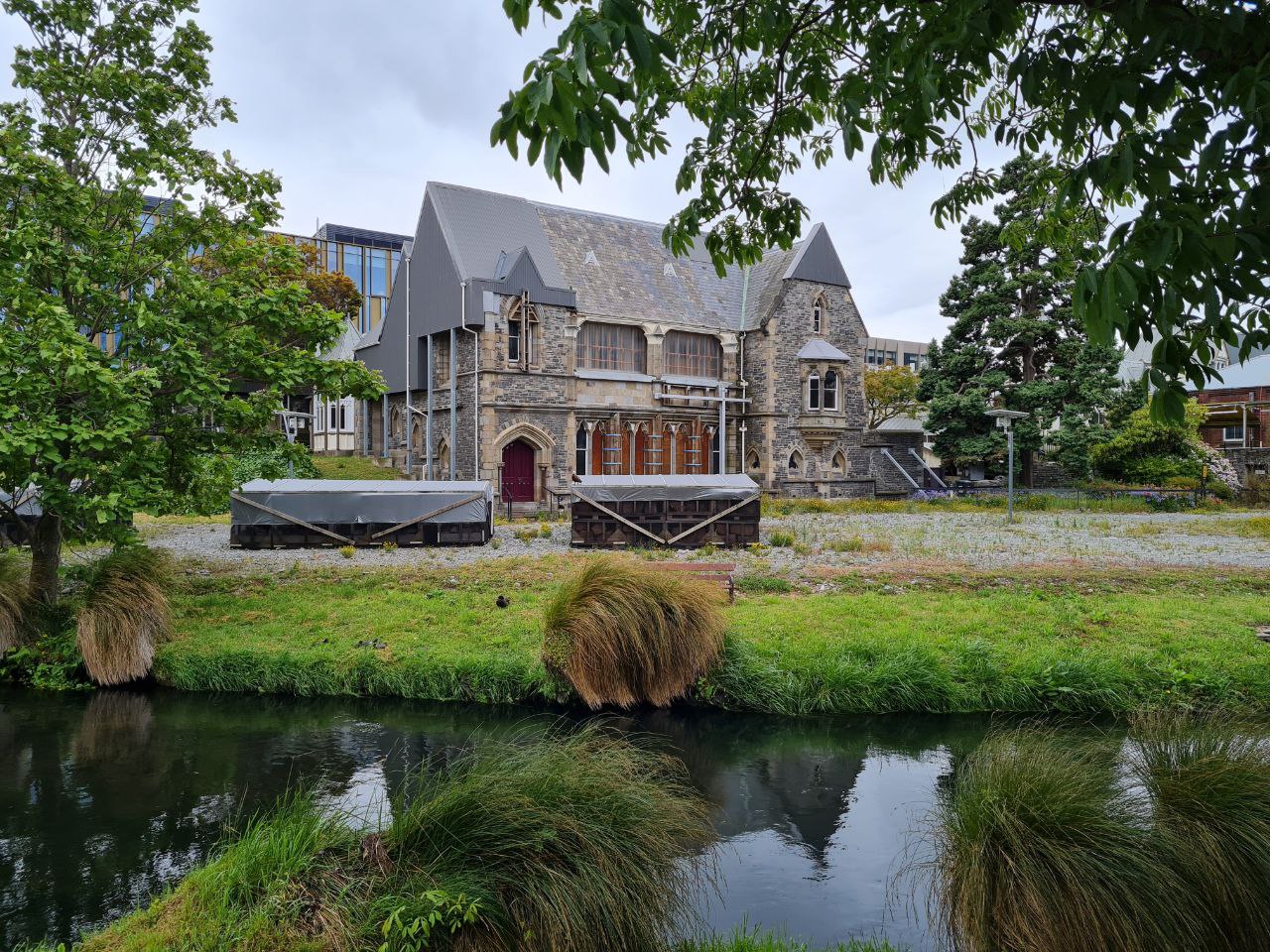
Canterbury Provincial Council Buildings
Benjamin Mountfort designed many buildings in Canterbury, but colleagues and historians agreed on which one was his masterpiece: the Stone Chamber of the Canterbury Provincial Council Buildings. Completed in 1865, it was the meeting room where the elected council of Canterbury Province debated the governance of a territory stretching from the Pacific coast to the Southern Alps. Its interior -- vaulted ceilings, carved stone, ornamental detail drawn from English Gothic tradition but executed with a confidence that was entirely colonial -- represented the most ambitious architectural achievement in nineteenth-century New Zealand. On February 22, 2011, the earthquake brought much of it down.
Democracy in Timber and Stone
New Zealand's provincial governments were born from the Constitution Act of 1852, passed by the Parliament of the United Kingdom, which carved the young colony into six provinces, each with its own elected council and superintendent. Canterbury, settled largely by the Canterbury Association's organized immigration from England, took to self-governance with particular enthusiasm. The council needed a place to meet, and in January 1858 the foundation stone was laid for the first building on a block bounded by Armagh, Durham, and Gloucester Streets and the Avon River. That initial structure was a two-storey timber building with the Timber Chamber -- modeled on fourteenth- and sixteenth-century English manorial halls -- as its meeting room, first used in September 1859. A northern extension followed in 1861, forming a courtyard. The third and final stage, built in 1864-1865, produced the Stone Chamber, which was larger and more elaborate to accommodate a growing council.
Mountfort's Finest Room
Benjamin Mountfort had already left his mark across Canterbury -- he designed the Canterbury Museum, several churches, and much of the province's early institutional architecture. But the Stone Chamber was where his ambition and skill converged most fully. The chamber drew on High Victorian Gothic, with pointed arches, ribbed vaulting, and decorative stonework that referenced English cathedrals while adapting to local materials and conditions. Art historian Ian Lochhead, who advised on the buildings' restoration from 1981, described the Stone Chamber as the single most significant heritage loss of the February 2011 earthquake -- a judgment that weighed it against the ChristChurch Cathedral's ruined spire and dozens of other demolished landmarks. The buildings are the only purpose-built provincial government structures still in existence in New Zealand, a physical record of a system of governance that was abolished in 1876 when the national parliament centralized power.
What the Earthquake Took
The February 2011 earthquake hit the Provincial Council Buildings hard. The stone tower on Armagh Street -- which had served as the entrance on the north side and once held the Victoria Clock Tower -- collapsed entirely. The Stone Chamber sustained catastrophic structural damage. Detailed engineering assessments found that significant portions of the complex would have to be rebuilt rather than repaired. The estimated cost staggered the city: $204 million for full restoration, a figure that rivaled the construction budgets of new buildings many times the size. The Christchurch City Council, already spending billions on earthquake recovery across hundreds of sites, pushed all restoration work to at least 2029. The buildings sat behind fences, exposed to the elements, their future uncertain. For years, the question was not when they would be restored but whether they would be restored at all.
The Slow Work of Putting It Back
In 2021, the council allocated $20 million in its budget for restoration, though the money was not expected to be spent until at least 2027. Then, in March 2023, funding was brought forward to the 2023-2024 budget cycle. An initial $2.1 million was released for the first stage of work: reconstruction and restoration of the wooden buildings and stone towers on Durham and Armagh Streets. The remaining $18 million is being spent periodically over subsequent years. It is a fraction of the full $204 million estimate, which means the restoration will proceed in stages over decades -- timber structures first, then the towers, and eventually, if funding allows, the Stone Chamber itself. Whether Mountfort's most celebrated interior will ever be fully reconstructed remains an open question, one that Christchurch will answer incrementally, budget cycle by budget cycle. In the meantime, the buildings stand as they have since 2011: damaged, fenced, waiting.
From the Air
Located at 43.53S, 172.63E in Christchurch Central City, occupying the block bounded by Armagh Street, Durham Street, Gloucester Street, and the Avon River. The buildings are near other central landmarks visible from the air, including the Christchurch Cathedral site and Victoria Square. Christchurch International Airport (NZCH) is approximately 10 km to the northwest. The flat Canterbury Plains extend west toward the Southern Alps.