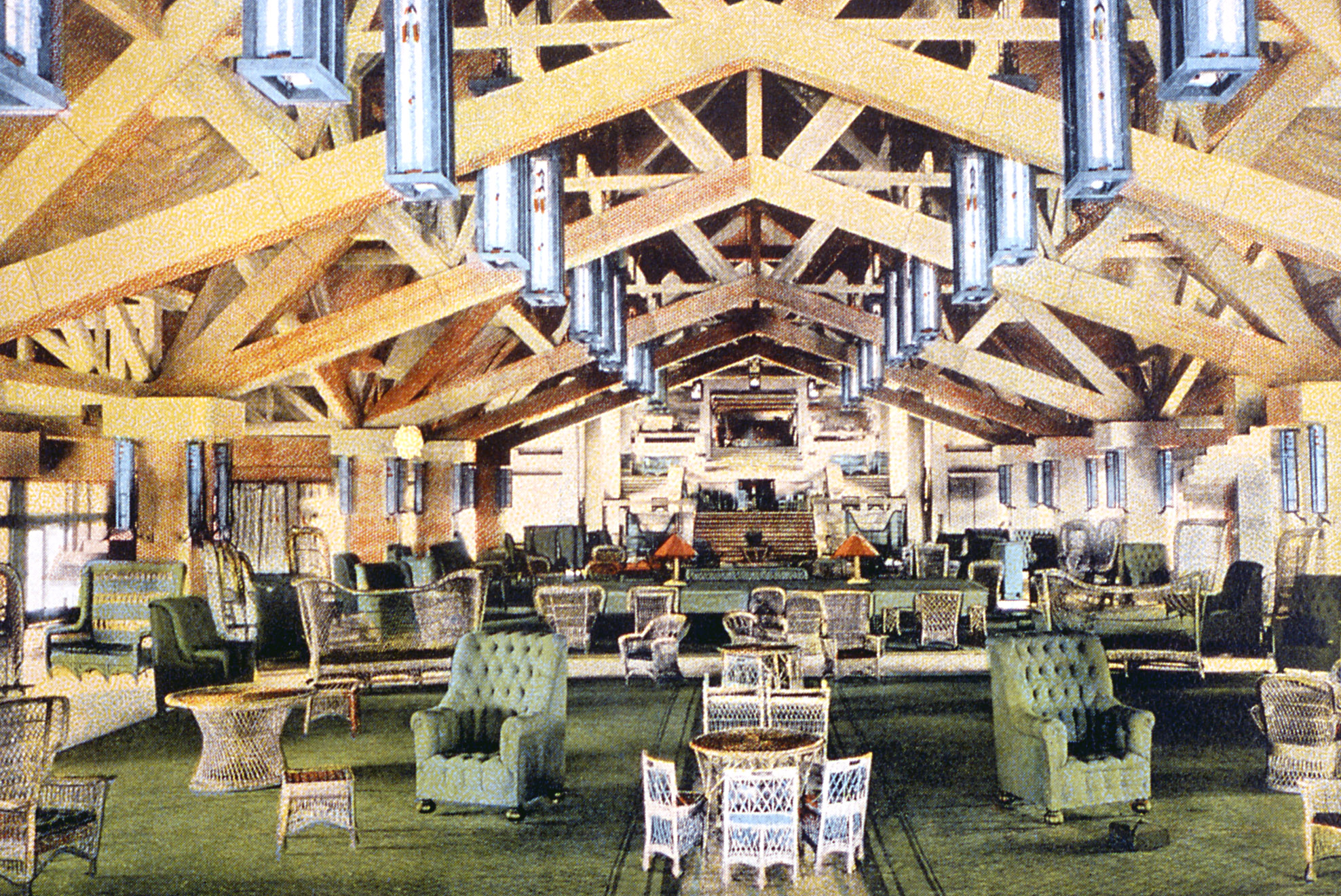
Canyon Hotel
The demolition contract went for twenty-five dollars. In 1959, the Carlos Construction Company of Cody, Wyoming, bid that sum to tear down what had been the largest building ever constructed in Yellowstone National Park, a hotel with a one-mile perimeter that architect Robert Reamer had designed to rival the great resorts of Europe. The company was given 900 days to complete the work. On the night of August 8, 1960, the Canyon Hotel burned to the ground. No cause was ever determined. What fire took, time has erased further. Today, only photographs remain of a building that represented the most ambitious architectural vision ever attempted in America's first national park.
Three Hotels, One Site
The Canyon Hotel that burned was actually the third hotel built near the Grand Canyon of the Yellowstone. The first, a prefabricated structure opened in May 1886, was intended as a temporary replacement for tent accommodations. By agreement with the Department of the Interior, it was to serve only a single season before construction began on a permanent hotel. Construction on that permanent hotel did not begin for three more years. When the second Canyon Hotel opened in 1891, the park superintendent declared it 'a most unsightly edifice.' Both buildings were merely functional. The third hotel would be something else entirely.
Reamer's European Vision
In 1909, Robert Reamer traveled through Europe with Yellowstone Park Company president Harry W. Child. They visited the great resort hotels of England, Germany, and Switzerland. Child returned home determined that Yellowstone would have a hotel to match. Reamer, who had already designed the rustic masterpiece of Old Faithful Inn, set about creating its opposite. Where the Inn embraced wilderness, the new Canyon Hotel would embody civilization. Reamer incorporated the 1891 building into his design but transformed it completely into a long horizontal structure flowing along the hillside, anchored by heavy hipped roofs and prominent dormers. Construction began in June 1910. By October, the building was enclosed. It opened to guests in June 1911, with the grand opening celebration on August 2.
A Mile of Architecture
The Canyon Hotel's perimeter measured one mile. Four hundred rooms with one hundred baths filled a structure that showed clear influences of Frank Lloyd Wright's Prairie School, with its emphasis on horizontal lines and dominating rooflines. The interior featured sturdy pilasters and exposed timber roof framing. The main lounge offered panoramic windows looking toward the Grand Canyon of the Yellowstone. Viewing platforms and bandstands overlooked the space. The basement held a wine cellar, bowling alleys, billiard rooms, and banquet facilities. In 1936, rates ran from $2.75 per day for a single room without meals to $9.00 for a single with bath and all meals. The hotel dominated its hillside site, visible for miles.
Mission 66 and the End
After World War II, the National Park Service declared the Canyon Hotel outdated. The park's master plan explicitly stated that present hotels should be placed into disuse and ultimately removed as they deteriorate. Mission 66, the Park Service's ambitious modernization program, targeted Canyon for replacement. Ground broke for Canyon Village in 1956, bringing 500 motel-style units, a visitor center, shops, and a service station. When Canyon Village opened in 1957, visitors preferred the old hotel. The Yellowstone Park Company, strained by its contributions to Mission 66, partially closed the Canyon Hotel to push guests toward the new facilities, then closed it entirely for the 1959 season.
The Night It Ended
Superintendent Lemuel Garrison ordered demolition in 1959, citing foundation issues dating to the 1891 building that could not be economically repaired. Some debated moving portions of the structure to Lake, but the idea was abandoned. On August 17, 1959, the Hebgen Lake earthquake struck just outside the park, magnitude 7.3, the most powerful ever recorded in the region. Though some cited the quake as justification for demolition, the decision had already been made months earlier. Demolition proceeded slowly. Then, on the night of August 8, 1960, fire consumed what remained. The cause was never determined. The largest building in Yellowstone's history vanished in a single night, leaving questions that will never be answered and photographs of a grandeur the park has never attempted to replicate.
From the Air
The Canyon Hotel site lies at 44.72N, 110.50W, west of the Grand Canyon of the Yellowstone at approximately 7,900 feet elevation. Today Canyon Village occupies the area, with the distinctive yellow-walled canyon visible to the east. The Yellowstone Falls provide a primary navigation reference, with the Upper Falls dropping 109 feet and the Lower Falls plunging 308 feet. The Grand Loop Road passes through Canyon Junction nearby. Nearest airports: West Yellowstone (KWYS) 35nm southwest, Jackson Hole (KJAC) 75nm south. The canyon creates thermal updrafts; approach with caution. Summer afternoon thunderstorms common at this elevation.