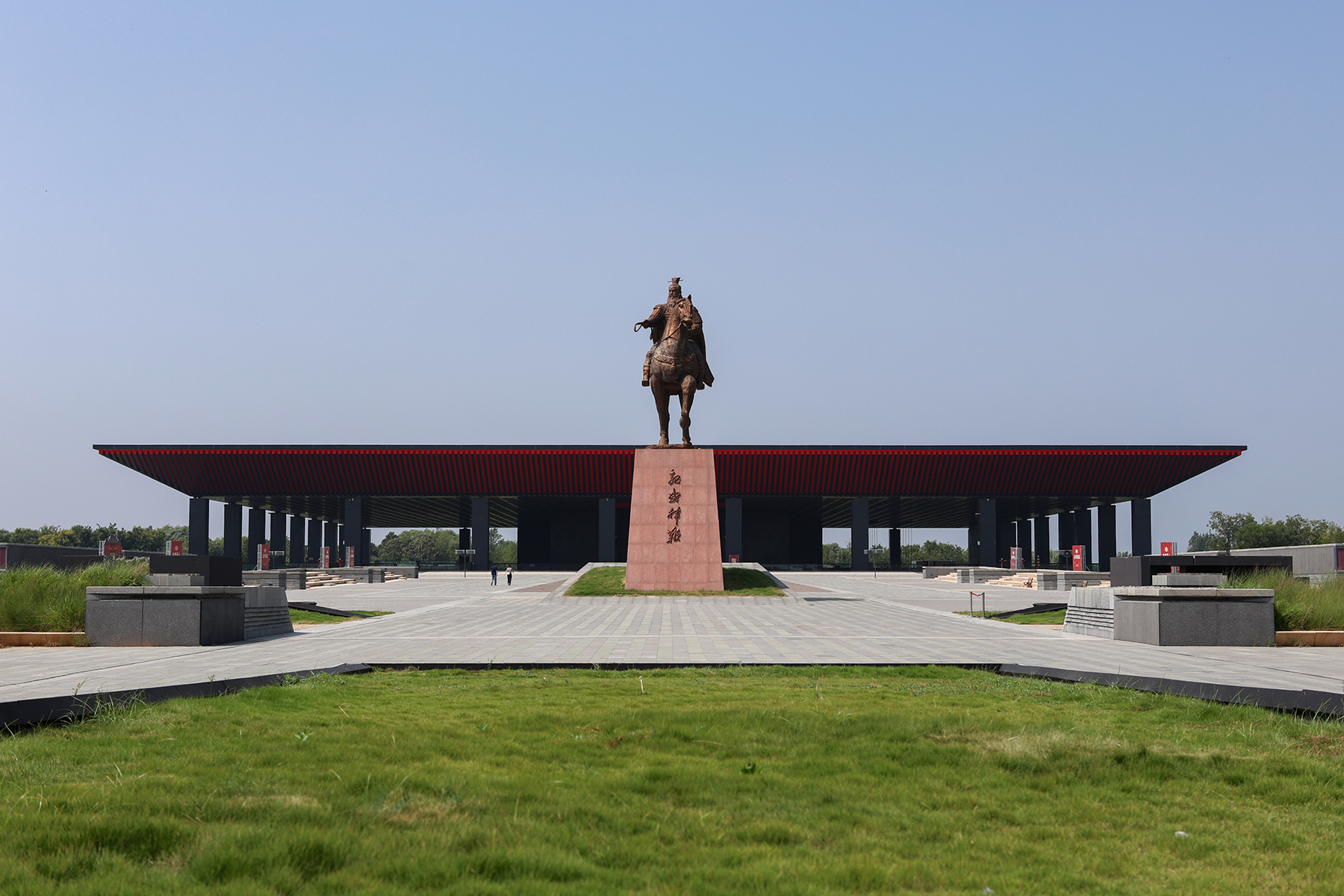
Cao Cao Mausoleum
The legend says Cao Cao built 72 tombs. The cunning warlord of the late Han dynasty, vilified in popular fiction as a scheming tyrant and celebrated by historians as a brilliant strategist, supposedly scattered decoy burial sites across northern China to foil grave robbers for eternity. For nearly 1,800 years, nobody could say with certainty where he actually lay. Then, in December 2008, workers at a kiln near Anyang, Henan Province, started digging for mud to make bricks.
The Warlord Who Shaped an Empire
Cao Cao (155-220 CE) rose from minor official to the most powerful man in China during the chaotic final decades of the Han dynasty. He controlled Emperor Xian as a figurehead while expanding his territory through military conquest and political maneuvering. In 216 CE, he claimed the title King of Wei, and his son Cao Pi would complete the work by founding the state of Cao Wei after Cao Cao's death in 220 CE. Cao Cao died in Luoyang at 65 and was posthumously honored as King Wu -- the Martial King. According to the Records of the Three Kingdoms, he was interred in a place called Gaoling, the High Mausoleum, about a month after his death. But where exactly that was remained a mystery compounded by folklore.
Grave Robbers and Stone Tablets
The tomb's discovery was not announced by archaeologists but forced by criminals. Local authorities seized a stone tablet bearing the inscription "King Wu of Wei" from grave robbers who claimed to have stolen it from the site near Xigaoxue Village. Over the following year, excavators recovered more than 250 relics: stone paintings depicting social life in Cao Cao's era, tablets listing sacrificial objects, weapons, and stone pillows labeled as the warlord's personal belongings. They also found the bones of three people -- a man in his sixties, a woman in her fifties, and another woman in her twenties. The discovery was officially announced on December 27, 2009, igniting immediate controversy.
A Debate That Refuses to Settle
Not everyone believes the tomb belongs to Cao Cao. In August 2010, twenty-three scholars presented evidence at a forum in Suzhou arguing that the artifacts were fake. Historian Lin Kuicheng raised a pointed objection: during Cao Cao's funeral, his son Cao Pi held the title King of Wei. Referring to the deceased as "King Wu of Wei" while the living king still bore the title would have been taboo. Others have proposed the tomb actually belongs to Cao Huan, the last Wei emperor, and his father Cao Yu. A seal found in the tomb -- initially presented upside down, rendering its inscription illegible -- was later read as bearing the character for "Huan." The debate has produced more scholarly publications than most ancient tombs generate in a century, and consensus remains elusive.
Ibuprofen for a Dead King
Whatever its occupant's true identity, the tomb became a nationally protected cultural site in 2010. A museum opened atop the site in April 2023, displaying the recovered artifacts and exploring Cao Cao's complex legacy -- statesman, poet, patron of the arts, and ruthless wielder of power. One detail captures the site's strange modern life: young visitors have taken to leaving packets of ibuprofen on the tomb. Historical records note that Cao Cao suffered from severe migraines throughout his life. The gesture is part tribute, part joke, and entirely characteristic of how contemporary China engages with its ancient past -- with irreverence that somehow deepens rather than diminishes the connection.
From the Air
Located at 36.241N, 114.260E near Xigaoxue Village, Anfeng Township, Anyang County, Henan Province. The site is in flat terrain on the North China Plain. Nearest major airport: Anyang Yuquan (ZHAY). The tomb museum is visible as a modern structure amid agricultural land. Recommended viewing altitude: 3,000-5,000 feet AGL.