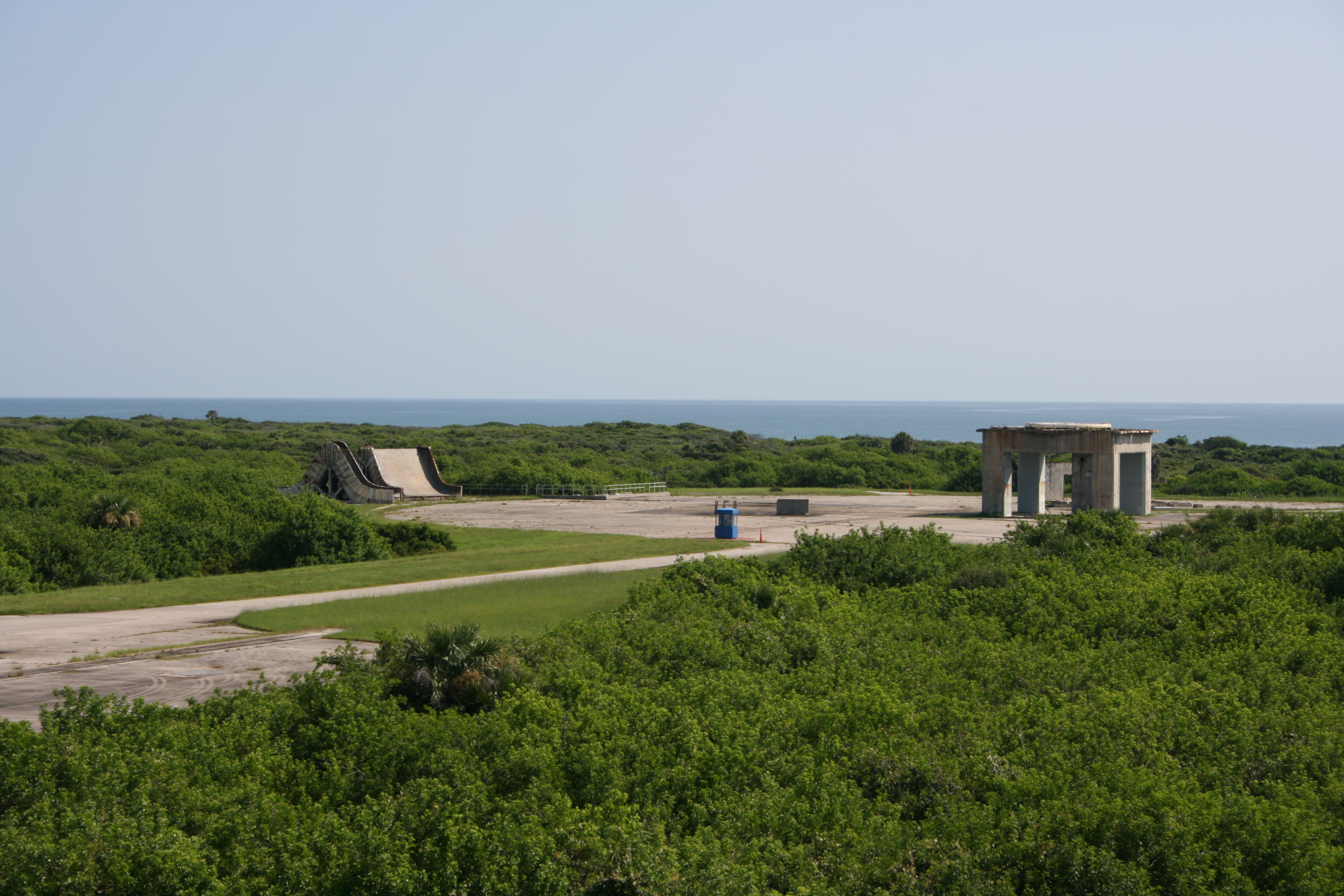
Launch Complex 34: Where Fire Changed Apollo
The plaque is bolted to a concrete column that once supported a launch umbilical tower. It reads: Friday, 27 January 1967, 1831 Hours. Below that, three names -- Virgil I. Grissom, Edward H. White II, Roger B. Chaffee -- and the instruction to remember them not for how they died but for those ideals for which they lived. There is no rocket here anymore. No tower, no service structure, no white room where technicians once helped astronauts into their spacecraft. Just the launch platform, two rusting steel flame deflectors on rails, and a domed blockhouse 320 meters away. Launch Complex 34 is the quietest place on Cape Canaveral, and the most important.
Built for Saturn
Construction began in 1960, and LC-34 was formally dedicated on June 5, 1961 -- one of the first facilities designed specifically for the Saturn rocket family that would eventually carry Americans to the Moon. The complex was ambitious for its time: a launch platform, umbilical tower, mobile service tower standing 95 meters high, fueling facilities, and a blockhouse modeled after the domed reinforced concrete structure at LC-20. The blockhouse could accommodate 130 people and their instrumentation equipment, with periscopes providing the only views outside its windowless walls. Two steel flame deflectors rode on rails beneath the launch platform. The service tower moved on its own set of rails, rolling 185 meters west before each launch. LC-34 hosted its first launch on October 27, 1961 -- mission SA-1, the inaugural Saturn I flight, which lofted a dummy upper stage on a suborbital trajectory into the Atlantic. Three more Saturn I launches followed through March 1963 before the Block II series moved to neighboring LC-37.
The Evening of January 27
By early 1967, LC-34 had been extensively modified for the larger Saturn IB. New anchor points held the service structure against Florida's winds. Access arms on the umbilical tower had been rebuilt, and at the 67-meter level, a white room gave technicians and astronauts access to the command module. Two Saturn IBs -- AS-201 and AS-202 -- had already launched successfully. The next mission, AS-204, was to be the first crewed Apollo flight, scheduled for February 21, 1967. On the evening of January 27, astronauts Gus Grissom, Ed White, and Roger Chaffee were sealed inside the Apollo 1 command module for a plugs-out test. At 6:31 PM, a fire erupted in the pure oxygen atmosphere of the cabin. The crew could not open the inward-opening hatch in time. All three died. Apollo operations across the Cape halted. When work resumed, the lessons were seared into every subsequent spacecraft design: a new quick-opening hatch, fire-resistant materials, and emergency escape systems including a slide wire from the top of the umbilical tower.
One Final Launch
Twenty months after the fire, LC-34 returned to service one last time. Apollo 7 lifted off on October 11, 1968, carrying astronauts Wally Schirra, Donn Eisele, and Walt Cunningham on the first crewed Apollo mission. It was a vindication flight -- eleven days in Earth orbit proving that the redesigned command module worked. The mission succeeded. Schirra, who had been close friends with Grissom, later said the flight was the most important of the entire Apollo program because without it, nothing else could follow. Apollo 7 was the last rocket to leave LC-34. NASA considered reactivating the pad for the Apollo Applications Program but chose to modify LC-39B instead. The decision to leave LC-34 alone was, in hindsight, the beginning of its transformation from launch site to memorial.
Abandon in Place
The military designation is blunt: 'Abandon in place.' It means leave the structure as it stands, perform no maintenance, let time take its course. After decommissioning, the umbilical tower and service structure were razed. What remains is the launch platform itself -- a concrete and steel pedestal at the center of the pad -- the two flame deflectors, and the blockhouse. The original spherical liquid oxygen tank stood at the pad until 2008, when SpaceX purchased it and relocated it to Space Launch Complex 40 for use in Falcon 9 flights. The launch platform now serves as the Apollo 1 memorial. A second plaque reads: 'In memory of those who made the ultimate sacrifice so others could reach the stars. Ad Astra Per Aspera -- a rough road leads to the stars.' The pad is fenced off, preventing visitors from walking beneath the platform or reading the plaques up close. Granite memorial benches line the southern edge.
Sacred Ground, Uncertain Future
LC-34 sits on increasingly valuable real estate. Cape Canaveral's active launch complexes are in high demand from commercial providers, and the Space Force has considered leasing the pad to a commercial tenant. The precedent was set in 2023 when Launch Complex 14 -- similarly preserved as a memorial to the Mercury Seven -- was allocated to Stoke Space for its Nova rocket. For now, LC-34 remains unoccupied, the most visited of Cape Canaveral's deactivated pads. Every January 27, NASA and Space Force personnel gather at the site for a remembrance ceremony. The wind off the Atlantic pushes through the open structure, and the concrete platform stands where it has stood since 1961, carrying the weight of three names and the memory of what they cost the nation -- and what their sacrifice ultimately made possible.
From the Air
Launch Complex 34 is located at 28.522°N, 80.561°W on Cape Canaveral Space Force Station, along the coast south of LC-37. From the air, the pad is identifiable by the bare concrete launch platform standing alone without a tower -- a stark contrast to the active complexes nearby. The two steel flame deflectors and the domed blockhouse are visible at lower altitudes. The pad sits along the historic Missile Row lineup of launch sites. Nearby airports: KTIX (Space Coast Regional, Titusville), KMLB (Melbourne Orlando International), KCOF (Patrick Space Force Base). Best viewed at 2,000-4,000 feet AGL along the coastline. The bare, isolated appearance of the platform distinguishes it from adjacent active complexes.