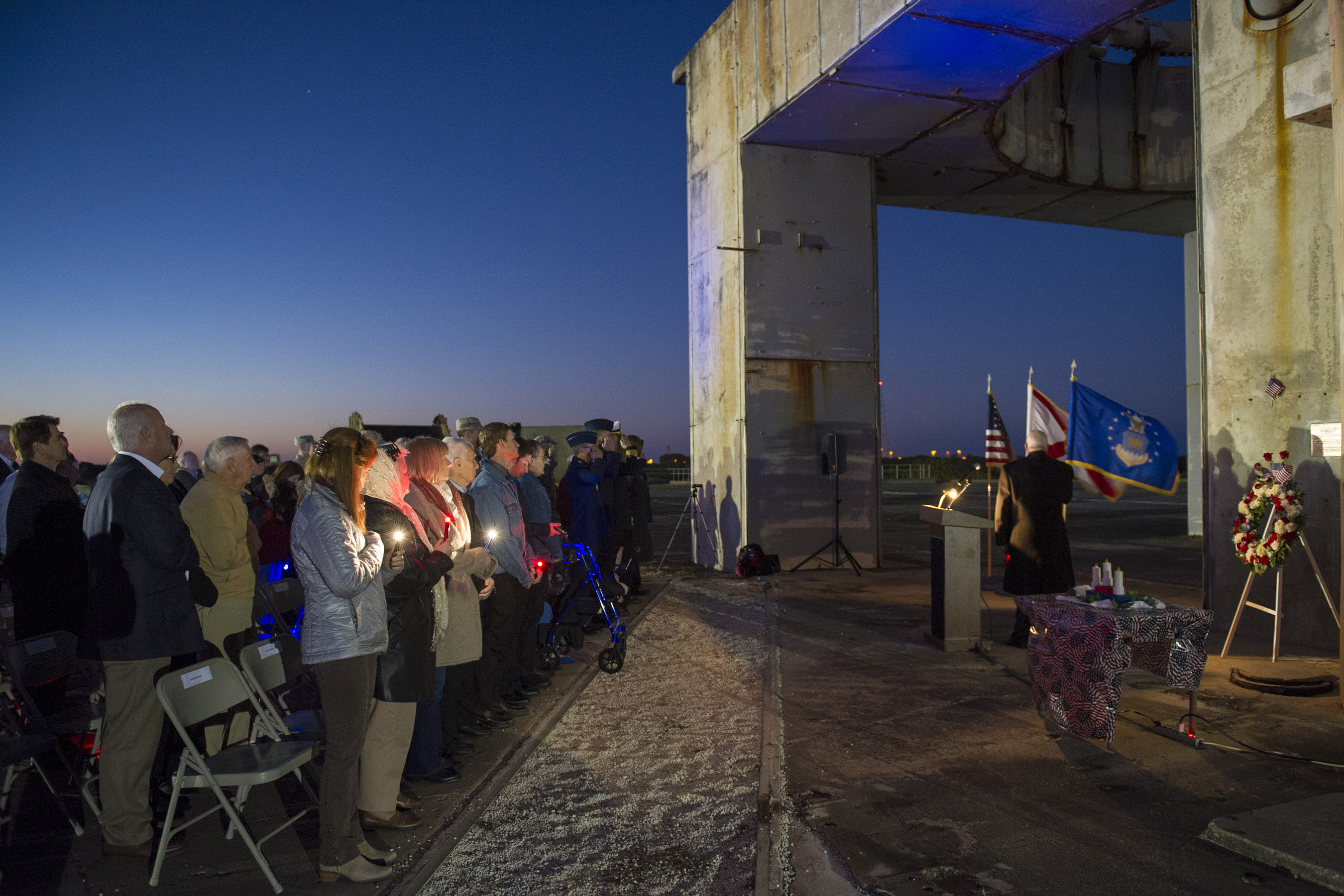
Cape Canaveral Launch Complex 36
On March 2, 1965, an Atlas-Centaur rocket designated AC-5 lifted off from Pad 36A at Cape Canaveral, rose briefly, then fell back onto the concrete and detonated in the largest on-pad explosion the Cape had ever seen. The fireball consumed the launch infrastructure and scattered wreckage across the surrounding scrubland. Rather than abandon the site, NASA used the disaster as a catalyst. A second pad, LC-36B, had been left 90 percent complete when budget priorities shifted elsewhere. The explosion changed the math. Within months, engineers finished 36B, and the complex went on to become one of America's most prolific deep-space launch sites, hurling spacecraft toward the Moon, Venus, Mars, Jupiter, and Saturn over the next four decades.
Gateway to the Outer Planets
Launch Complex 36 was built in 1962 to support the Atlas-Centaur, a rocket pairing that combined the proven Atlas booster with the experimental Centaur upper stage, the first American rocket to burn liquid hydrogen. The combination gave NASA the throw weight to send probes beyond Earth orbit on relatively modest hardware. From LC-36A and 36B, Atlas-Centaur variants launched the Surveyor lunar landers that scouted Apollo landing sites, the Mariner probes that mapped Venus and Mars, and Pioneer 10, the first spacecraft to cross the asteroid belt and return close-up images of Jupiter. Pioneer 10 carried a gold-anodized plaque engraved with a message for any extraterrestrial civilization that might someday find it, and it departed from this flat stretch of Florida coastline on March 2, 1972, exactly seven years after the AC-5 explosion on the same pad.
Evolving Through Generations
As rocket technology advanced through the 1980s and 1990s, LC-36 evolved with it. General Dynamics, and later Lockheed Martin after corporate mergers reshuffled the aerospace industry, modified both pads to accommodate the Atlas I, Atlas II, and Atlas III. The complex handled commercial satellite launches alongside government payloads, adapting its infrastructure to each new variant. The Atlas G also flew from Pad 36B during the late 1980s. By the time the last Atlas III launched from the complex in the early 2000s, LC-36 had supported missions spanning more than forty years and multiple generations of the Atlas rocket family. The twin mobile service towers that had sheltered every rocket on the pads were demolished in controlled explosions on June 16, 2007, Tower B falling first at 9:59 AM Eastern, Tower A following twelve minutes later.
From Government Range to Commercial Frontier
After the towers came down, LC-36 entered a transitional period. The Air Force no longer needed the complex, and in 2010 the 45th Space Wing issued real property licenses to Space Florida, a state agency created to attract commercial spaceflight operators. Moon Express, a startup pursuing commercial lunar landings, leased Pad 36A in 2015 as a development and test site for its lunar lander prototypes. That same year, Jeff Bezos's Blue Origin signed a long-term lease for the broader complex. The two companies shared the site briefly, Moon Express on 36A and Blue Origin on 36B, until Moon Express relocated to Launch Complexes 17 and 18 in 2016, giving Blue Origin full run of the facility.
New Glenn Rises
Blue Origin broke ground on a massive reconstruction of LC-36 in June 2016, aiming to transform the aging Atlas-era infrastructure into a launch site for New Glenn, a heavy-lift orbital rocket standing over 300 feet tall. Aerial photography released after Hurricane Dorian swept through in September 2019 revealed the scale of the work: foundations for a horizontal integration facility, a launch service structure, lightning towers, a water tower, and a propellant tank farm all taking shape along the Florida shoreline. Blue Origin also leased neighboring Launch Complexes 11 and 12 for hardware storage. The pad that once sent Pioneer 10 sailing past Jupiter is being rebuilt to carry payloads into orbit for a new era of commercial spaceflight, the latest chapter in a sixty-year story of reinvention on the same patch of Cape Canaveral sand.
From the Air
Launch Complex 36 is located at 28.47°N, 80.54°W on the Atlantic coast of Cape Canaveral Space Force Station, Florida. From the air, look for the large construction activity and horizontal integration facility south of the Missile Row launch range. The complex sits between LC-34 to the south and LC-11/12 to the north. Nearest airports: Space Coast Regional Airport (KTIX) approximately 15nm northwest; Merritt Island Airport (KCOI) approximately 8nm west; Melbourne Orlando International Airport (KMLB) approximately 30nm south. Patrick Space Force Base (KCOF) is approximately 12nm south. Recommended viewing altitude: 3,000-5,000 ft AGL for a clear view of the launch complex layout and surrounding Cape infrastructure. The Atlantic Ocean provides the eastern backdrop.