Space Launch Complex 41: The Pad That Sent Voyager to the Stars
On September 5, 1977, a Titan IIIE rocket rose from Launch Complex 41 carrying Voyager 1 toward Jupiter. Sixteen days earlier, its twin Voyager 2 had departed from the same pad. Between them, they would visit all four giant planets, take the first detailed photographs of their moons, and eventually cross into interstellar space -- the farthest any human-made objects have ever traveled. The pad they left from has been rebuilt three times since, and it has never stopped sending extraordinary machines to extraordinary places. They call it Slick Forty-one.
Titan Country
LC-41 was built in 1964 as part of the Integrate-Transfer-Launch Complex, a system designed to assemble and launch Titan III rockets at a rapid rate. The ITL connected a Vertical Integration Building, a Solid Motor Assembly Building, and two launch pads -- LC-40 and LC-41 -- by the first rail line at Cape Canaveral. Rockets were stacked indoors, mated with solid boosters, then rolled to the pad on rails. The first launch from LC-41 came on December 21, 1965: a Titan IIIC carrying four military payloads. Throughout the rest of the 1960s, the pad launched ten Titan IIICs, all carrying military hardware -- Vela nuclear detection satellites, Lincoln Experimental Satellites, and classified reconnaissance payloads. One of those Vela satellites, launched from LC-41 in May 1969, would later detect a mysterious double flash over the southern Indian Ocean, triggering the still-debated Vela incident.
Grand Tour
In the early 1970s, LC-41 was modified to launch the Titan IIIE, which replaced the Transtage upper stage with a more powerful Centaur. The upgrade transformed the pad into NASA's premier deep-space launch site. The two Helios probes departed from LC-41 in 1974 and 1976, flying closer to the Sun than any previous spacecraft -- a record that held until the Parker Solar Probe in 2018. The two Viking probes launched in 1975, becoming the first spacecraft to successfully land on Mars and transmit images from the surface. And in the summer of 1977, the two Voyager spacecraft began their grand tour. Voyager 2 flew past Jupiter, Saturn, Uranus, and Neptune. Voyager 1 took a faster path past Jupiter and Saturn before heading toward the edge of the solar system. Both are still transmitting data from interstellar space. After Voyager 1 departed on September 5, 1977, the Titan III facility at LC-41 was deactivated. The pad had sent humanity's farthest-reaching emissaries on their way.
Titan IV and the Tear-Out
The pad sat dormant for nearly a decade before Martin Marietta stripped the existing mobile service tower and umbilical tower down to their main structural components in 1986. This was not demolition but renovation -- a 'tear-out and refurbish' contract that prepared the ITL for a new rocket configuration. LC-40 would handle the civilian Commercial Titan III, while LC-41 was designated for the military-focused Titan IV, the most powerful unmanned American rocket of its era. The Titan IV era at LC-41 ran from 1989 through 1999, launching classified military payloads and giving the pad its second life as a heavy-lift facility. When the Titan program ended, the pad faced another reinvention.
Atlas V and the Return of Astronauts
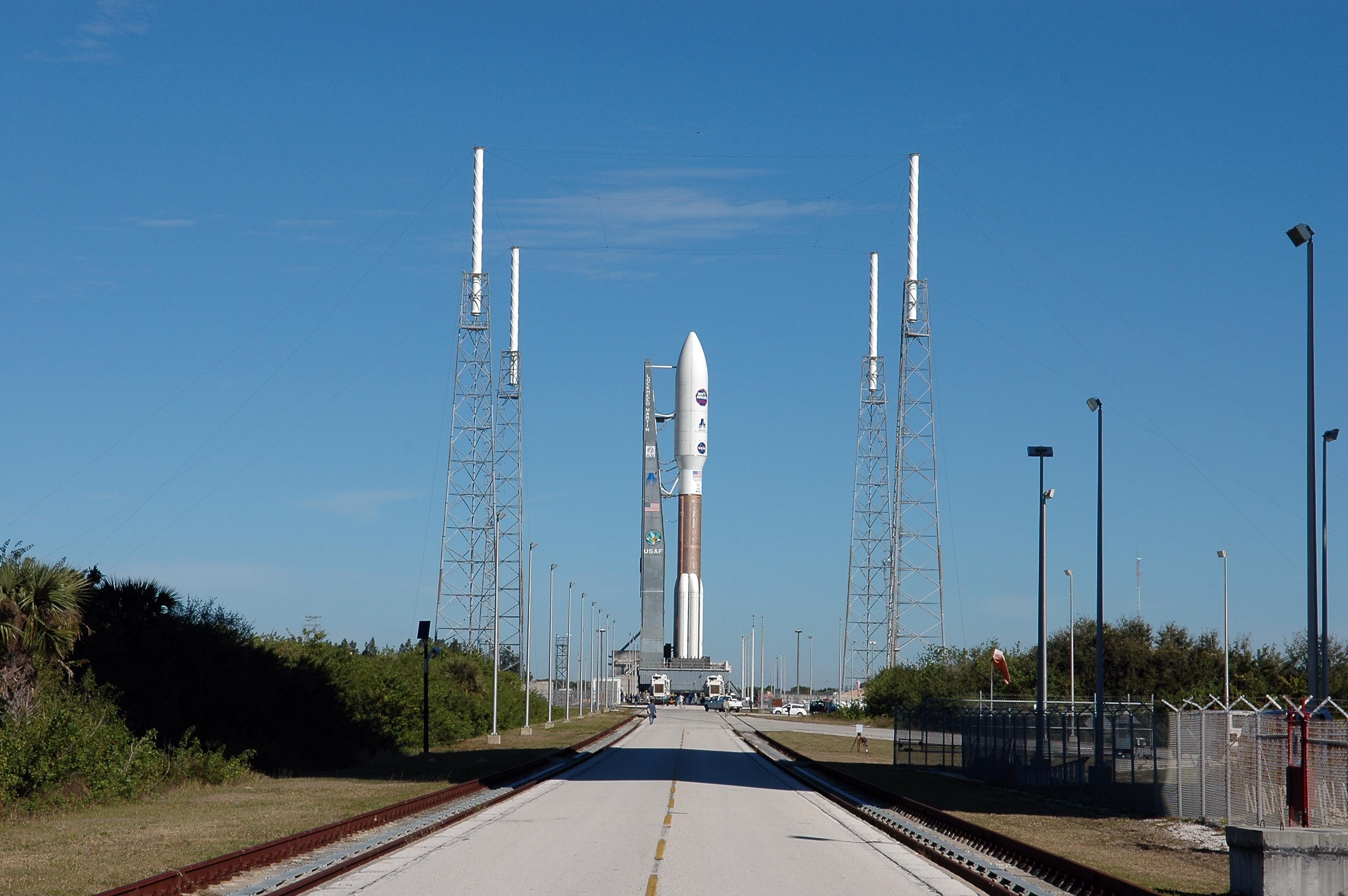
Lockheed Martin and the Air Force renovated LC-41 again in the early 2000s for the Atlas V, part of the Evolved Expendable Launch Vehicle program. The old tower and service structure came down; a new Vertical Integration Facility went up. The pad was rechristened SLC-41, and on August 21, 2002, the first Atlas V launched a Eutelsat communications satellite into geostationary orbit. The years that followed produced a remarkable manifest: the Mars Reconnaissance Orbiter in 2005, New Horizons to Pluto in 2006, Juno to Jupiter in 2011, the Curiosity rover in 2011, and the Perseverance rover in 2020. In 2006, Lockheed Martin and Boeing merged their launch operations into United Launch Alliance, which took over SLC-41. Then Boeing won a Commercial Crew contract, and the pad was modified again -- this time with a crew access tower for the CST-100 Starliner. On June 5, 2024, astronauts Barry Wilmore and Sunita Williams launched from SLC-41 aboard Starliner, the first crewed launch from Cape Canaveral Space Force Station since Apollo 7 departed LC-34 in 1968.
Vulcan and the Next Chapter
The latest reinvention of SLC-41 began in the late 2010s, driven by geopolitics. The Atlas V relied on Russian-built RD-180 engines for its first stage, a dependency that grew untenable after Russia's 2014 annexation of Crimea and the 2022 invasion of Ukraine. ULA developed Vulcan Centaur as the Atlas V successor, using American-made BE-4 engines from Blue Origin. Rather than shut down for a full renovation, SLC-41 was modified to support both rockets simultaneously -- Atlas V launches continued for Starliner and Amazon Kuiper satellite missions while Vulcan prepared for its debut. The first Vulcan Centaur launched from SLC-41 on January 8, 2024, carrying the Peregrine lunar lander for NASA's Commercial Lunar Payload Services program. The pad that sent Voyager to the stars now sends rockets to the Moon, and its rail lines -- descendants of the original 1964 tracks -- still carry vehicles from the integration building to the launch stand.
From the Air
Space Launch Complex 41 is located at 28.583°N, 80.583°W on Cape Canaveral Space Force Station, at the northern end of the station near the Kennedy Space Center boundary. From the air, the complex is identifiable by the Vertical Integration Facility (a tall enclosed building where rockets are assembled), the crew access tower added for Starliner, and the rail lines connecting the VIF to the launch pad. SLC-41 sits just north of SLC-40 (SpaceX Falcon 9). The lightning protection towers flanking the pad are visible from altitude. Nearby airports: KTIX (Space Coast Regional, Titusville), KMLB (Melbourne Orlando International), KCOF (Patrick Space Force Base). Best viewed at 2,000-5,000 feet AGL. Active launch complex -- operations may restrict airspace. Check NOTAMs before overflying.