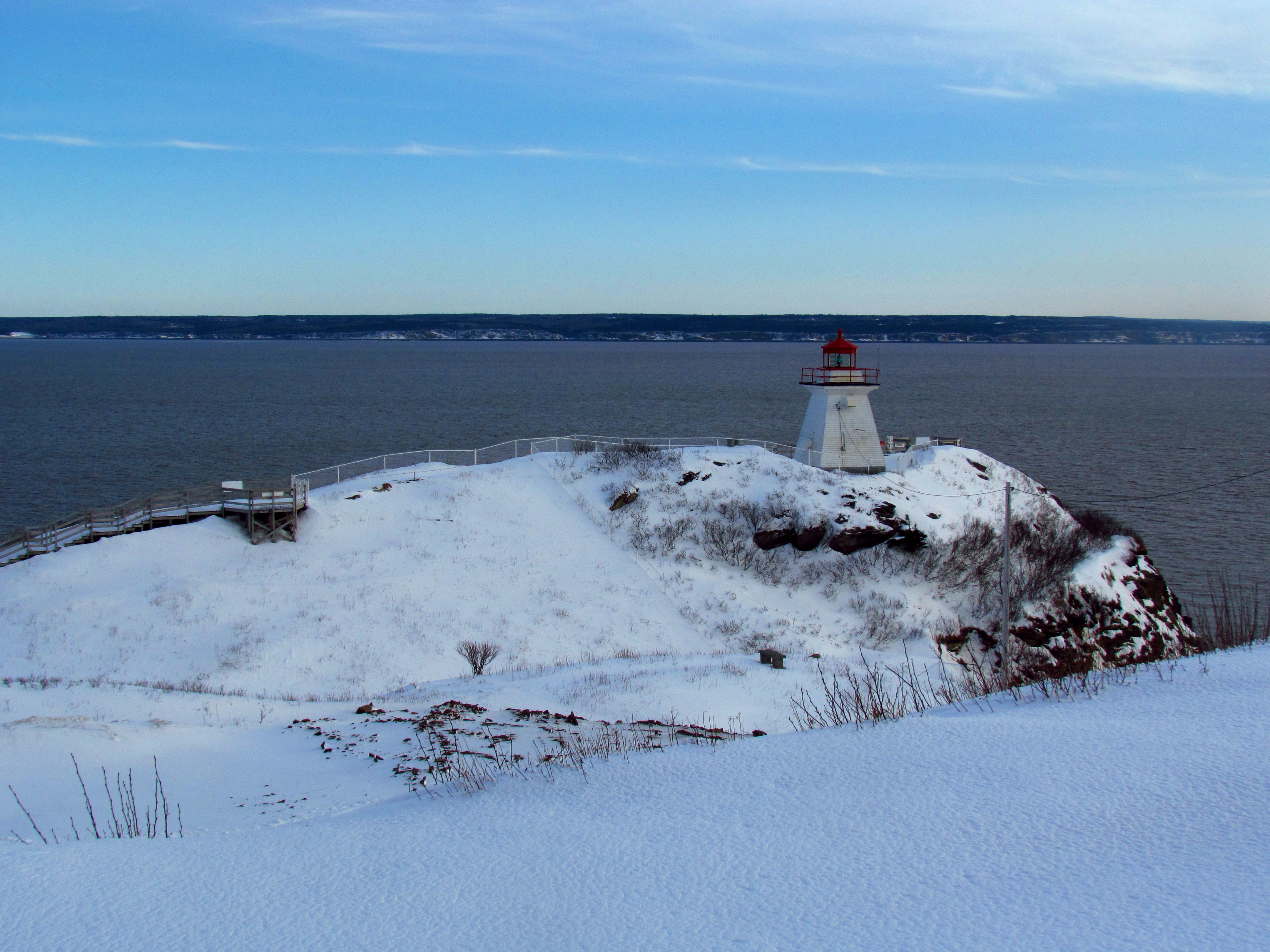
Cape Enrage Lighthouse
Acadian sailors called it Cap Enrage -- the furious cape -- and anyone who has watched the Bay of Fundy hurl itself against the reef below understands why. The water here does not merely rise and fall with the tide. It rages. Waves collide with a submerged rock shelf that extends hundreds of meters from the cliff face, and the resulting turbulence can churn the surface into a white chaos visible from kilometers away. Perched on the cliff above this violent meeting of rock and sea stands the first lighthouse ever built on the Upper Bay of Fundy, a beacon that has guided mariners since 1840 -- and that nearly vanished before a group of teenagers decided it was worth saving.
Where the Sea Loses Its Temper
Cape Enrage juts into the Bay of Fundy from the southern New Brunswick coast, a sheer cliff dropping roughly 50 meters to the churning water below. The tides here are among the highest on Earth, with ranges that can exceed 14 meters between low and high water. At low tide, the reef that gives the cape its reputation emerges like the spine of some buried creature, slick with kelp and barnacles. At high tide, that same reef disappears beneath the surface, but the water above it never settles -- the collision of current and rock produces a perpetual agitation that Acadian fishermen found so alarming they named the place for fury itself. After the Acadian expulsion in the mid-18th century, British settlers anglicized the French name, but the temperament of the water remained unchanged.
A Light Against the Dark
By the 1820s, the growing shipping traffic in the Upper Bay of Fundy made the cape's reef a serious hazard. Cape Enrage competed with other sites for the distinction of receiving Chignecto Bay's first lighthouse, and ultimately won. Construction began in 1838, and the light was first lit in 1840. The decades that followed tested the structure relentlessly. Boathouses and keeper's quarters were built, damaged by storms, rebuilt, and damaged again. The lighthouse itself took heavy damage in a storm during the 1840s and required extensive repair. The current keeper's house, the one that survives today, dates from 1952 -- the latest in a long succession of buildings that the Bay of Fundy treated as temporary.
The Physics Teacher's Rescue
When the Canadian Coast Guard automated the light in the late 1980s, the last keeper, Noel Justison, left the property in 1988. Without human presence, the site deteriorated fast. Vandals broke windows. The salt air ate at exposed wood. By 1993, every building except the lighthouse itself was scheduled for demolition. That year, a physics teacher from Moncton named Dennison Tate brought a small group of his high school students to the site with an improbable plan: restore the entire property and run it as a summer operation. Using grants from a federal student employment program, Tate hired six students that first summer to paint the keeper's duplex, install new shutters, and build a stairway down to the beach. A stairway to the lighthouse followed in 1997, and a gift shop known as the Whistle House went up in 1999. For sixteen years, from 1993 to 2009, the Cape Enrage Interpretive Centre operated as a not-for-profit, student-run organization -- teenagers maintaining a 19th-century lighthouse while offering visitors rock climbing, rappelling, and sea kayaking along the cliffs.
One of Canada's Best Views
In 2004, the Canadian Coast Guard formally transferred ownership of the lighthouse to the organization the students had built. The keeper's house had already been transferred to the Province of New Brunswick in 1995, along with more than four acres of surrounding land. What was once a demolition site became a destination. Frommer's travel guide listed the view from Cape Enrage as one of the best in Canada, and it is not hard to see why. From the clifftop, the entire upper bay spreads out before you -- the Nova Scotia coast visible across the water, the tidal flats stretching into the distance at low tide, the water changing color from slate gray to deep green depending on the light. The lighthouse itself, compact and white against the dark spruce trees, has become one of the most photographed landmarks on the Fundy coast. What began as a student summer project became a permanent rescue -- proof that a place worth seeing is also worth fighting for.
From the Air
Located at 45.59N, 64.78W on the southern New Brunswick coast, Cape Enrage is visible as a prominent headland jutting into the Bay of Fundy. The white lighthouse contrasts sharply against dark forest and red-brown cliffs. Best viewed at 2,000-3,000 feet from the south or southwest, with the exposed reef visible at low tide. Nearest airport: CYSJ (Saint John Airport), approximately 80 km to the west. The Bay of Fundy's dramatic tidal flats are visible from higher altitudes.