Cape Floristic Region
Nine thousand species. That number alone would make the Cape Floristic Region remarkable, but here is the detail that elevates it to something almost improbable: 69 percent of those plants grow nowhere else on the planet. Squeezed into roughly 78,555 square kilometers along South Africa's southwestern tip, this is the smallest of the world's six recognized floral kingdoms, yet it holds more plant diversity per square meter than tropical rainforests many times its size. Botanists call it a biodiversity hotspot. The designation is almost too clinical for what you encounter on the ground -- a rolling, low-canopy landscape where hundreds of species can coexist within a single hillside, each adapted to fire, poor soil, and the particular angle of the sun.
A Kingdom Unto Itself
Most biodiversity hotspots are fragments of larger floral kingdoms. The Cape Floristic Region is different: it constitutes an entire kingdom on its own, one of only two hotspots in the world to hold that distinction. The other is New Caledonia, a Pacific island chain. What sets the Cape apart is its Mediterranean climate -- dry summers, wet winters -- combined with nutrient-poor soils derived from ancient Table Mountain sandstones. These harsh conditions did not suppress life. They forced it to diversify. The dominant vegetation, fynbos, is a sclerophyllous shrubland that looks modest from a distance but reveals staggering complexity up close. Proteas unfurl their sculptural flower heads alongside hundreds of species of Erica heaths, while restios -- the reed family -- fill the gaps between them. Five of South Africa's twelve endemic plant families are found here and nowhere else in the country.
Born from Fire
Fynbos is a fire-dependent ecosystem. Without periodic burns, the shrubland stagnates and loses diversity. Many species have evolved to flower only after fire has swept through, their seeds triggered by smoke compounds or heat. Walk across a hillside eighteen months after a burn and you will see the cycle in action: fresh green shoots pushing through white, infertile sand, each species reclaiming its niche in a sequence refined over millennia. Renosterveld, the other major vegetation type here, occupies richer shale soils along the coastal forelands. Dominated by members of the daisy family, particularly the renosterbos shrub, it once covered vast tracts of lowland. Much of it has been converted to farmland, making the surviving patches critically important. In sheltered ravines, patches of ancient Southern Afrotemperate Forest persist -- remnants of a wetter era, shady and cool amid the sun-blasted fynbos.
The Rooibos Connection
One of this region's most famous exports is rooibos, the red bush tea now sold worldwide. The plant grows only here, in the Cederberg mountains and surrounding fynbos, thriving in the same acidic, sandy soils that support the region's extraordinary diversity. It is a reminder that this ecosystem's value extends beyond aesthetics and into daily life. The region also harbors sandveld -- a soft coastal scrubland on the Western Cape's Atlantic-facing shore -- and wetlands along rivers like the Palmiet, where indigenous trees such as wild almond and yellowwood create corridors of green through the otherwise shrubby terrain. Each vegetation type supports its own community of specialists, from sunbirds pollinating proteas to the geometric tortoise, one of the world's rarest reptiles, which depends on lowland renosterveld.
A Heritage Under Pressure
In 2004, UNESCO inscribed the Cape Floral Region Protected Areas as a World Heritage Site, recognizing eight reserves that together represent the kingdom's diversity. The list reads like a tour of the Western Cape's wildest landscapes: Table Mountain National Park, the Cederberg Wilderness Area, the Kogelberg Nature Reserve, De Hoop, Baviaanskloof. Yet the recognition came with a warning. The Cape Floristic Region faces one of the most rapid extinction rates in the world. Invasive alien plants -- Australian acacias and hakeas, introduced during the colonial era -- spread aggressively through fynbos, outcompeting native species. Habitat loss from agriculture and urban expansion continues to fragment the lowlands. Conservation organizations work to clear invasive species and restore burned areas, but the scale of the challenge matches the scale of the biodiversity at stake.
Where the Kingdoms End
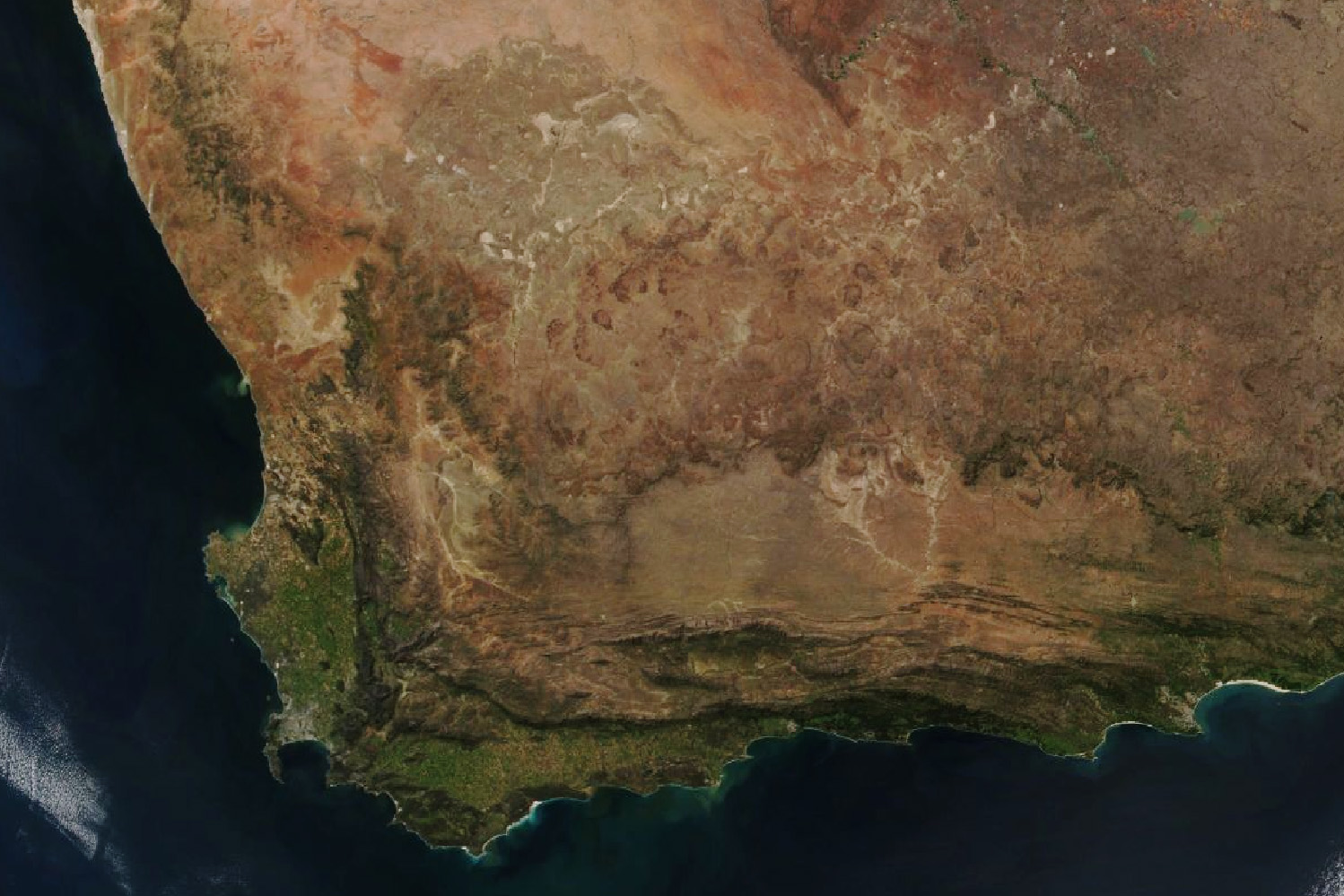
The Cape Floristic Region stretches from the Western Cape's Atlantic coast eastward into the Eastern Cape, a transitional zone where winter rainfall gives way to summer storms and the fynbos gradually yields to subtropical vegetation. This eastern boundary is not a line but a gradient, a slow dissolving of one world into another. From the air, you can trace it: the low, gray-green fynbos thinning against the darker greens of Albany thickets and subtropical forest. Below, the landscape that botanists have spent two centuries trying to catalog continues to surprise them. New species are still being described. Old ones are being lost. The smallest floral kingdom on Earth remains, in the most literal sense, a place where every square meter matters.
From the Air
Centered near 34.17°S, 18.38°E, the Cape Floristic Region spans much of the Western Cape from the Atlantic coast to the Eastern Cape. From altitude, the fynbos appears as low gray-green shrubland on hillsides, distinct from agricultural greens in valleys. Table Mountain (FACT) and Cape Town International (FACT) provide the nearest major airport. Best viewed at 5,000-10,000 ft AGL for landscape contrast. The Kogelberg and Cederberg ranges offer dramatic mountain scenery. Cape Town International Airport ICAO: FACT.