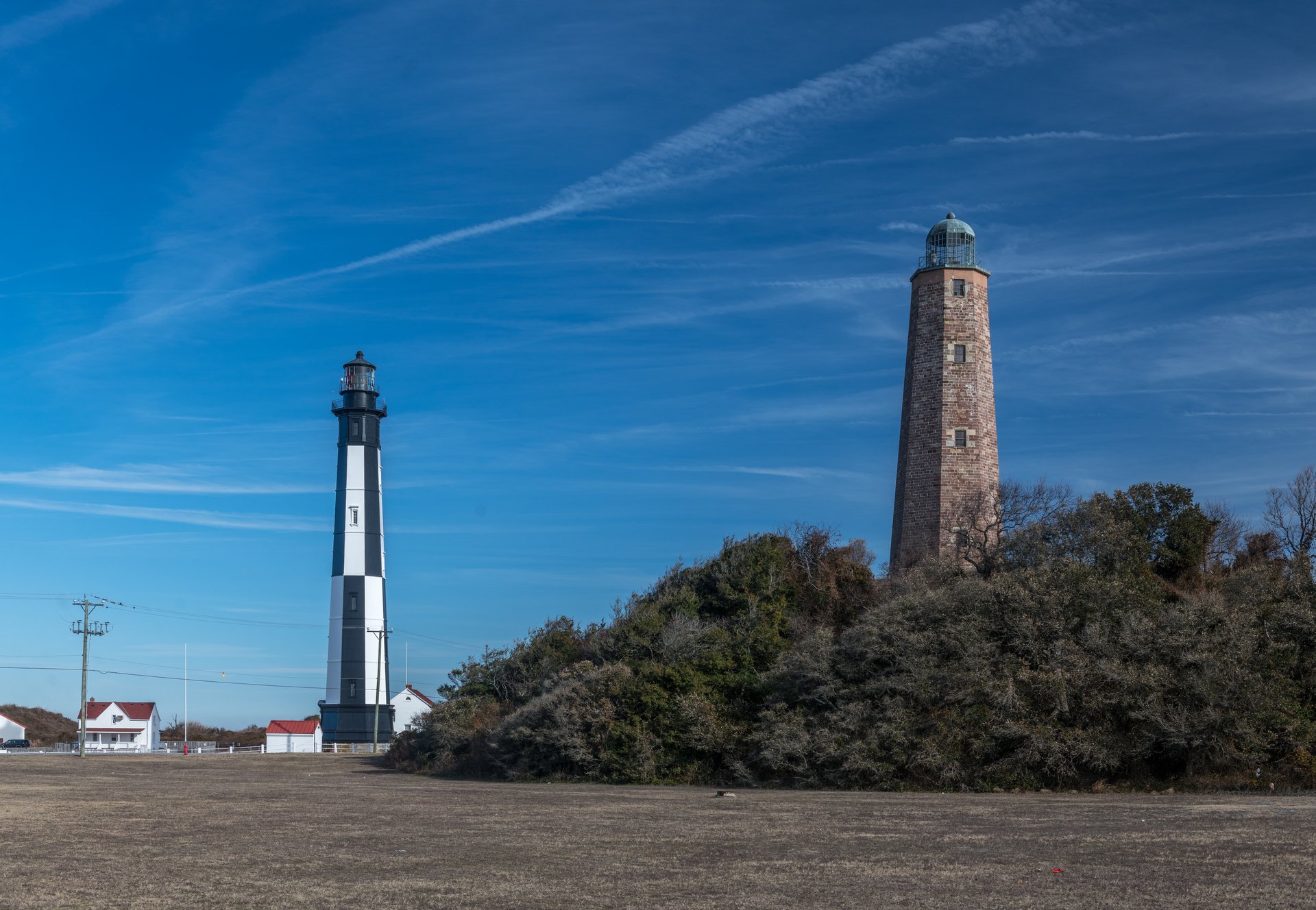
Cape Henry Lighthouses
Before there was a White House, before there was a Capitol Building, before the new United States government built anything at all, it built a lighthouse. The octagonal sandstone tower that rose at Cape Henry in 1792 was the first construction project authorized under the Constitution, and the stone came from the same Aquia Creek quarry that would later supply the President's house. Two centuries on, the old tower still stands at the southern entrance to Chesapeake Bay, just 350 feet from the cast-iron replacement that was built when cracks started spreading across its weathered faces. Together, the pair form one of the most compact and complete stories in American lighthouse history.
The Republic's First Stone
Congress authorized the Cape Henry lighthouse in 1790, making it the very first act of federal construction. The contract went to John McComb Jr. for $15,200, though an additional $2,500 was needed to finish the job. McComb, who would go on to co-design New York City Hall, built the tower from Aquia Creek sandstone and brown Connecticut or Portland brownstone. Completed in November 1792, it stood 26 feet in diameter at its base, tapering to 16 feet at the top, its octagonal form modeled on the 1767 Cape Henlopen Light in Delaware. For shipmasters rounding the Virginia Capes into the Chesapeake, this beacon marked the gateway to one of the busiest waterways in the young nation, guiding traffic to the harbors of Norfolk, Hampton, and the rivers reaching deep into Virginia and Maryland.
Dark Years and Cracked Faces
The lighthouse went dark twice during the Civil War. Confederate forces extinguished the light and removed the lens, understanding that the beacon served Union navigation to Fort Monroe, a critical federal stronghold that never fell to the Confederacy. Union troops recovered the lighthouse in 1863 and restored the light, which continued guiding ships through the war's final years. But time was wearing on the old tower. By the 1870s, Lighthouse Service inspectors discovered alarming cracks spreading across six of the eight sandstone faces. The structural damage raised serious concerns about whether the tower could continue standing, let alone functioning. Rather than tear down the original, the government decided to build a replacement nearby and let the old tower serve as a daymark.
Iron and Glass
Construction on the new Cape Henry lighthouse began in 1879 and finished in 1881. The replacement tower, built of cast iron and wrought iron, stood taller and carried a first-order Fresnel lens far more powerful than anything the old tower had ever held. That lens remains in place today, making the new Cape Henry light the only lighthouse on the Virginia coast still equipped with a first-order Fresnel. The lighthouse was fully automated in 1984 and continues to serve as an active navigational aid for the enormous volume of commercial and military shipping that passes through the mouth of the Chesapeake. The two towers stand just 350 feet apart, the old one warm and textured in weathered sandstone, the new one a dark iron column reaching higher into the salt air.
Preserved in the Same Stone
Preservation Virginia acquired the old lighthouse in 1930, adding a brick lining and iron stairway to make the interior safe for visitors. The National Historic Landmark designation came in 1964, and in 2002 the American Society of Civil Engineers recognized it as a National Historic Civil Engineering Landmark. Both towers together received National Historic Landmark status in 1970. The lighthouses sit within Joint Expeditionary Base East, a Navy installation in Virginia Beach, adjacent to the Cape Henry Memorial that commemorates the 1607 landing of English settlers. In 2025, Preservation Virginia carried out repairs using Aquia Creek stone from a supply originally quarried in the 18th century, closing a loop of preservation that stretches back to the republic's founding. Visitors who climb the old tower's observation platform look out over the Atlantic from one of the oldest federal structures in the country, standing on stone older than the nation itself.
From the Air
Located at 36.93°N, 76.01°W at Cape Henry, the southern headland marking the entrance to Chesapeake Bay. The two lighthouse towers are visible from the air as a pair of structures on the cape's tip within the Joint Expeditionary Base East military installation. Best viewed at 1,500-3,000 ft AGL. First Landing State Park stretches along the shore to the south. Norfolk International Airport (KORF) is 14nm west. NAS Oceana (KNTU) is 8nm south - active military airspace. The Chesapeake Bay Bridge-Tunnel is a prominent visual reference extending north from the cape. Expect military traffic and restricted areas in the Hampton Roads vicinity.