Cape Inubō
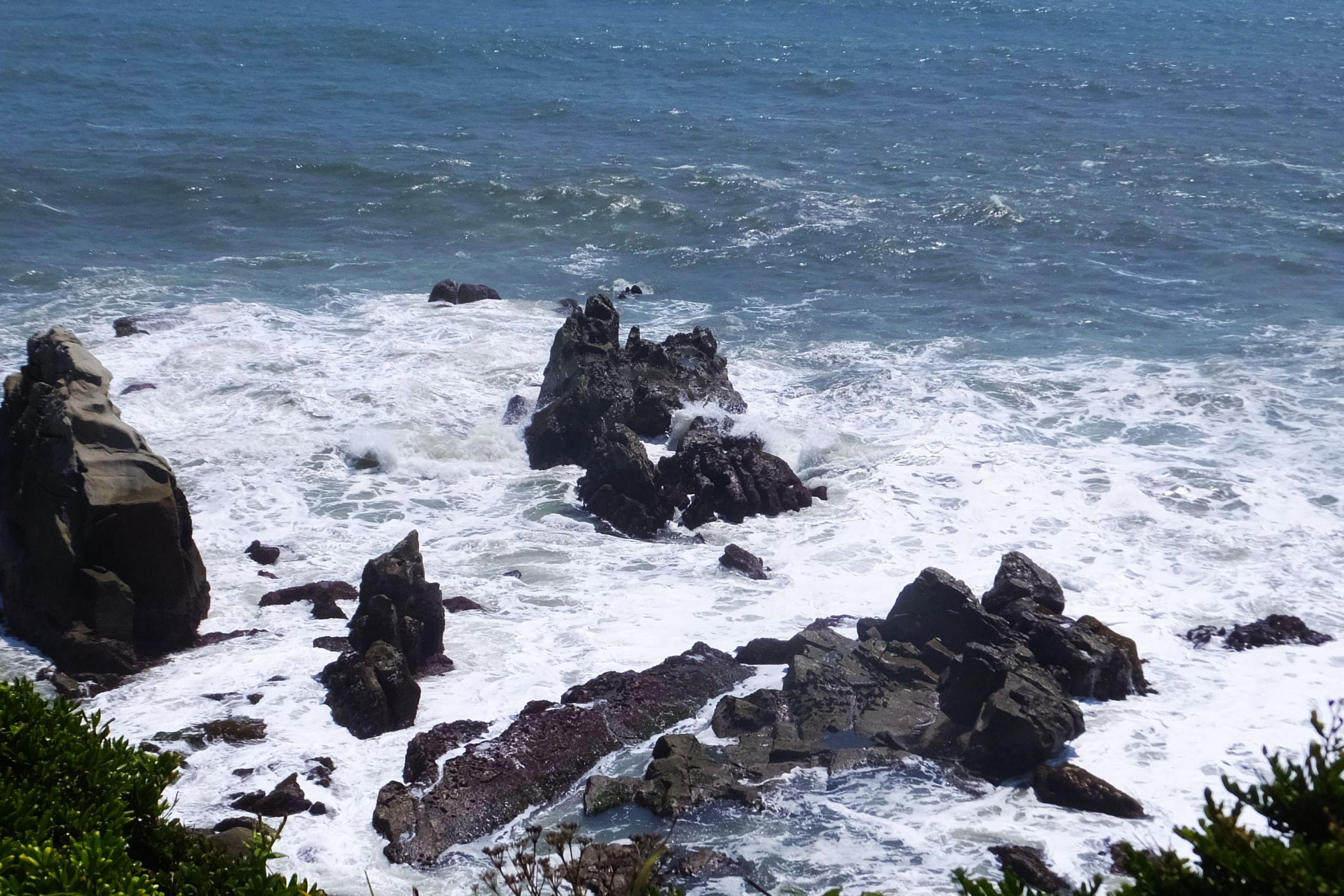
Every time you watch a Toei Company film -- Dragon Ball, Battle Royale, Power Rangers, or any of thousands of titles -- the opening seconds drop you at Cape Inubō. Three dark rocks stand in the Pacific surf as waves crash over them in slow, dramatic arcs. That image, first filmed in 1954 and used continuously since 1958, is one of the most recognized studio logos in world cinema, and those rocks are real. They sit just off the easternmost point of Chiba Prefecture, at the tip of a small headland that punches into the open Pacific near the midpoint of Japan's main island. But the cape earned its name long before any camera arrived, and the story involves a howling dog, a fleeing samurai, and the barking of animals that no longer exist.
The Howling Cape
The name Inubō is written with two Chinese characters: 犬, meaning dog, and 吠, meaning howling. Several origin stories compete for the name's true source. The most dramatic involves Minamoto no Yoshitsune, the legendary 12th-century samurai general. According to tradition, when Yoshitsune fled through this region, his pet dog Wakamaru was left behind on the peninsula. The abandoned animal howled for seven days and seven nights, its cries carrying across the water until the cape itself took the dog's name. A more naturalistic explanation points to Japanese sea lions, which once inhabited the coastal waters here in large numbers. Their barking calls, resembling a dog's voice, may have given the headland its canine identity. A third possibility suggests the name derives from the ancient Ainu language, predating Japanese settlement entirely. Whatever the true origin, the name stuck -- and the cape has been the Howling Dog Point for centuries.
First Light at the Edge
Cape Inubō marks the easternmost point of Chiba Prefecture, jutting into the Pacific Ocean near the mouth of the Tone River. It is technically a small peninsula, though custom and convention have always called it a cape. The headland forms part of Suigō-Tsukuba Quasi-National Park, and beneath the lighthouse, an extensive marine cave system threads through the reef. In 1874, the Inubōsaki Lighthouse was built on the cape's highest point. It remains one of the few lighthouses in the world that still houses its original first-order Fresnel lens -- the largest and most powerful type of Fresnel lens ever manufactured for lighthouse use. The lighthouse is designated a Registered Tangible Cultural Property of Japan, its white tower a landmark visible for miles along the coast and a reliable waypoint for vessels navigating the approaches to Tokyo Bay.
Three Rocks, One Billion Viewers
In 1954, Toei Company first filmed its now-iconic opening logo at Cape Inubō: waves crashing over three dark rocks in the Pacific surf, the studio's name superimposed above the spray. The black-and-white original gave way to color in 1961, and the sequence has been reshot and updated multiple times over seven decades, but the location has never changed. Those three rocks near Cape Inubō have appeared before more films and television episodes than perhaps any other natural feature in Japan. The logo has opened everything from samurai epics to anime blockbusters, making these particular wave-battered stones familiar to audiences who have never heard of Chōshi. The 45th Super Sentai series, Kikai Sentai Zenkaiger, even worked the Cape Inubō rocks into its storyline, featuring the iconic shot in the background of a signature attack sequence.
Poetry Carved in Stone and Wind
The cape's dramatic setting has drawn more than filmmakers. Stone markers on the headland commemorate the works of two celebrated Japanese poets who found inspiration here. Kyoshi Takahama, a haiku master of the Shōwa period who lived from 1874 to 1959, composed verses at the cape that captured the meeting of wind, wave, and rock. Bokusui Wakayama, a naturalist tanka poet who lived from 1885 to 1928, left his own literary mark on the landscape. Their memorial stones stand on the windswept promontory, facing the same Pacific horizon that inspired their brushwork. The cape is easily reached -- a 10-minute walk from Inuboh Station on the Chōshi Electric Railway Line, or 20 minutes by bus from JR Chōshi Station -- and the approach on foot, with the lighthouse growing larger against the sky and the sound of surf building with each step, remains the best way to understand why poets and filmmakers keep returning.
From the Air
Located at 35.708°N, 140.870°E at the easternmost point of Chiba Prefecture, Japan. The cape is a prominent headland jutting into the Pacific, easily identifiable from the air by the white Inubōsaki Lighthouse on its tip and the dramatic Byōbugaura cliffs extending to the south. The Tone River mouth lies to the north, providing an additional landmark. Look for the three dark rocks just offshore on the south side of the cape -- these are the Toei Company logo rocks. Nearest airport: Narita International Airport (RJAA) approximately 55 km to the west. Chōshi city spreads inland from the cape. Pacific winds can be strong at this exposed eastern headland; expect turbulence at lower altitudes along the coastline.