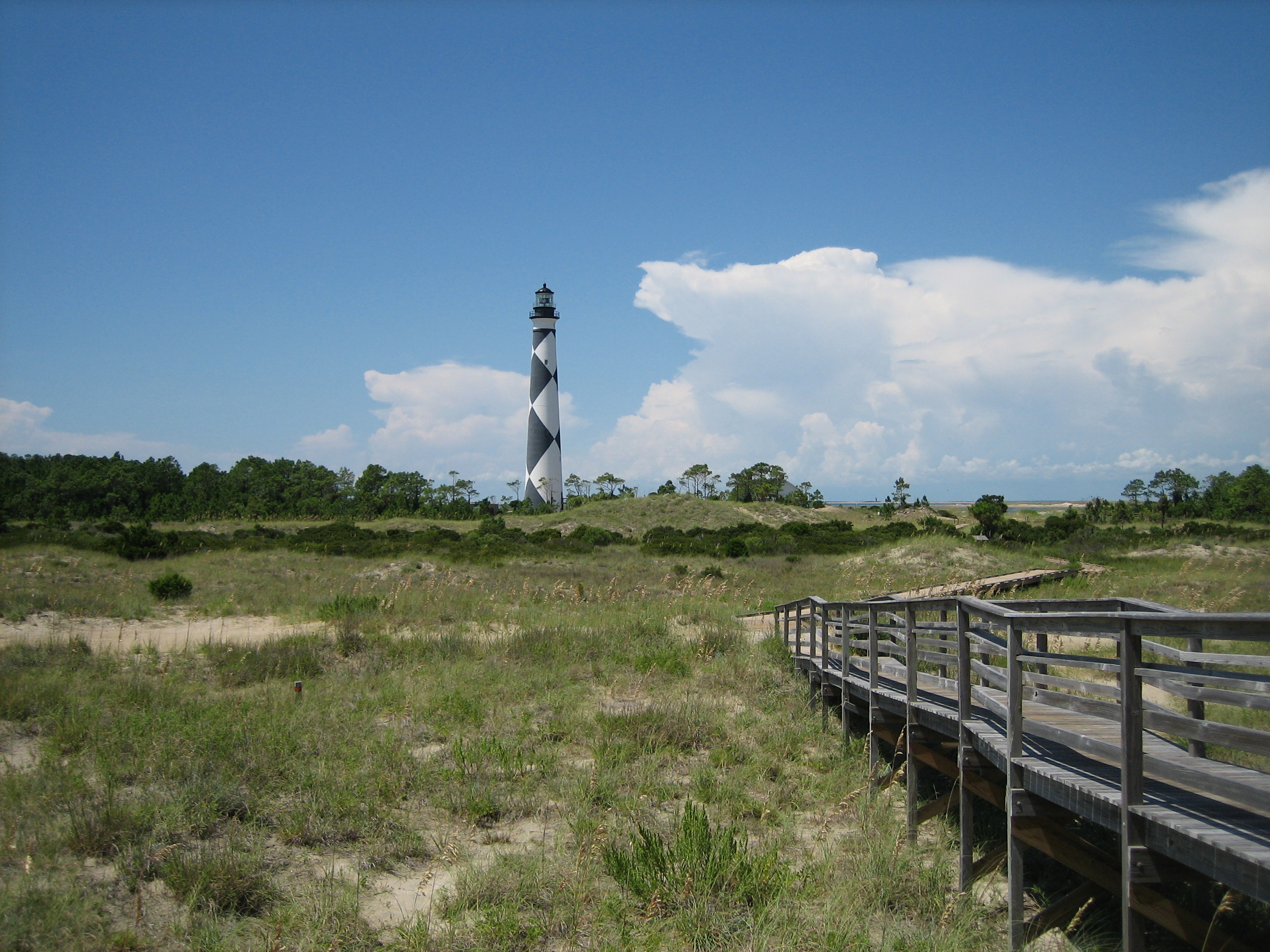
Cape Lookout Lighthouse
Every lighthouse on the Outer Banks tells you where you are by what it looks like. Spiral stripes mean Cape Hatteras. Horizontal bands mean Bodie Island. Bare red brick means Currituck Beach. But only one lighthouse in the entire United States wears a bold black-and-white checkerboard: Cape Lookout, standing 163 feet above the southern Outer Banks, its diamond pattern a compass rose embedded in brick and mortar. The center of each black diamond points north and south. The center of each white diamond points east and west. Even in daylight, before any lamp is lit, the tower itself is a navigational instrument -- a signal painted onto the sky for sailors who need to know not just where the land is, but which direction they are facing.
The Horrible Headland
The waters off Cape Lookout earned a grim reputation long before any lighthouse stood here. Lookout Shoals, a treacherous expanse of shifting sandbars extending miles offshore, wrecked enough ships to earn the nickname "The Horrible Headland." Congress authorized the first lighthouse in 1804, but it took eight years to build, finally lighting in 1812 at a cost of more than $20,000. That original tower rose 96 feet, its brick walls covered in wooden shingles painted with red and white horizontal stripes. It was the fourth lighthouse built in North Carolina. But 96 feet was not enough. The shoals reached farther than the light, and ships continued to run aground in the dark. Something taller and more powerful was needed.
A Lens That Changed Everything
Congress approved $45,000 in 1857 for a replacement, and on November 1, 1859, the present Cape Lookout Lighthouse was completed and lit. Its secret weapon was a first-order Fresnel lens, the largest and most powerful class -- a masterwork of concentric glass prisms that could bend candlelight into a beam visible 19 miles out to sea. The tower flashes every 15 seconds, and it is one of the very few lighthouses in the country that operates during the day, its painted diamonds serving as a daymark when the lamp is off. The lighthouse became fully automated in 1950, but the Fresnel lens and the checkerboard paint have kept it working as both a beacon and a landmark for more than 160 years.
Sabotage in the Dark
When North Carolina joined the Confederacy on May 20, 1861, every Fresnel lens along the coast was removed and hidden to prevent Union ships from navigating safely. Union forces captured nearby Beaufort and Morehead City in 1862, and by the following year a smaller third-order Fresnel lens was installed in the Cape Lookout tower as a temporary fix. But the lighthouse remained a target. On April 2, 1864, a small Confederate raiding party led by L.C. Harland slipped through Union lines and reached the tower. Their attempt to blow it up failed, but the explosion destroyed the oil supply and damaged the iron staircase. With iron impossible to obtain during wartime, the broken stairs were patched with wooden replacements. It was not until 1867, two years after the war ended, that iron stairs were restored and the original first-order Fresnel lens -- recovered in Raleigh along with the lenses from every other North Carolina lighthouse -- was reinstalled.
Diamonds and Diamond City
In 1873, the lighthouse received its signature black-and-white diamond pattern. The daymark patterns along the Outer Banks were randomly assigned -- there is no evidence that Cape Lookout and Cape Hatteras ever swapped designs, despite persistent local legend. But the diamonds left a lasting mark on the surrounding community. Diamond City, a settlement on the eastern end of nearby Shackleford Banks, took its name directly from the lighthouse's checkered face. The community thrived on whaling and fishing for decades before a series of devastating hurricanes at the turn of the twentieth century drove its residents away. The lighthouse outlasted the town that bore its name.
Climbing the Checkerboard
Today Cape Lookout Lighthouse stands within Cape Lookout National Seashore, accessible only by private ferry -- there are no bridges, no roads leading here. During the summer season, from mid-May to mid-September, visitors can climb the 207 steps to the gallery for sweeping views of Core Banks, Shackleford Banks, and the open Atlantic. The Keepers' Quarters Museum at the base of the tower tells the story of the families who tended the light. Tower climbs were suspended in 2008, reopened permanently in July 2010, then closed again in March 2021 after inspectors found cracks in the iron landing plates and separations between the stairs and the masonry walls. The National Park Service has been working to restore safe access, a reminder that maintaining a structure built in 1859 is itself a never-ending act of stewardship.
From the Air
Located at 34.605N, 76.536W on the southern tip of Core Banks. The black-and-white diamond pattern is clearly visible from altitude. Nearest airport is Michael J. Smith Field (KMRH) in Beaufort, NC, approximately 12 nm northwest. Cape Lookout National Seashore stretches along the barrier islands below; look for the hook-shaped cape extending southward. Best viewed at 2,000-5,000 ft AGL. The lighthouse sits on a narrow sand spit with Lookout Bight to the west and the Atlantic to the east.