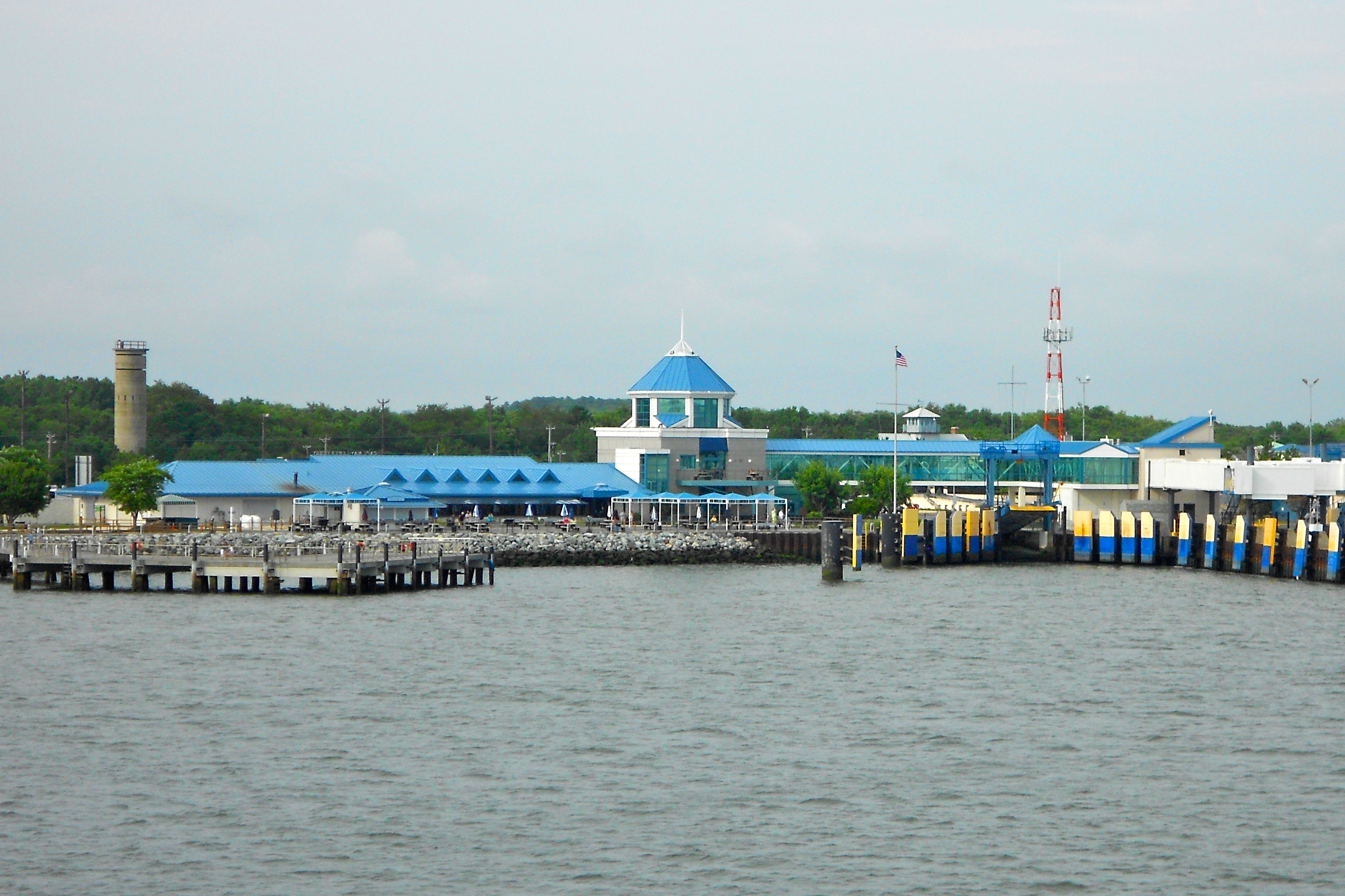
Cape May-Lewes Ferry
The ships that launched the Cape May-Lewes Ferry in 1964 were somebody else's discards. Five vessels -- four steamships and a converted World War II landing ship -- bought from Virginia's defunct Little Creek-Cape Charles Ferry, which had been killed by the opening of the Chesapeake Bay Bridge-Tunnel that same year. One state's obsolete fleet became another state's brand-new transit link. For more than sixty years now, those ships and their successors have been making the 85-minute crossing of Delaware Bay, connecting North Cape May, New Jersey, with Lewes, Delaware -- the final crossing of the Delaware River-Delaware Bay waterway before it meets the Atlantic Ocean. Along the way, the ferry transformed from utilitarian transport into a floating tourist destination, complete with a vessel once described as a miniature cruise ship.
Virginia's Leftovers
The idea of a ferry across Delaware Bay surfaced as early as 1926, when planners proposed using a World War I military ship to carry passengers and cars. That scheme died within months. It took the Delaware River and Bay Authority until October 17, 1962, to conduct a trial run, borrowing the Pocahontas from Virginia's Chesapeake Bay Ferry Commission. Service officially began on July 1, 1964, with the purchased Virginia fleet: the SS Cape May (originally the SS Delmarva, built in 1934), the SS Delaware (originally the SS Pocahontas, 1941), the SS New Jersey (originally the SS Princess Anne, 1936), and the MV Cape Henlopen (originally the USS Buncombe County, a 1944 tank landing ship renamed MV Virginia Beach in 1955). The first trip sailed from Cape May to Lewes. The first manager was Nolan C. Chandler, a former oiler for Virginia's Norfolk-Kiptopeke Ferry, who started on March 15, 1964.
Three Lighthouses in Eighty-Five Minutes
The crossing itself is the attraction. Eighty-five minutes across the widest part of Delaware Bay, where the river system finally meets the Atlantic. Each vessel carries up to 100 vehicles and 800 passengers, their shallow-displacement hulls sitting almost barge-like on the water. From the upper decks, passengers can spot three lighthouses: the Cape May Light on the New Jersey side, and the Harbor of Refuge Light and Delaware Breakwater East End Light near Lewes. The ferry is technically part of U.S. Route 9 -- one of only two U.S. routes to include a ferry crossing, the other being U.S. Route 10 across Lake Michigan. Taking the ferry means skipping the long drive around the bay through the New Jersey Turnpike and across the Delaware Memorial Bridge. It is one of only two year-round direct crossings between Delaware and New Jersey, the other being that very bridge.
The Miniature Cruise Ship
In the 1990s, the fleet underwent ambitious renovations that attempted to turn utilitarian ferries into attractions. The MV Twin Capes received a $27 million overhaul between 1994 and 1996 that replaced everything above the second deck with four new decks, multiple lounges, a new pilot house, and distinctive shark-fin smokestacks. She emerged as a miniature cruise ship: two sets of elevators, a sweeping interior staircase, an enlarged retail shop, a food court with a brick pizza oven, four bars, and a buffet restaurant inside a two-deck-tall glass-enclosed atrium. The restaurant was shut down in 2000 after FDA inspectors found violations in the galleys of all five vessels, but the ship remained popular. Declining ridership eventually caught up. The Twin Capes was retired in October 2013, towed away in July 2017, and deliberately sunk on June 15, 2018, off Bethany Beach, Delaware, to become part of the Del-Jersey-Land Inshore Artificial Reef.
Weathering the Bay
Delaware Bay has tested the ferry service repeatedly. On December 10, 2009, the New Jersey ran aground on a sandbar near the mouth of the Cape May Canal during an unusually low tide, freed only by the rising water. On March 30, 2019, a vessel lost power with 143 passengers aboard and spent two hours drifting before being towed back to Cape May. On November 17, 2020, high winds pushed the Cape Henlopen aground off the coast of Cape May shortly after departure. No passengers were harmed in any of these incidents. The bay's challenges echo the same forces that made the Delaware Breakwater and its lighthouses necessary in the first place -- the unpredictable convergence of river current, tidal surge, and Atlantic weather at the mouth of one of the East Coast's most important waterways.
More Than a Ride
Today the Cape May-Lewes Ferry operates three vessels -- the MV Delaware, MV New Jersey, and MV Cape Henlopen -- running daily service between terminals that both feature distinctive glass-enclosed towers and elevated walkways. Shuttle buses on both sides connect the ferry to destinations along the shore: Cape May's Victorian downtown, the Tanger Outlets and Rehoboth Beach in Delaware, even the Cape May County Park and Zoo. The DRBA runs a Fourth of July fireworks cruise with entertainment on the car deck and catered meals. The ferry that began as five used ships from Virginia has become a tourism engine linking two states' beach economies. In August 2020, the service welcomed its first female permanent captain, Sharon Urban -- another milestone in a crossing that has been reinventing itself since its first borrowed boat made the run across the bay in 1962.
From the Air
The Cape May-Lewes Ferry route crosses the mouth of Delaware Bay between North Cape May, NJ (38.95°N, 74.96°W) and Lewes, DE (38.78°N, 75.14°W). From altitude, the ferry vessels are visible as large flat-decked ships making the 85-minute crossing. The Cape May terminal sits on the north shore of the Cape May Canal; the Lewes terminal is on the bay shore near the Delaware Breakwater. Three lighthouses are visible along the route: Cape May Light (southern NJ shore), Harbor of Refuge Light (end of outer breakwater), and Delaware Breakwater East End Light. Nearest airports: Cape May County Airport (KWWD) approximately 3nm from the NJ terminal; Sussex County Airport (KGED) approximately 15nm west of Lewes. Atlantic City International (KACY) approximately 40nm northeast. The bay mouth can produce rough seas, fog, and strong tidal currents. Summer weekends see heavy ferry traffic.