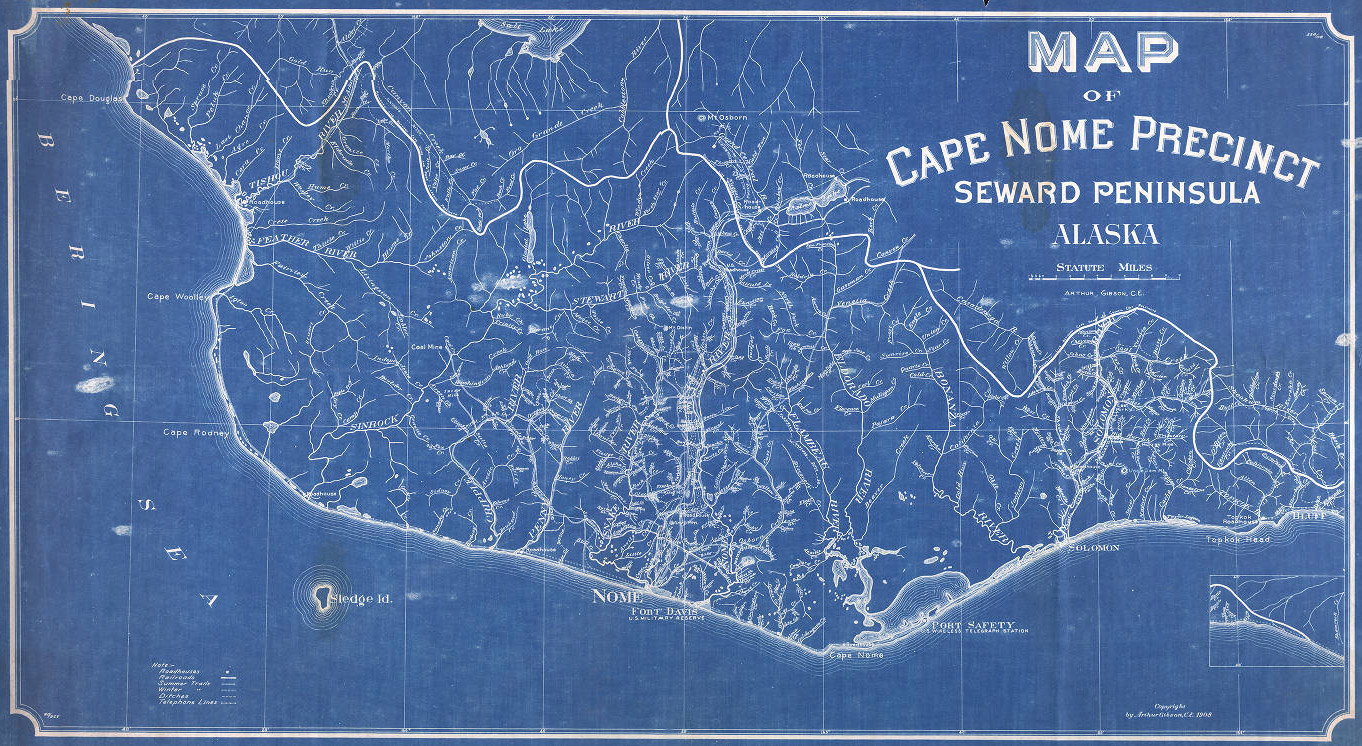
Cape Nome
Cape Nome juts into the cold waters of Norton Sound on Alaska's Seward Peninsula, a headland whose very name may be a mapmaker's error. One theory holds that a draftsman misread the notation '? Name' as 'C. Nome' on a British Admiralty chart, christening both the cape and the city that would rise nearby. Whether true or apocryphal, the story captures something essential about this remote corner of the world, where chance and circumstance have shaped human destiny in unexpected ways.
Before the Gold
Long before prospectors arrived, the Inuit village of Ayacheruk stood near Cape Nome. The 1880 census recorded 60 residents, all Inuit. Russian explorers named the headland Tolstoi, meaning 'blunt' or 'broad,' in 1833. By 1849, the name Nome appeared on British charts created during the search for the lost Franklin Expedition. A government reindeer herd grazed here, and a mission served the local population. The cape was simply another piece of the vast Alaskan wilderness.
The Rush Begins
Everything changed in 1898 when a prospecting party discovered placer gold on the Snake River. News spread to miners at Golovnin Bay, and by October 18 of that year, the Cape Nome mining precinct was officially formed. The rush was on. Thousands poured into the region, transforming the landscape. The native village recorded in earlier censuses never appeared on the census rolls again, its residents absorbed into or displaced by the tide of gold seekers.
Granite and Garnet
Cape Nome's geology tells a deeper story. The headland is composed of ancient granite intruded by greenstone formations, with veins of quartz and crystals of orthoclase feldspar reaching an inch and a half in diameter. Heavy mineral sands containing garnet crystals wash up on the beaches. The rocks here have witnessed the rise and fall of ice ages, the passage of the Bering land bridge, and the brief human drama of the Gold Rush, all recorded in stone older than memory.
From the Air
Cape Nome extends into Norton Sound from the southern coast of the Seward Peninsula. The city of Nome is visible approximately 12nm to the west along the coast. The headland is bounded by Norton Sound to the south, Hastings Creek to the west, and a coastal lagoon to the east. The Bering Strait lies approximately 100nm to the northwest. Nearest airport: Nome Airport (PAOM) 10nm west.