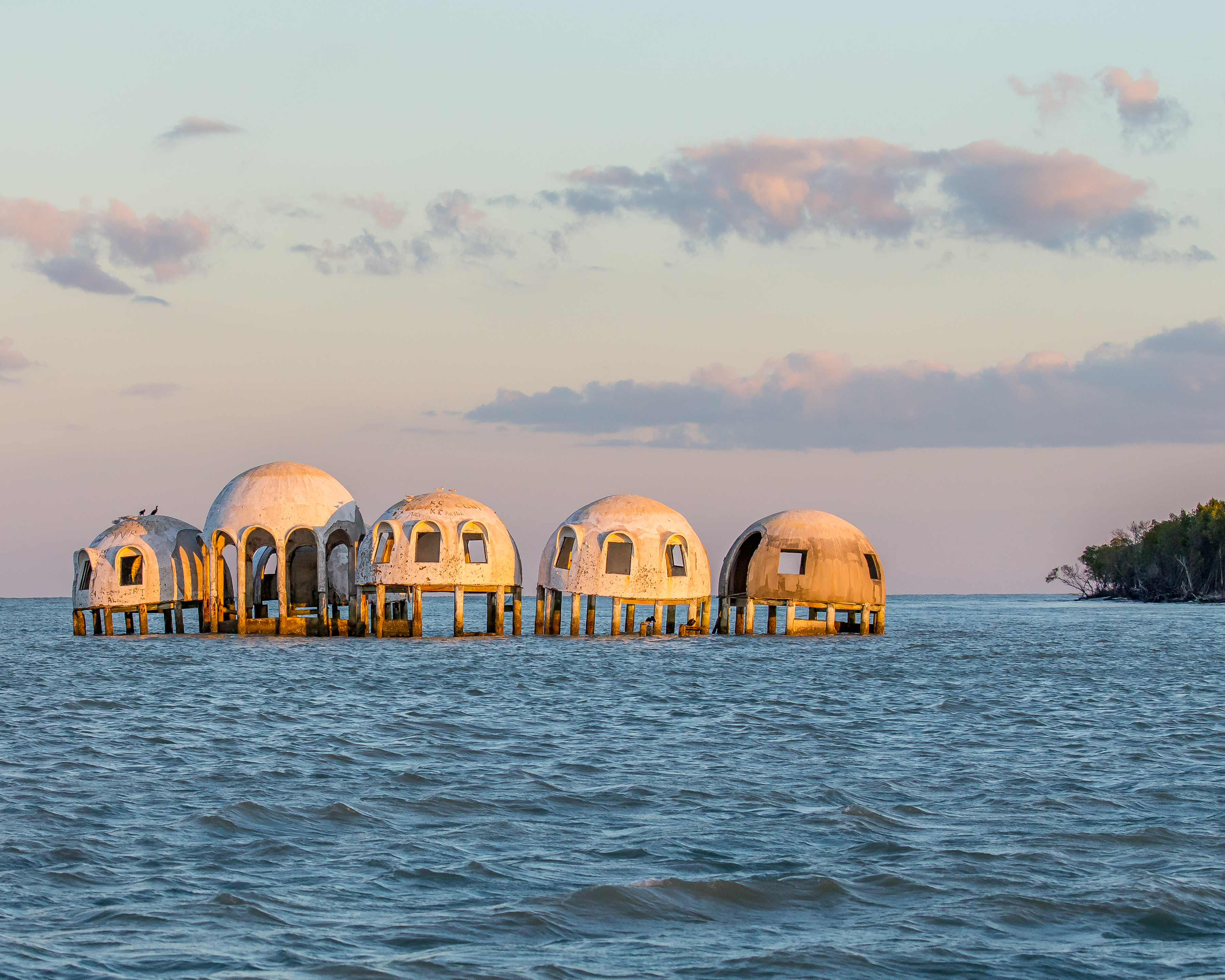
Cape Romano Dome House
For years, boaters rounding the southern tip of Marco Island would see them -- six pale domes on stilts, standing in the surf like the abandoned outpost of some lost civilization. The structures appeared to be sinking into the Gulf of Mexico, and in a sense, they were. But the Cape Romano Dome House was never meant to be an offshore ruin. When retired oil producer Bob Lee completed the house in 1982, it stood firmly on dry land on an islet near Cape Romano Island, in the maze of mangrove islands called the Ten Thousand Islands. The ocean came to it. Hurricane by hurricane, storm surge by storm surge, the sandy islet eroded until the house that was designed to survive anything stood in open water, its rounded concrete shells resisting the waves even as the ground they rested on disappeared beneath them.
An Inventor's Dream on a Shell Island
Bob Lee spent 1978 and 1979 surveying and purchasing four adjacent plots on Morgan Island, a remote spit of sand and shell in Collier County, Florida. His family described him as an adventurous inventor, a man who designed a heat source for under-floor warming and rigged a mechanical arm to carry logs through a wall and drop them directly onto the fireplace. The dome house was his most ambitious creation. The concrete walls were cast using sand dredged from the island itself. The rounded shapes were not merely aesthetic -- their curved profiles offered superior resistance to hurricane-force winds, deflecting pressure that would buckle flat walls. The floors were tile and carpet, the interior walls painted white, and every room had large windows on all sides, flooding the living spaces with the subtropical light of the Florida coast. His daughter Jane Maples remembered it simply: her father loved the seclusion of island life -- fishing, shelling, watching the weather roll in off the Gulf.
Sun, Rain, and Self-Reliance
Decades before off-grid living became a movement, Lee's dome house operated entirely on renewable resources. Gutters built into the curved roofs channeled rainwater and morning dew down into a 23,000-gallon cistern beneath the central dome. The water passed through filters and supplied every sink, bath, shower, and appliance in the house. Solar contractor Dell Jones of Fort Myers installed the power systems: an Amcor Solon thermosyphon solar water heater for hot water and a hybrid photovoltaic array with Arco solar modules, a gasoline backup generator, and a 24-volt lead-acid battery bank. The refrigerator was a SunFrost high-efficiency unit running directly off the battery bank. The lighting was state-of-the-art compact fluorescent -- cutting-edge technology in the early 1980s. Bob Lee's grandson Mike Morgan marveled at the completeness of the system: the house was totally self-sustaining, needing nothing from the mainland except the occasional visit.
The Sea Closes In
The Gulf of Mexico was patient. The islet beneath the domes eroded gradually through the 1990s and 2000s, each tropical storm shaving away more sand. In 2005, Lee sold the house to Naples resident John Tosto for $300,000. Tosto invested $500,000 trying to restore the property, with estimates of $900,000 to complete the work. But the sea was faster than the renovations. When Hurricane Irma struck in September 2017 as a Category 3 storm, two of the westernmost domes collapsed into the ocean, leaving four still standing on their concrete stilts, now surrounded by saltwater at all tides. In 2018, Collier County's Code Enforcement division closed the case on the property and ownership passed to the state of Florida. The remaining domes became one of the most photographed curiosities on the southwest Florida coast -- an eerie cluster of white shells half-submerged in turquoise water, looking more like a science fiction set than a former family home.
The Final Storm
On September 28, 2022, Hurricane Ian made the question of the dome house's future irrelevant. The Category 4 storm drove a massive storm surge through the Ten Thousand Islands, and the four remaining domes collapsed. Only a few concrete pilings still break the surface, marking the spot where Bob Lee's invention once stood. The destruction ended a forty-year arc from visionary construction to gradual surrender. Yet the dome house's legacy outlasted its physical structure. It had proven that a home could run entirely on sunlight and rainwater, that curved concrete could withstand storms that flattened conventional buildings, and that one determined builder on a remote island could engineer a self-contained world. The pilings that remain are a monument less to failure than to the stubborn ambition of a man who built something extraordinary in a place the ocean was always going to reclaim.
From the Air
Located at 25.85°N, 81.68°W, approximately 1 mile offshore from the southern tip of Marco Island in the Ten Thousand Islands region of Collier County, Florida. The site is now mostly submerged, with only concrete pilings visible above the waterline. Best viewed at 1,000-3,000 feet AGL. The nearest airport is Marco Island Executive (KMKY) approximately 5 nm north. Naples Municipal (KAPF) is approximately 15 nm north-northwest. Southwest Florida International (KRSW) is approximately 30 nm north. Clear, calm conditions recommended for spotting the remnant pilings.