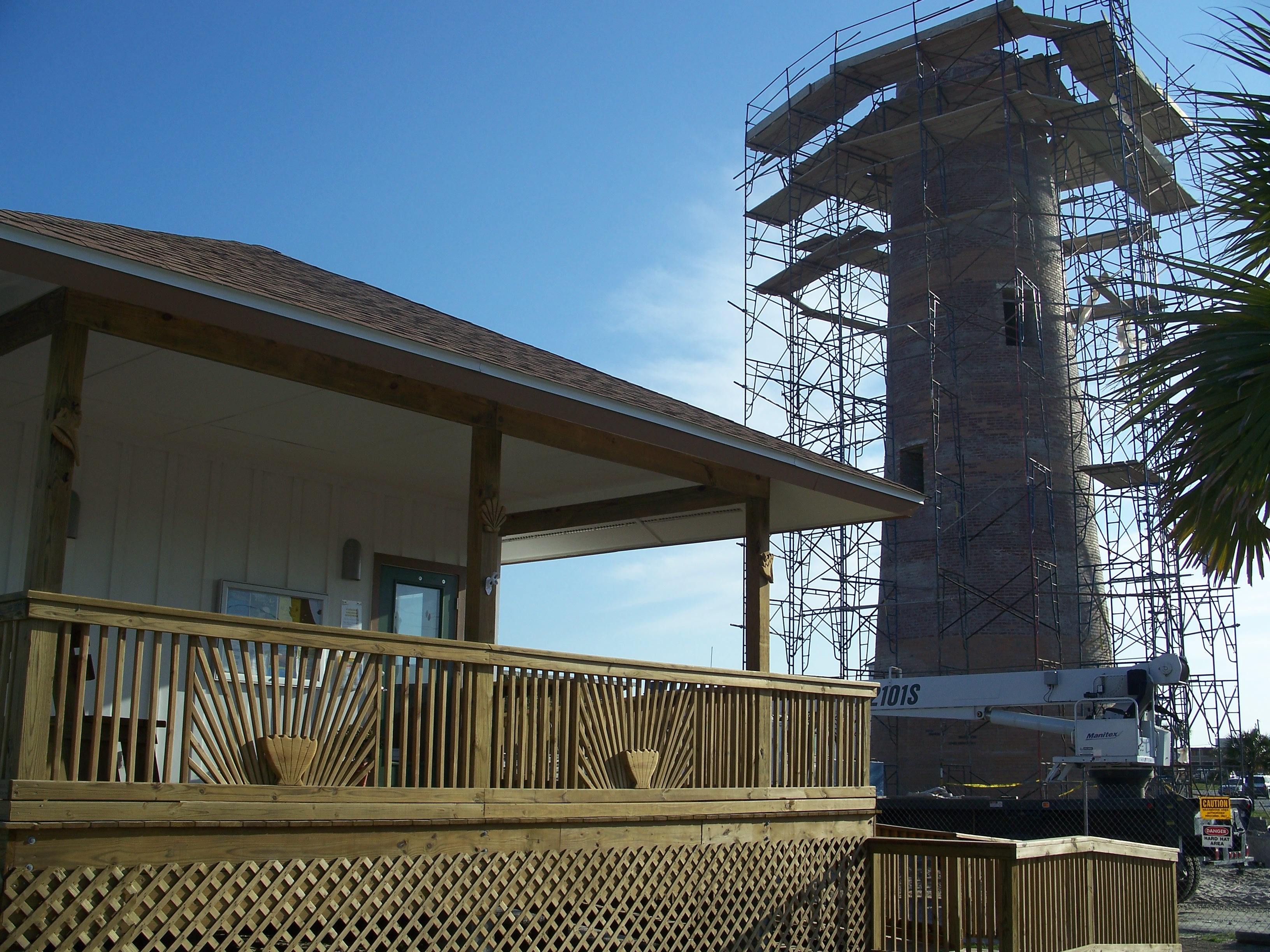
Cape St. George Light
On October 22, 2005, the brick lighthouse at Cape St. George finally lost its long battle with the Gulf of Mexico. After 153 years of standing against hurricanes, erosion, and war, the tower crumbled into the surf off St. George Island, Florida. It had been leaning for a decade, propped up and straightened by supporters who spent $210,000 trying to save it. The collapse might have been the end of the story. Instead, volunteers waded into the water, salvaged 24,000 bricks, and rebuilt the lighthouse on higher ground - proving that stubbornness runs as deep as the pine pilings the original builders drove into the sand.
A Light for the Cotton Fleet
The first lighthouse on St. George Island went up in 1833, marking the narrow entrance to Apalachicola Bay at West Pass, the channel between St. George Island and St. Vincent Island. In that era, Apalachicola was a booming cotton port, and the light guided merchant vessels navigating the shallow waters of Florida's Forgotten Coast. The original tower stood 65 feet tall and held 13 lamps with reflectors, though a revenue cutter captain reported in 1834 that he counted only 11 lamps. Because of the sharp convex bend in St. George Island's southern coast at Cape St. George, ships approaching from the eastern Gulf could not see the original light. In 1847, Congress appropriated $8,000 for a new lighthouse on the cape itself, southeast of the original site. Materials salvaged from the first tower were recycled into the second - a pattern of frugal reuse that would define this lighthouse's entire existence.
Built, Broken, Built Again
The second lighthouse lasted barely four years. A hurricane undermined it in 1850, and the fourth hurricane of the 1851 Atlantic season toppled it entirely, destroying the nearby Cape San Blas and Dog Island lights in the same blow. The third version - the one that would stand for over 150 years - rose in 1851-52, built inland from its predecessor's site. Workers salvaged two-thirds of the bricks from the ruins, drove pine pilings deep into the sand for a foundation, and erected walls of hydraulic cement that tapered from thick at the base to thin at the top. A third-order Fresnel lens gave the tower a beam visible to ships far out to sea. When the Civil War came, Confederates removed the lens and other components, hiding them first in Apalachicola and then further inland. Union forces captured the town in April 1862, but the light stayed dark until war's end. The lens was reinstalled, though its damage created a persistent "dark angle" that was not corrected until a replacement arrived in 1899.
The Long Surrender
For decades the lighthouse served faithfully, its power source evolving from whale oil to mineral oil in 1882, then to incandescent oil vapor in 1913. Automation came in 1949, ending over a century of human keepers - men like Braddock Williams, who served two separate terms between 1854 and 1874, and Edward G. Porter, who kept the light for twenty years from 1893 to 1913. The Coast Guard decommissioned the lighthouse entirely in 1994. Then nature closed in. Hurricane Opal in 1995 washed away the sand around the tower, shifted it off its pilings, and left it leaning ten degrees from vertical. Hurricane Georges battered it further in 1998. Local supporters raised $50,000, secured $160,000 from the state, and managed to right the tower and build a new foundation in 2002. But the surf kept reaching the base, the new foundation deteriorated, and on that October day in 2005, gravity finally won.
Brick by Stubborn Brick
The collapse catalyzed something remarkable. Island volunteers formed the St. George Light Association and hired a salvage company to retrieve bricks from the water. Of the lighthouse's 160,000 original bricks, 24,000 were pulled from the Gulf, and volunteers cleaned them by hand. The Association secured $525,000 in federal and state grants and chose a protected site in a county park near the center of St. George Island - far from the eroding shoreline that had doomed every previous incarnation. Local contractors donated reduced-rate labor. The salvaged bricks were incorporated into the interior lining of the rebuilt conical tower, connecting the new structure to the old in the most literal way possible. In April 2008, the restored lantern room was set in place atop the tower. The completed reconstruction opened to the public on December 1, 2008, a lighthouse reborn on its third island home.
From the Air
Located at 29.66N, 84.86W on St. George Island, a barrier island off Florida's Forgotten Coast in Franklin County. The reconstructed lighthouse is in a park near the center of the island. Apalachicola Regional Airport (KAAF) is the nearest field, approximately 15nm to the north-northwest on the mainland. Northwest Florida Beaches International (KECP) is about 55nm west. From the air, St. George Island is a long, narrow barrier island clearly visible, with Apalachicola Bay to the north and the Gulf of Mexico to the south. The cape's distinctive bend in the shoreline is apparent at lower altitudes. Best viewed at 2,000-4,000 feet AGL to appreciate the island's shape and the lighthouse's position relative to the surrounding water.