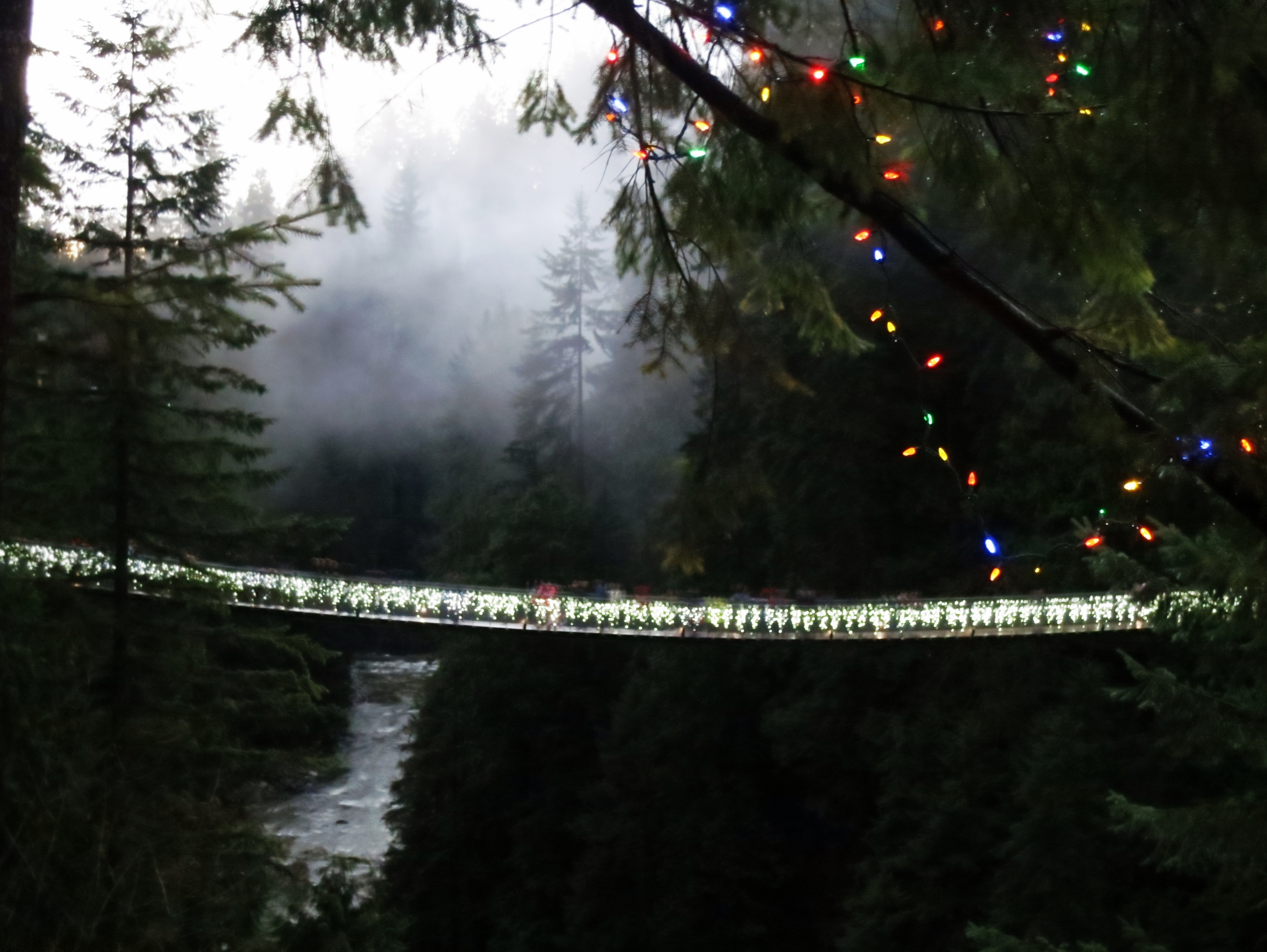
Capilano Suspension Bridge
Just minutes from downtown Vancouver, a suspension bridge spans a rainforest canyon 230 feet above the Capilano River. The Capilano Suspension Bridge has drawn visitors since 1889, when Scottish engineer George Grant Mackay built the first version from hemp rope and cedar planks. The bridge has been rebuilt multiple times - today's version uses steel cables - but the experience remains primal: 460 feet of swaying walkway over empty space, with the river rushing below and rainforest giants towering on either side. The site has expanded to include treetop walkways through old-growth Douglas firs and the Cliffwalk - a series of cantilevered platforms attached to the granite cliff face. Over 800,000 visitors annually face their fears (or confirm them) at one of British Columbia's most visited attractions.
The Original Bridge
George Grant Mackay was a Scottish civil engineer and park commissioner who purchased land along the Capilano River canyon in the 1880s. In 1889, he built a suspension bridge across the canyon using hemp rope and cedar planking - a way to access his property on the far side and perhaps a tourist draw from the start. The bridge became known as 'the bridge that keeps him on his property,' and Mackay charged visitors for the experience of crossing. After his death in 1892, the bridge changed hands multiple times. It was rebuilt with wire cable in 1903, expanded and strengthened repeatedly, and transformed into the steel-cable structure that exists today.
The Crossing
Crossing the Capilano Suspension Bridge is the main event. The bridge stretches 460 feet across the canyon, swaying and bouncing with the footsteps of fellow crossers. The walkway is 230 feet above the river - high enough that the churning water below looks small, low enough to hear it. The bridge can hold 96 people, but feels most precarious with a moderate crowd causing unpredictable movement. Some visitors stride confidently; others grip the cable railings and shuffle. Both reactions are valid - the bridge is safe but feels thrilling. Those who can't manage the crossing can observe from stable platforms on either end.
The Treetops
The Treetop Adventure, opened in 2004, extends the experience into the rainforest canopy. Seven suspension bridges connect platforms built around old-growth Douglas fir trees, up to 100 feet above the forest floor. The platforms don't pierce the trees - they're attached using compression systems that grip without penetrating. The walkway through the canopy offers a different perspective than the canyon crossing: instead of looking down at empty space, visitors are surrounded by trees at crown level, moving through an ecosystem usually seen only by birds and squirrels. The total treetop experience is 650 feet of elevated walking.
The Cliffwalk
The Cliffwalk, opened in 2011, adds another dimension of elevated anxiety. A series of cantilevered walkways and suspended bridges are anchored to the granite cliff face above the Capilano River, jutting out from the rock with seemingly nothing beneath. The engineering is impressive - 16 anchor points drilled 6 feet into the granite support the entire structure - but the visual effect is terrifying. Some sections are glass-bottomed; some extend out from the cliff at heights guaranteed to test acrophobes. The Cliffwalk is 700 feet of exposure, offering views down the canyon and across to the main suspension bridge.
Visiting Capilano Suspension Bridge Park
Capilano Suspension Bridge Park is located at 3735 Capilano Road in North Vancouver, 15 minutes from downtown Vancouver. The park charges admission (relatively expensive compared to other attractions). Hours vary seasonally; the park is open year-round. Free shuttle buses run from downtown Vancouver. The park includes the suspension bridge, Treetop Adventure, Cliffwalk, rainforest nature trails, and cultural exhibits including totem poles. The park can be crowded in summer; early morning or evening visits offer shorter lines. Canyon Lights runs during winter holiday season, with the park illuminated at night. Dress for rain - this is a coastal rainforest. YVR International Airport is 30 minutes away.
From the Air
Located at 49.34°N, 123.12°W in North Vancouver, British Columbia. From altitude, Capilano Suspension Bridge is not visible - it spans a narrow forested canyon. The Capilano River is visible descending from the North Shore mountains toward Vancouver Harbour. The Cleveland Dam and Capilano Lake are upstream. Downtown Vancouver is visible to the south across Burrard Inlet. The Lions Gate Bridge connects North Vancouver to Stanley Park. The North Shore mountains - Grouse, Seymour, and others - rise immediately behind the park. The terrain is classic Pacific Northwest - steep, forested, wet, with development clinging to a narrow strip between mountains and sea.