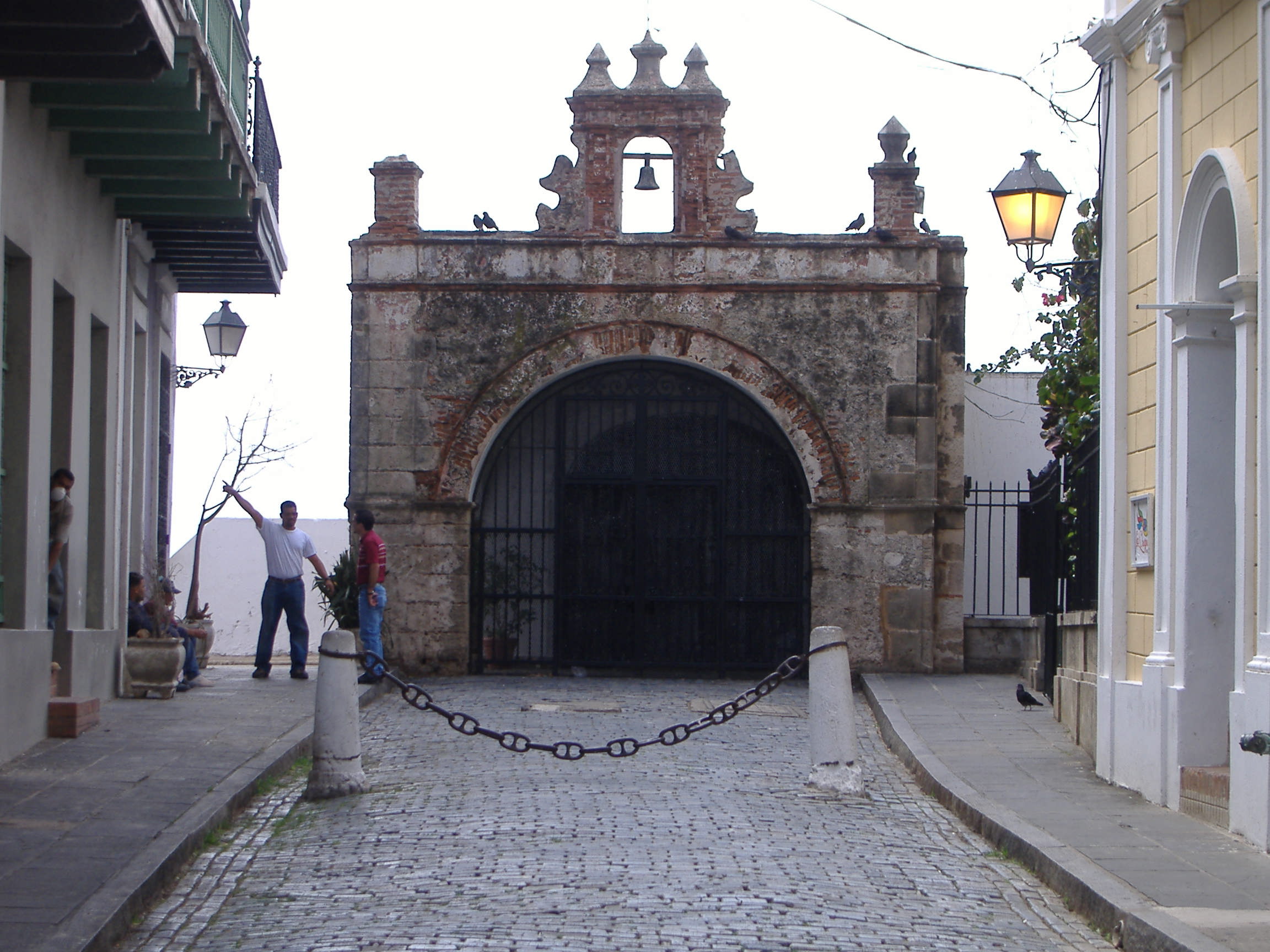
Capilla del Cristo
The story changes depending on who tells it. A young rider named Baltazar Montanez races his horse down Calle del Cristo during the annual festival of San Juan and San Pedro. The horse reaches the edge of the bluff -- and then what? In one version, someone screams for divine intervention and Baltazar survives the fall. In another, the horse dies but the rider lives. Puerto Rican historian Cayetano Coll y Toste, writing years later, described Baltazar as an enslaved man who worked in the sugar cane fields and made no mention of the legendary accident at all. Whatever actually happened, it was enough. The Catholic Church granted permission to build a chapel on the spot, and the Capilla del Cristo has stood at the end of that narrow street ever since.
Where the Street Ends
The chapel sits at the terminus of Calle del Cristo, a pedestrian walkway in the Old San Juan Historic District on the western edge of San Juan Islet. It is a tiny building -- one story of brick and stone in the Spanish Baroque style, designed by the Extremaduran architect Juan Francisco Mestre. A curved belfry tops the structure. Three oversized arches open toward the Parque de Palomas, Tetuan Street, and the street that bears the chapel's name. A wrought-iron gate, added in the 1940s, protects the interior. For a building this small, its cultural footprint is enormous: the chapel's facade appears on Puerto Rican travel guides, canvas prints, posters, and souvenir mugs. It has become one of the island's most recognized images.
Silver, Gold, and Oil Paint
The chapel opens to visitors only on Tuesdays, and stepping inside reveals why pilgrims still come. The altar is crafted from silver and gold, with most of its objects dating to 1753. Paintings by Jose Campeche -- one of Puerto Rico's most celebrated colonial-era artists -- hang on the walls, alongside a painting by Jorge Sen called El Milagro (The Miracle), which depicts the event that gave the chapel its reason to exist. Religious pilgrims occasionally leave votives at the site, small offerings of faith tucked into the space between legend and devotion. Near the chapel, La Fortaleza -- the official residence of the governor of Puerto Rico -- stands as a reminder that spiritual and political power have always lived in close quarters in Old San Juan.
The Race That Never Stopped
The annual festival that supposedly produced the miracle has its own long life. The St. Juan and St. Peter races -- Las carreras de San Juan y San Pedro -- have taken place on Cristo Street near the chapel since before the mid-19th century. The celebration predates the chapel's fame as a tourist destination by generations. In a neighborhood where every building carries centuries of layered history, the festival is a thread connecting today's Old San Juan to the colonial-era street where horses once ran and crowds once gasped. The chapel was built to memorialize a single moment of faith, but it is the annual repetition of the festival that keeps the story circulating through the district like a shared inheritance.
Icon and Archive
The chapel was surveyed by the Historic American Buildings Survey in 1933 and photographed for the Library of Congress archives -- an institutional recognition that matched the affection Puerto Ricans had long held for the structure. Built in the 18th century, it faced demolition in the 20th before being preserved, a pattern common across Old San Juan where colonial-era buildings survived not through accident but through deliberate rescue. Today the Capilla del Cristo functions as both chapel and museum, a dual identity that suits a building born from a story no one can fully verify. The miracle may be apocryphal. The faith it inspired is real, and so is the small, beautiful building at the end of the street.
From the Air
Located at 18.464N, 66.118W at the southern end of Calle del Cristo in Old San Juan, Puerto Rico. The chapel is a very small structure and difficult to identify individually from altitude, but sits within the tightly packed historic district near La Fortaleza (governor's mansion). Nearest airport is San Juan Luis Munoz Marin International (TJSJ), approximately 8 nm southeast. Best viewed below 2,000 ft AGL where the narrow colonial streets become visible.