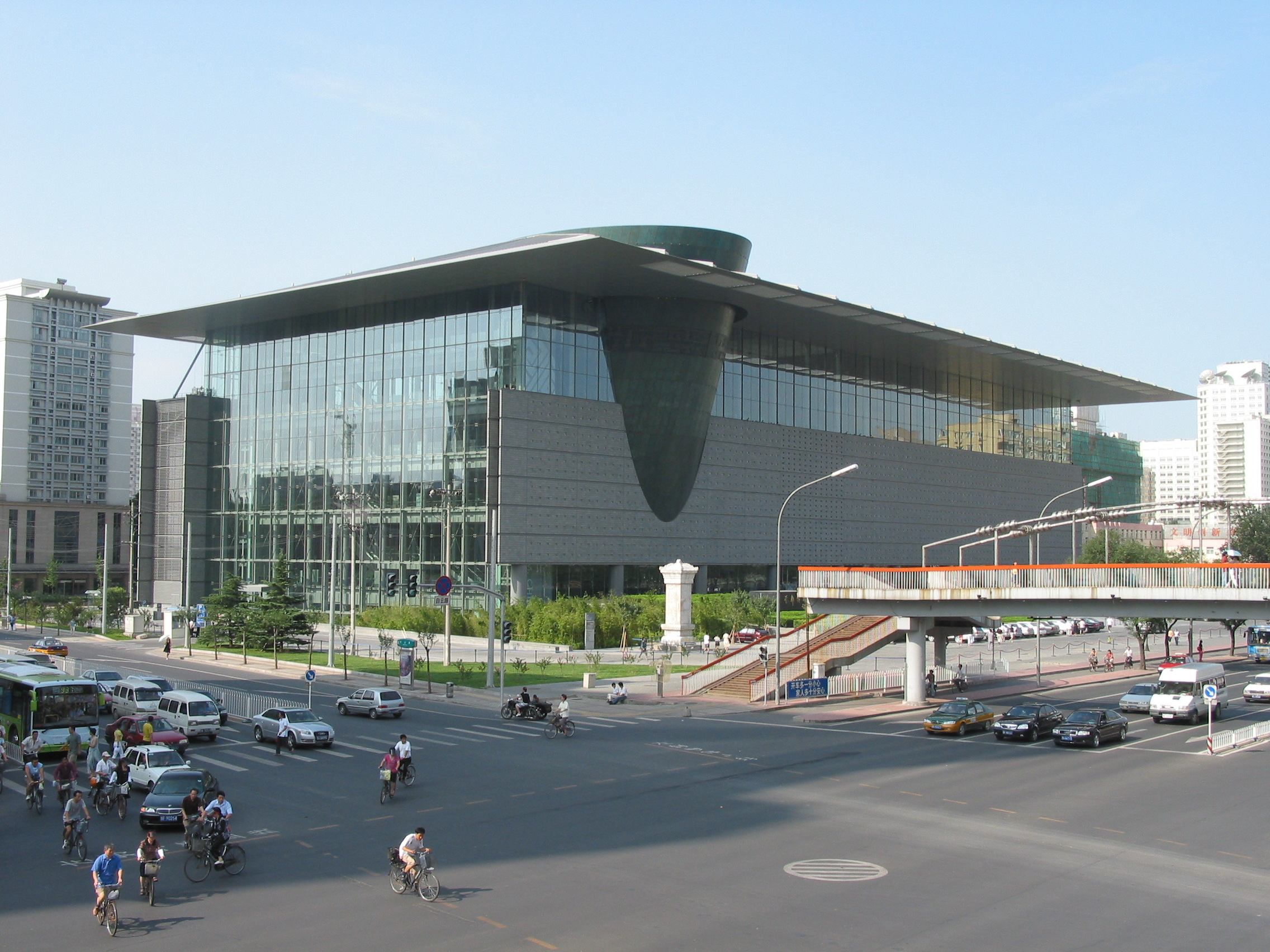
Capital Museum
Most visitors to Beijing head straight for the Forbidden City or the National Museum, and the Capital Museum is content to let them go. Quieter and more intimate than its famous neighbors, this municipal museum holds over 200,000 cultural relics -- ancient porcelain, bronze vessels, jade carvings, Buddhist statues, calligraphy, and paintings -- many of them unearthed from the soil of Beijing itself. The collection tells the story not of China in the abstract, but of this specific city across thousands of years.
From Temple to Tower
The museum opened in 1981 with its collections housed in an unlikely venue: the Confucius Temple on Guozijian Street, a serene complex of ancient halls better known for its stone-carved classics than for exhibition galleries. By 2006, the collection had outgrown its historical quarters, and the museum moved into a purpose-built structure designed to make a statement about Beijing's identity. The new building's stone exterior walls were meant to evoke the city walls and guard towers of ancient Beijing -- massive, austere, protective. A piece of danbi, a huge carved stone bearing images of dragons, phoenixes, and imperial artifacts, is embedded in the ground before the north gate. Inside the reception hall, a decorative archway from the Ming Dynasty establishes the building's "central axis," the organizing principle of traditional Chinese architecture.
Buried Beneath Beijing
What distinguishes the Capital Museum from China's national-level institutions is its focus on local archaeology. A significant percentage of the art collection comprises artifacts dug from Beijing's own ground -- objects that trace the city's evolution from a frontier garrison to an imperial capital to a modern metropolis. The porcelain ranges across dynasties, from Song-era celadons to Ming blue-and-white. The bronze collection reflects ritual practices spanning centuries. Buddhist statues from different periods show how religious art evolved alongside political power. The museum rotates its exhibitions, displaying only a small fraction of its holdings at any given time, which means that repeat visits reveal entirely different collections.
A Building That Tells a Story
The architecture is inseparable from the collection. The oval-shaped Bronze Exhibition Hall was designed to suggest the act of unearthing ancient relics: its slanting form extends from ground level upward and outward, as if the building itself were being excavated. The stone walls, the embedded danbi, the Ming archway -- each architectural element references something specific about Beijing's layered past. It is a museum that insists you cannot separate the objects from the place that produced them. Compared to the vast halls of the Palace Museum or the political monumentality of the National Museum of China, the Capital Museum offers something more personal: a city's own memory, carefully preserved and beautifully displayed.
From the Air
Located at 39.91N, 116.34E in western Beijing, near the intersection of Fuxingmen Outer Street and the 2nd Ring Road. The modern building with its distinctive stone facade and oval Bronze Exhibition Hall is visible amid the urban grid. Nearest major airport is Beijing Capital International Airport (ZBAA/PEK), approximately 28 km northeast. Beijing Daxing International Airport (ZBAD/PKX) lies about 45 km south. Best viewed at 3,000-5,000 ft.