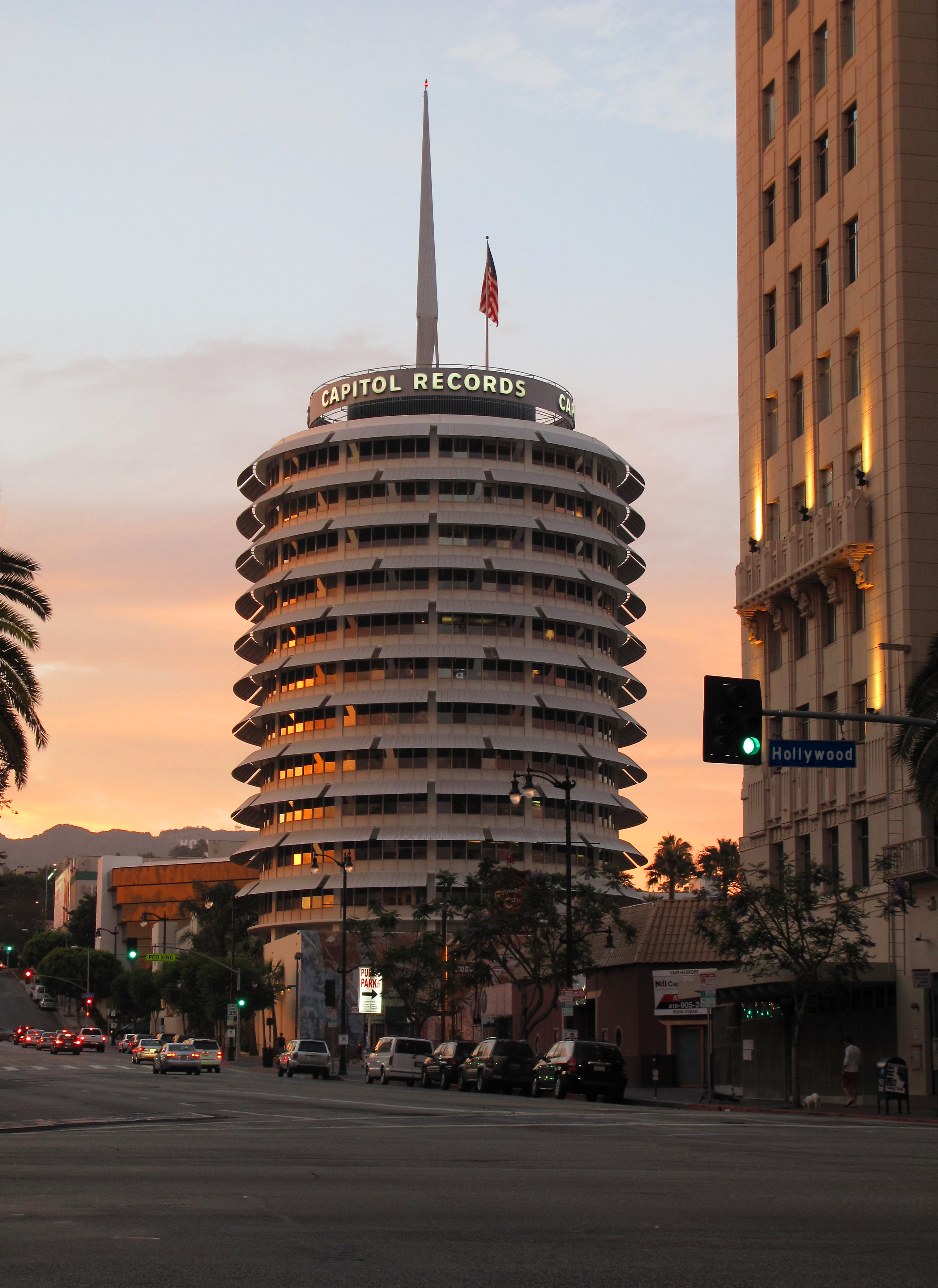
Capitol Records Building
Every night, the light at the top of the Capitol Records Building blinks a message in Morse code. Slowly, steadily, it signals the same word: H-O-L-L-Y-W-O-O-D. It's been doing this since the building opened in April 1956, an idea from Capitol Records' president Alan Livingston, who wanted to advertise the label's status as the first record label based on the West Coast. The light was switched on by Leila Morse, granddaughter of Samuel Morse, the inventor of the code. This is the kind of detail that happens in Hollywood.
A Circular Building Nobody Wanted
The design came from Louis Naidorf, who was 24 years old when he drew it for his graduate school thesis. The wide curved awnings over each story and the spike emerging from the top do, admittedly, look like a stack of records on a turntable with the spindle pointing skyward. Naidorf has always said the resemblance was coincidental—Welton Becket Associates, the firm he worked for, kept the client's identity secret during the design process. When Capitol Records' president Glen Wallichs first saw the circular design, he hated it and demanded a rectangular building. Naidorf provided both options. The company's lender sided with the round design, arguing it would attract attention and make the building easier to lease. Wallichs conceded. Construction began after EMI acquired Capitol Records in 1955 and was completed in April 1956, making the Capitol Records Building the first circular office building in Los Angeles.
The House That Nat Built
The building is nicknamed "The House That Nat Built" in recognition of Nat King Cole, whose record sales for Capitol were so enormous that they funded the company's growth into the kind of organization that could commission and fill a 13-story tower. Cole recorded at Capitol during the years when the label was building its identity as a major force in American popular music—the years of Frank Sinatra, Dean Martin, and the artists who made Hollywood the center of gravity for recorded popular sound. The 13-story building conforms to the 150-foot zoning height limit in place at the time of construction. The thirteenth floor, the Executive Level, is designated "E" in the building's two elevators—a Los Angeles solution to the traditional superstition about unlucky numbers.
Capitol Studios and the Echo Chambers
Below the tower, beneath the street, are eight echo chambers engineered by guitarist and inventor Les Paul. They are 30 feet underground, accessed from the studios above. Three main recording studios—A, B, and C—occupy the building, and they have been used by virtually every major artist who recorded for Capitol. Frank Sinatra had such a close relationship with the studios that his personal Georg Neumann U 47 microphone is still kept there and used for sessions. The first album recorded in the tower was Frank Sinatra Conducts Tone Poems of Color. In 2012, Studio A received a new mixing console designed and built for producer Al Schmitt and Paul McCartney. The echo chambers, renowned for their particular sound, have outlasted—at least in the imagination—everything else: a Life After People episode showed them surviving the building's collapse after humanity disappears.
A Los Angeles Landmark
The Capitol Records Building was designated a Los Angeles Historic-Cultural Monument in 2006 and is listed on the National Register of Historic Places. From the 101 Freeway just to the south, the tower is a constant presence—a reminder that this particular stretch of Hollywood has been, for nearly seventy years, a center of the music industry. A hand-glazed ceramic tile mural on the south wall, Hollywood Jazz: 1945–1972, restored in 2011 by artist Richard Wyatt Jr., covers the building's exterior in larger-than-life images of jazz musicians. Grand Theft Auto V modeled the fictional Badger Building on it. The blinking light at the top continues its nightly message, patient and persistent, in a code that fewer people read every year.
From the Air
Located at 34.10°N, 118.33°W at 1750 N. Vine Street, just north of the Hollywood and Vine intersection. The circular tower is distinctly visible from the air at 2,000–3,000 feet MSL and serves as an excellent landmark for the Hollywood area. Nearest airports: KBUR (Burbank, ~7 miles north), KLAX (LAX, ~14 miles southwest). The 101 Freeway passes just south of the building and is a useful navigational reference from altitude.