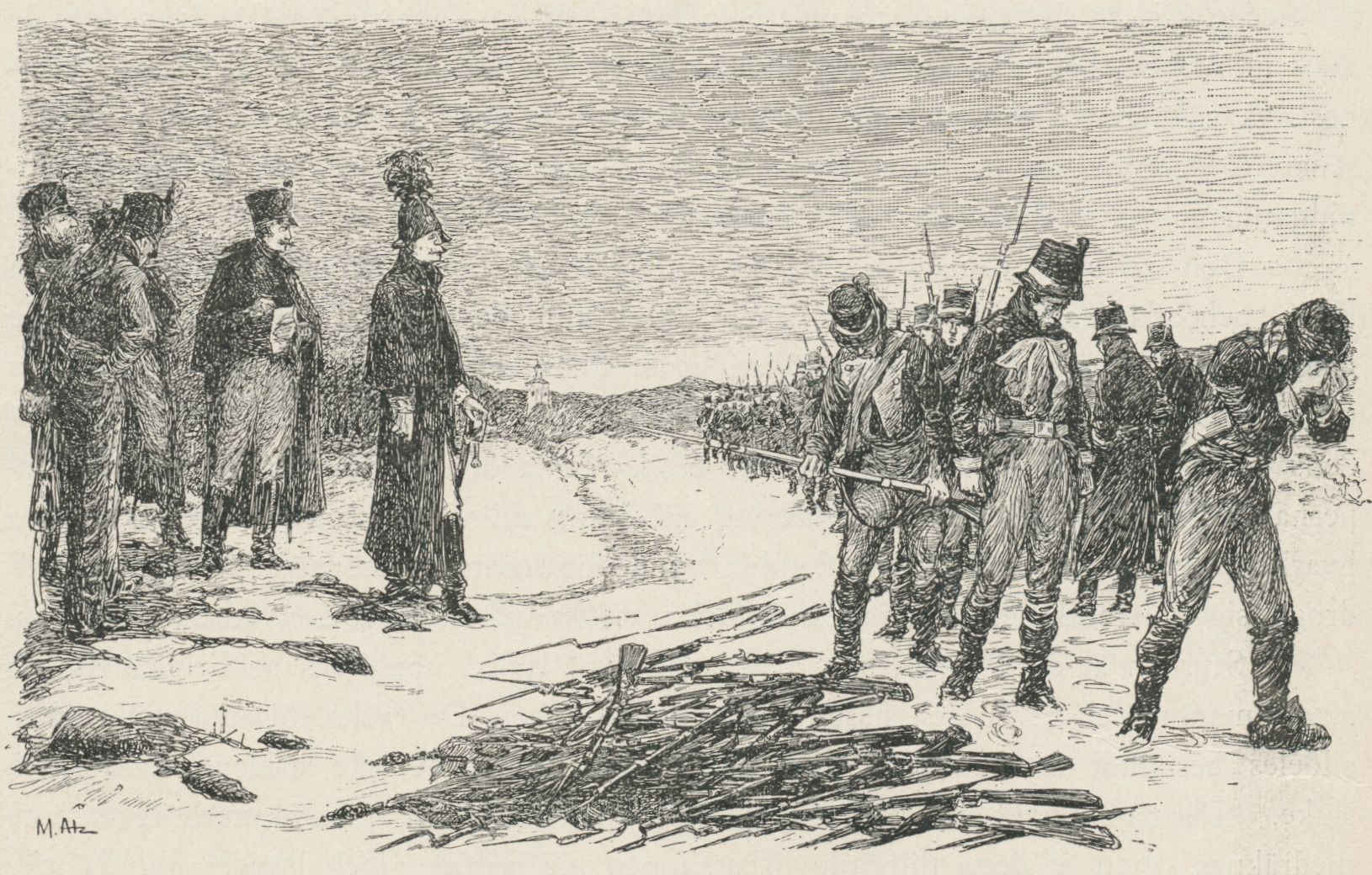
Capitulation of Kalix
The letter that doomed an army arrived while the snow was still deep on the Kalix River. On March 25, 1809, General Gripenberg read Major General Cronstedt's dispatch estimating the Russian force bearing down on them at 10,000 to 11,000 men -- a number that was wrong, but that Gripenberg had no way to verify. Believing his 3,800 to 4,500 Swedish and Finnish troops would be cut off from southern Sweden by an overwhelming enemy, he signed the Convention of Saivis and surrendered. The Swedish High Command called it treachery. The court-martial that followed would argue otherwise.
Three Blows at Once
The capitulation at Kalix was one prong of a coordinated Russian offensive designed to force Sweden into a quick peace. After conquering Finland, Emperor Alexander I ordered a threefold attack. From the south, Gotthard Johann von Knorring led a large force against the Swedish garrison on the Aland islands, aiming to use the archipelago as a springboard toward Stockholm. Across the frozen strait of Kvarken, Michael Andreas Barclay de Tolly marched 3,700 men over the ice and forced the Swedish commander at Umea to retreat on March 22. Meanwhile, a Russian corps of 9,000 pushed against the northern border along the Torne River. The timing was deliberate: Sweden was convulsing through its own revolution, having just deposed King Gustav IV Adolf in a coup on March 13. Russia struck while its enemy was divided against itself.
The Decision at the River
Gripenberg had pulled his retreating force behind the Kalix River and dug in for a delaying action. When the Russian vanguard made contact with his rearguard near Sangis, fighting broke out briefly before both sides paused to parley. Gripenberg's intelligence was grim. Cronstedt's letter painted a picture of an unstoppable Russian advance from the south, and the 9,000-man corps pressing from the north seemed to confirm encirclement. The Russians offered generous terms: Swedish and Finnish soldiers could go home as free men rather than languish as prisoners, provided they withdrew from the war entirely. Faced with what he believed was a hopeless strategic position, Gripenberg accepted. Whether this was prudent command or cowardice would become the central question of his career.
Battle-Hardened Men Walk Home
The capitulation encompassed roughly 7,075 men in total, including sick soldiers and non-combatants spread across multiple locations. The core of Gripenberg's force consisted of battle-hardened Finnish regiments -- the Abo Infantry, the Bjorneborg Infantry, the Tavastehus Infantry, the Nyland Dragoons and Jagers, and the Osterbotten Infantry among them. As the terms required, these soldiers marched south through Tornio, surrendered their weapons at Kemi Church, and then simply walked home to Finland. Not every unit complied. One battalion of the Vasterbotten Infantry Regiment refused the capitulation terms outright and fought on, only to be captured days later at the Battle of Skelleftea. The distinction mattered: for the men who chose to walk home, the Finnish War was over. For Sweden, the loss of these veterans was irreplaceable.
Treachery or Tragedy
The Swedish establishment branded the capitulation a disgrace on par with Carl Olof Cronstedt's infamous surrender of the fortress of Sveaborg. Gripenberg was court-martialed, his name blackened. Yet the judgment of history has softened. The intelligence Gripenberg received was faulty, the strategic situation genuinely dire, and the revolution consuming Stockholm had left the Swedish army without clear direction or support. The Russian threefold offensive, for all its tactical success in the north, ultimately failed to achieve the quick peace Alexander I wanted. Knorring, the Russian supreme commander, lost his position to Barclay de Tolly. The Finnish War dragged on through the summer, ending only with the Treaty of Fredrikshamn on September 17, 1809 -- the treaty that severed Finland from Sweden after six centuries of shared rule. The men who walked away from Kalix were walking into a new country, though they did not yet know it.
From the Air
Located near 65.85N, 23.17E at the Kalix River in northern Sweden, close to the Finnish border. The Kalix River valley is visible from altitude as a winding corridor through boreal forest. The town of Kalix lies along the river's lower course near the Gulf of Bothnia. Nearest airports include Lulea/Kallax (ESPA), approximately 50 km south, and Kemi-Tornio (EFKE) across the Finnish border to the east. The terrain is flat coastal lowland transitioning to forested interior, with the Torne River marking the Swedish-Finnish frontier nearby.