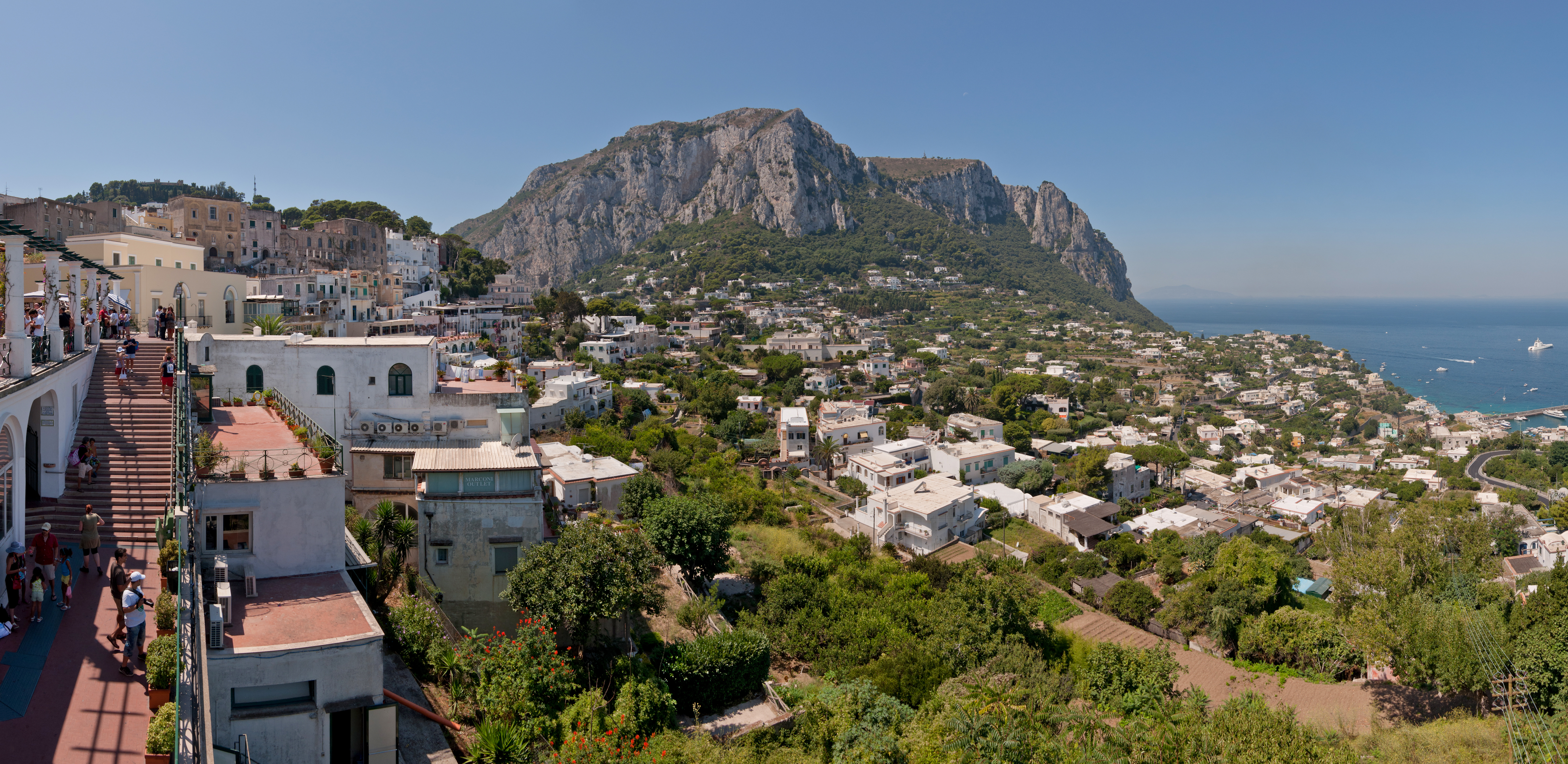
Capri
Capri has been seducing visitors since before tourism existed. The emperor Augustus traded Ischia to Naples for this tiny island; his successor Tiberius built twelve villas here and ruled the Roman Empire from its cliffs. Two thousand years later, the island still draws the powerful and the famous, though now they share ferries with day-trippers from Naples and Sorrento. The appeal is obvious from the moment the boat rounds the eastern point: limestone cliffs rising sheer from waters so clear the bottom shows at thirty feet, the whitewashed town climbing the saddle between peaks, the Faraglioni rocks standing sentinel offshore. Capri is expensive, crowded in summer, and unquestionably one of the most beautiful places in the Mediterranean - a beauty that has been making visitors abandon their plans and extend their stays since long before Somerset Maugham wrote about exactly that experience.
Two Towns
The island divides between Capri town and Anacapri, linked by a road of serpentine curves or a challenging walk up ancient steps. Capri town occupies the lower saddle, its famous Piazzetta serving as the island's living room - four cafes surrounding a tiny square where everyone eventually passes and those with time (and money) sit watching. Narrow lanes radiate outward past designer boutiques to viewpoints over the Marina Piccola and the Faraglioni. Anacapri sits higher and quieter, its whitewashed houses spreading beneath Monte Solaro. A chairlift climbs to the summit, offering views encompassing the Gulf of Naples, Vesuvius, and, on clear days, the Apennines beyond. Anacapri lacks Capri town's celebrity buzz but compensates with the Villa San Michele and its gardens, created by Swedish physician Axel Munthe as a monument to beauty and his own considerable ego.
The Blue Grotto
The Grotta Azzurra has been Capri's signature attraction since its 'rediscovery' in 1826 - the cave was certainly known to the Romans, who built a nymphaeum at its entrance. The magic happens when sunlight passes through an underwater opening, filtering through the water to illuminate the cavern in electric blue. Small rowboats ferry visitors through the low entrance (passengers must lie flat), emerging into a chamber where the water itself seems to glow. The experience is extraordinary and extraordinarily brief - crowds necessitate quick turnover, and rough seas can close the grotto entirely. Cynics note the queues, the additional boat fees beyond ferry costs, the rushed visits measured in minutes. But the blue is genuine, an optical phenomenon that no photograph captures and no description prepares you for. Swimming in the grotto after the boats stop (technically forbidden, widely practiced) ranks among Capri's legendary experiences.
Imperial History
Tiberius spent his final decade on Capri, ruling Rome through correspondence while indulging appetites that ancient historians described in lurid detail. His Villa Jovis on the island's eastern summit is the best preserved of his Caprian residences, its ruins still commanding views over the Sorrentine Peninsula. Whether the cliff called Salto di Tiberio was actually used to execute those who displeased the emperor remains disputed; the views from its edge are undeniably spectacular. Earlier, Augustus had established the imperial connection, trading the larger and more fertile Ischia because Capri charmed him - possibly the most expensive real estate transaction in Roman history. The island's later history includes Norman towers, Carthusian monasteries, and the brief British occupation that gave the Marina Grande its distinctly un-Italian harbor layout.
Natural Beauty
Beyond the grottos and the ruins, Capri offers natural landscapes that reward exploration. The Arco Naturale, a limestone arch on the island's eastern cliffs, marks the start of a walking route descending through Mediterranean vegetation to the Grotta di Matermania and eventually to the Via Krupp - the spectacular switchback path that descends to the Marina Piccola. The Faraglioni, three massive rocks rising from the sea off the southern coast, have become Capri's visual symbol, visible from multiple viewpoints and circled by tourist boats. The water quality throughout the island supports swimming of remarkable clarity; the Marina Piccola offers beach access (mostly on smooth rocks), while boat rentals allow access to quieter coves around the perimeter. Monte Solaro's summit reveals how much of Capri remains wild despite the crowds below - terraced hillsides, Mediterranean scrub, and views that Tiberius would still recognize.
Visiting the Island
Day trips from Naples (40 minutes by hydrofoil) or Sorrento (20 minutes) bring thousands of visitors daily in high season. The crowds concentrate around the ferry arrival, the funicular to Capri town, the Piazzetta, and the Blue Grotto boats - avoid these between 11:00 and 15:00 for a less hectic experience. Those staying overnight discover a different island after the last ferries depart: the Piazzetta cafes fill with residents and long-stay visitors, the footpaths empty, and the sunset views from the gardens of Augustus require no jostling. Accommodation on Capri commands prices reflecting its location and reputation; Anacapri offers marginally less expensive options. The island's pronunciation trips up many visitors: the stress falls on the first syllable - KAH-pree, not kuh-PREE - a distinction locals notice and appreciate.
From the Air
Located at 40.55°N, 14.23°E in the Tyrrhenian Sea, 5km from the Sorrentine Peninsula. The island is visible from altitude as a small limestone mass (approximately 10 sq km) with dramatic cliff faces, particularly on the southern and eastern coasts. The Faraglioni rocks are distinctive off the southeast coast. Two main settlements are visible: Capri town on the lower saddle and Anacapri higher to the west. Marina Grande harbor is on the north coast. Naples International Airport (NAP) lies 30km to the north-northwest. Sorrento on the mainland peninsula is the nearest major town.