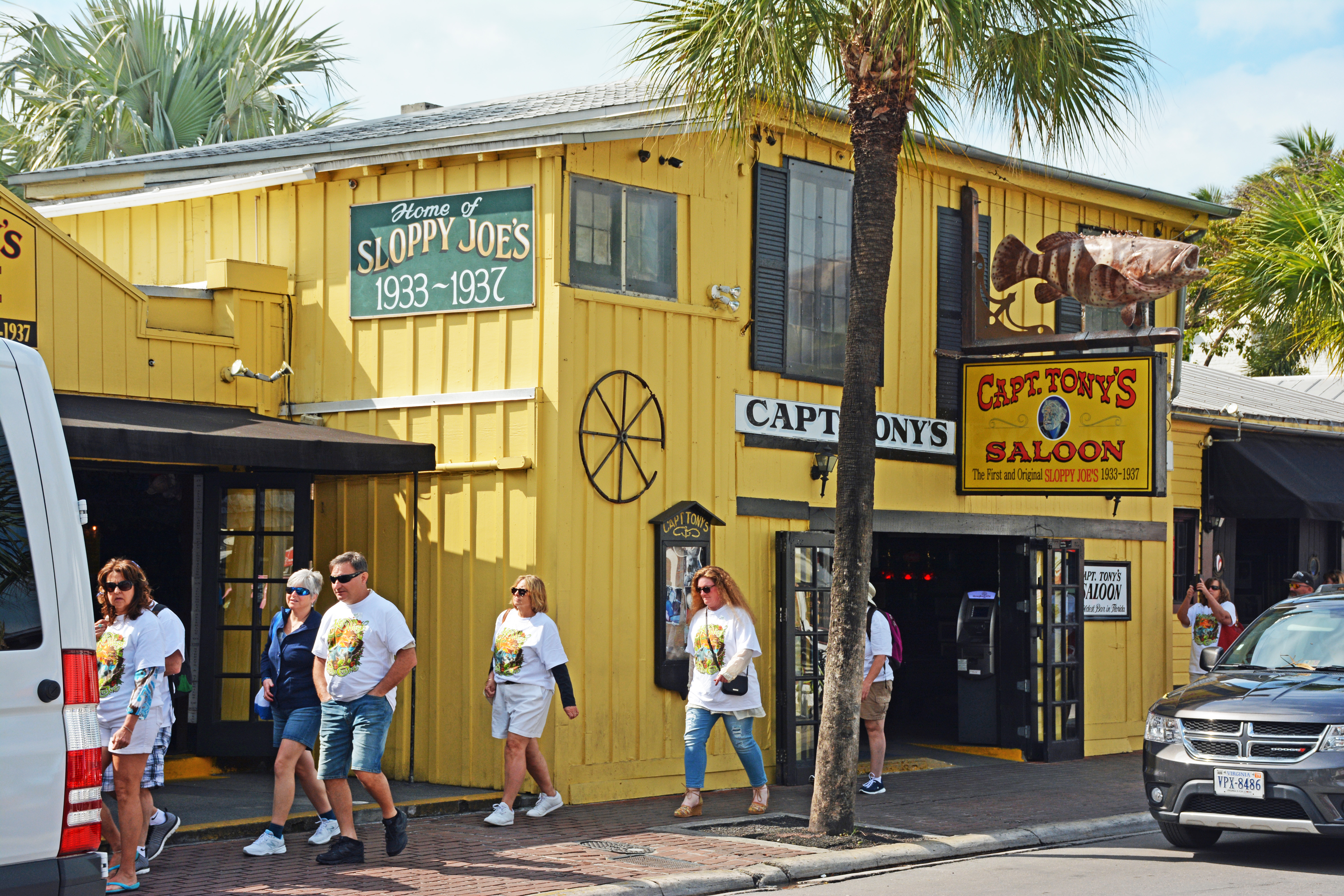
Captain Tony's Saloon: The Bar Hemingway Left Behind
When the landlord at 428 Greene Street raised the rent by one dollar a week in 1938, Josie Russell did not negotiate. He and his customers picked up the entire bar -- stools, bottles, everything -- and moved it down the block to 201 Duval Street, where it became the Sloppy Joe's that tourists line up for today. The original building sat empty. Nobody realized they had left behind the most storied address in Key West. The place where Hemingway actually drank, where the news of the USS Maine's destruction was telegraphed to the world, where bootleggers poured rum during Prohibition -- that building is Captain Tony's Saloon, and it has been accumulating history like barnacles on a hull since 1851.
Ice, Death, and Morse Code
The building at 428 Greene Street started life in 1851 as an icehouse that doubled as Key West's city morgue -- a practical combination in a tropical port town where ice was precious and bodies needed keeping cool. By the 1890s, the building housed a wireless telegraph station, and its most consequential moment came in 1898 during the Spanish-American War. When the battleship USS Maine exploded in Havana harbor, the news traveled by wire to Key West, and from this building it was relayed to the rest of the world. After the telegraph era, the building became a cigar factory in 1912, then a bordello popular with Navy sailors, and finally a string of speakeasies during Prohibition. The last of these was called The Blind Pig, specializing in gambling, women, and bootleg rum -- the full menu of illegal entertainment.
Hemingway's Real Bar
In the early 1930s, a local named Josie Russell bought the business at 428 Greene and created Sloppy Joe's Bar. Ernest Hemingway, who lived in Key West from 1931 to 1939, became a regular. Between 1933 and 1937, Hemingway spent most of his evenings here, drinking with Russell and the rotating cast of fishermen, drifters, and locals who made up Key West society. This is where Hemingway drank -- not the neon-lit tourist attraction on Duval Street that carries the Sloppy Joe's name today. That location only got the name and the furnishings after the 1938 move. The original building, the one that soaked up Hemingway's presence for years, went quiet. It passed through several owners and iterations before David Wolkowsky inherited it from his father in 1962, restored it, and named it "The Oldest Bar."
The Captain Takes the Helm
In 1968, Tony Tarracino -- a charter boat captain with a gift for storytelling and an outsized personality -- purchased the bar from Wolkowsky and renamed it Captain Tony's Saloon. Tarracino was a local legend: a New Jersey transplant who had come to Key West on a shrimp boat and never left. He ran for mayor of Key West and won in 1989. Under his ownership, the bar became a gathering place for the island's creative misfits. A tradition emerged: when a celebrity visited, a barstool would be painted with their name. The collection grew to include stools for Hemingway, Truman Capote, Jimmy Buffett, Shel Silverstein, John Prine, John F. Kennedy, and Harry Truman, among others. Above the front door, a massive Atlantic goliath grouper that Tarracino caught and had preserved watches over Greene Street. Local legend says tossing a quarter into the fish's mouth brings good luck until you leave the island.
Where Margaritaville Began
In the early 1970s, a young singer-songwriter named Jimmy Buffett drifted into Key West and started playing at Captain Tony's. He was often paid in tequila. The bar became his launchpad -- the place where Buffett developed the Caribbean-tinged, laid-back persona that would make him famous and eventually wealthy enough to build a restaurant empire. Buffett immortalized both the bar and Tarracino in his song "Last Mango in Paris." Bob Dylan, too, developed a connection to Key West that showed up decades later in his 2020 song "Key West (Philosopher Pirate)," and his name is painted on a barstool at Captain Tony's. Tarracino sold the bar in 1989 but kept showing up most Thursdays to greet customers and fans. He did this until his death in November 2008, at the age of 92.
Still Standing at 428 Greene
Captain Tony's Saloon is not polished. The ceiling is hung with bras and business cards. The walls are covered with license plates, photographs, and decades of accumulated ephemera. A tree grows through the roof. It looks nothing like the sanitized Hemingway experience available a block away on Duval Street. That is exactly the point. This building has been serving one function or another -- storing ice, storing bodies, transmitting war news, rolling cigars, pouring illegal rum, hosting America's greatest novelist, launching one of its most successful musicians -- for over 170 years. The tourists who stumble in off Greene Street are drinking in the same space where Hemingway sat, in a building that was already old when he arrived. Captain Tony's is Key West's real history, unpolished and unreconstructed, still open, still pouring.
From the Air
Captain Tony's Saloon is located at 24.559N, 81.805W in the heart of Key West's Old Town, on Greene Street one block north of Duval Street. From the air, the building is indistinguishable in the dense grid of Old Town's historic structures, but the compact downtown area between the harbor and Duval Street is clearly visible. Key West International Airport (KEYW) is on the eastern end of the island. The bar sits in the cultural core of Key West, surrounded by other historic buildings and within walking distance of the waterfront, Mallory Square, and the Hemingway Home on Whitehead Street.