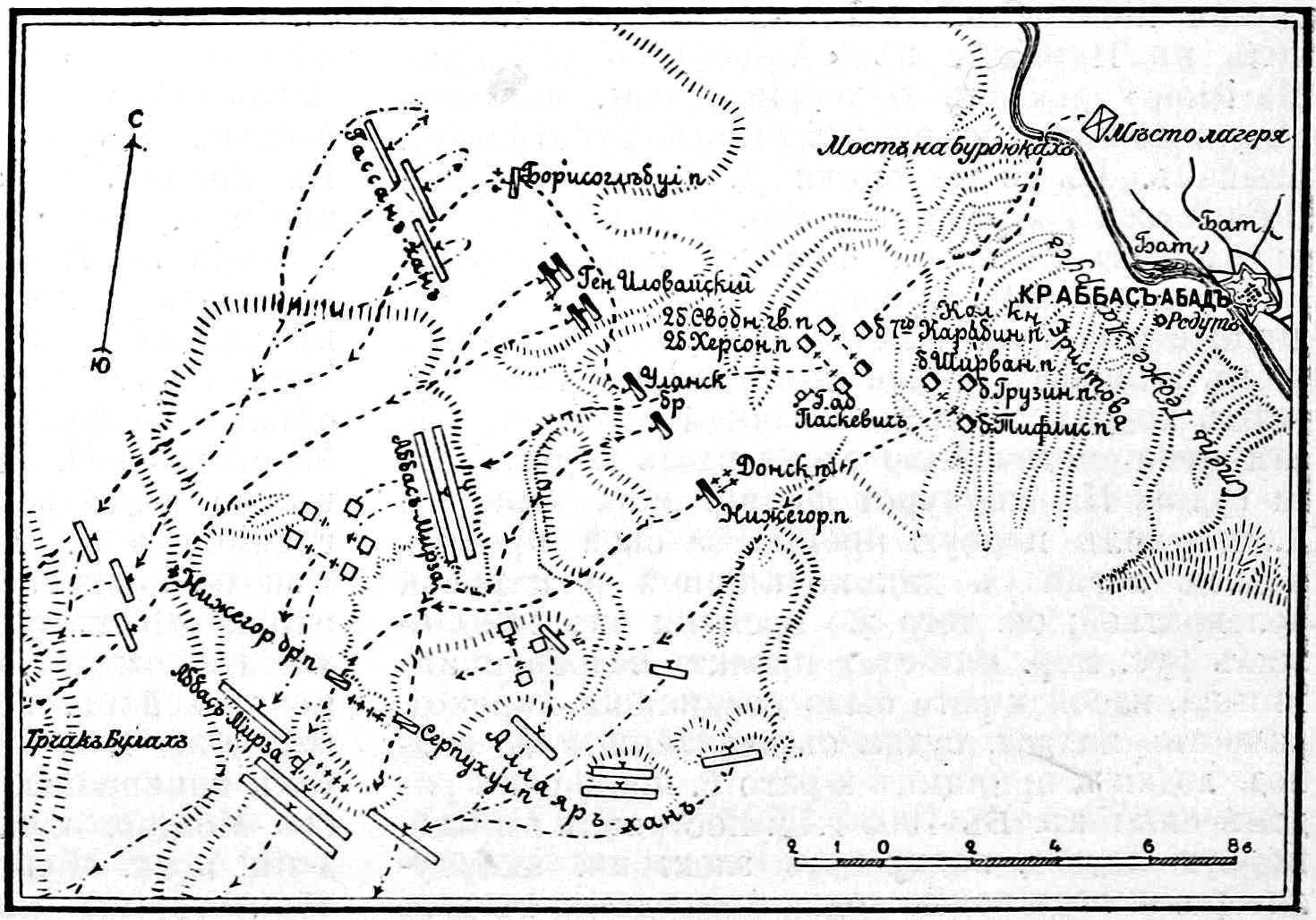
Capture of Abbasabad
The fortress fell not because its walls were breached, but because a cavalry battle 56 versts to the south shattered the army coming to save it. In July 1827, during the Russo-Persian War, Russian General Paskevich marched down the Araks River to seize the fortress of Abbasabad and the Nakhichevan Khanate. What followed was a textbook combined-arms operation: a siege to pin the garrison, a field battle to destroy the relief force, and a betrayal from within that made the final assault unnecessary. The fortress surrendered on July 19, seven days after the siege began.
Paskevich Moves South
In March 1827, infantry general Ivan Paskevich took command of the Separate Caucasian Corps and the administration of the Caucasian Territory. His first objective was to isolate the Persian garrison at Erivan by cutting off its supply lines from the south. In April, having besieged Erivan, he turned his forces toward Nakhichevan and the Abbas-Abad fortress. The force he assembled was substantial: 14 battalions, 14 squadrons, six Cossack semi-regiments, and 42 guns. Nakhichevan fell without a fight in late June. But Abbas-Abad, a stone fortress on the Araks, could not be bypassed. Paskevich knew it -- and he also knew that Crown Prince Abbas Mirza was waiting with a 40,000-strong army in a fortified camp beyond the river.
Seven Days on the Araks
Siege trenches went into the ground on July 13. By July 15, Russian artillery had punched gaps in the fortress's stone walls. The siege work crept forward to within 165 paces. Then word arrived that Abbas Mirza was marching to relieve the fortress with his entire army. Paskevich made a bold decision: he left a skeleton force of three and a half battalions and 28 guns to maintain the siege, took everything else -- all cavalry, eight infantry battalions, and field artillery -- and rode out to meet the Persian army head-on. The gamble worked. At Jevan-Bulak, Russian cavalry under Colonel Raevsky and Prince Andronnikov hit the Persian positions before Abbas Mirza could dig in. The infantry seized the commanding hill and placed their battery. The Persian army broke and fled.
Betrayal and Surrender
With the relief army scattered, the garrison of Abbas-Abad had no hope left. But the fortress might still have held out for weeks behind its damaged walls. Instead, it fell to treachery. Ehsan Khan Nakhichevansky, commanding the Nakhichevan Sarbaz battalion inside the fortress, rose up against the rest of the garrison by prior arrangement with the Russian command. His revolt from within, combined with the defeat at Jevan-Bulak, forced the fortress to surrender on the morning of July 19. The Russians took 2,700 prisoners and 23 guns. One hundred and one celebratory cannon shots were fired from the captured artillery. Paskevich received the Order of St. Vladimir, 1st degree. Ehsan Khan was given the rank of colonel and appointed administrator of the Nakhichevan Khanate.
The Road to Peace
The fall of Abbasabad opened the road to Tabriz and broke Persian control of the Nakhichevan Khanate. Alexander Griboedov, the playwright and diplomat, was dispatched to begin peace negotiations. Russian administration was imposed on the region, with a commandant installed at Abbas-Abad under Major General Baron Osten-Saken. The negotiations that followed culminated in the Treaty of Turkmenchay in 1828, which ceded the Nakhichevan and Erivan khanates to Russia and established the Araks River as the permanent border between Russia and Persia -- a border that, in altered political form, persists to this day. The fortress itself, its strategic purpose exhausted, was abandoned and fell into ruin.
From the Air
Located at 39.15N, 45.38E in the Nakhchivan Autonomous Republic of Azerbaijan, along the Araks (Aras) River. The fortress ruins sit near the river, which forms the Iran-Azerbaijan border. Nearest airport is Nakhchivan International Airport (UBBN), approximately 15 km to the southeast. The terrain is arid and relatively flat near the river, with mountains rising to the north. The battle of Jevan-Bulak took place south of the fortress along the Araks valley.