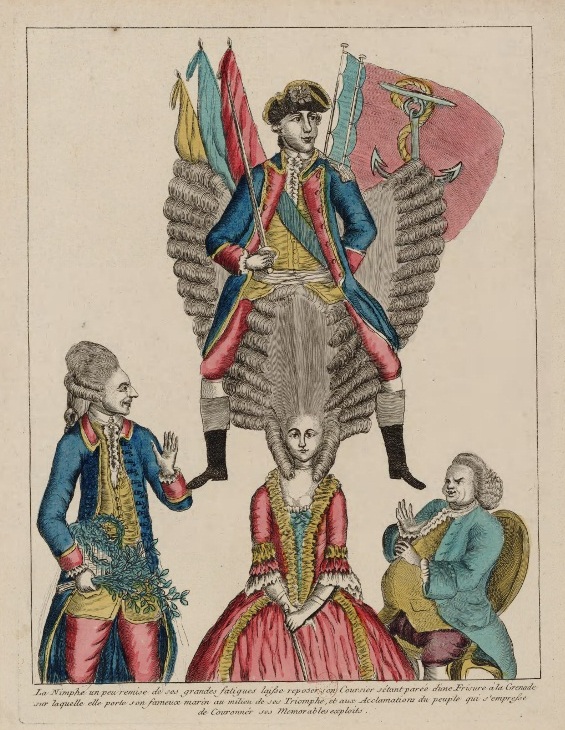
Capture of Grenada (1779)
Governor Lord Macartney had been warned, but warning without reinforcement is just anxiety with official stationery. The British governor of Grenada spent the early summer of 1779 writing urgent letters to Admiral Byron and the garrison at St. Kitts, pleading for troops and ships against a French attack he knew was coming. The replies were reassuring and useless: Saint Vincent was the French target, not Grenada. Byron would come if needed. On 2 July, when the sails of Admiral Estaing's fleet appeared off St. George's harbor - twenty-five warships and transports carrying over two thousand soldiers - Macartney had at his disposal 101 regulars from the 48th Regiment of Foot, 24 artillerymen, and roughly 400 militia he did not trust, because a third of them were of French descent.
The Richest Prize in the Windwards
Grenada in 1779 was no backwater outpost. It was one of Britain's wealthiest Caribbean colonies, its hillsides thick with sugar plantations worked by enslaved people whose labor produced fortunes shipped to London drawing rooms. Two hundred merchant ships sat in St. George's harbor the day the French arrived - a floating treasury of sugar, rum, and colonial commerce. Estaing had originally set his sights on Barbados, the crown jewel of the British West Indies, but the relentless easterly trade winds refused to cooperate. Grenada, lying conveniently downwind, became the consolation prize - though with its rich plantations and crowded harbor, consolation hardly captures the scale of opportunity that presented itself.
Bayonets on Hospital Hill
Estaing landed 2,100 troops on 2 July: 1,400 men of Dillon's Regiment and 700 drawn from the Champagne, Foix, Auxerrois, and Hainaut regiments. He sent a parley flag demanding surrender. Macartney refused. With Byron's relieving fleet potentially days away, Estaing chose speed over siege. His plan was elegant in its audacity: three columns of 300 men each would scale the back of Hospital Hill in a bayonet charge, approaching from the direction the British least expected. A small fourth force of 200 would create a noisy diversion from the predictable angle of attack. The columns moved out on the evening of 3 July, led by Arthur Dillon, Edouard Dillon, and the comte de Noailles. At four in the morning, the diversion opened fire. The three assault columns charged uphill in the dark. The British defenders panicked and fled downhill to Fort George. By dawn, the French held Hospital Hill, had captured its cannons, and trained them on the fort below. The garrison was trapped.
The Governor's Coat
What followed was unusual even by the harsh standards of 18th-century warfare. Macartney offered terms of capitulation. Estaing rejected them and countered with his own, which Macartney found so extreme that he called them "not merely unprecedented and humiliating, but so ensnaring and uncertain in their nature, extent, and aim that they might at any time supply a pretext for taking away the lives, together with the fortunes, of the capitulants." His council unanimously rejected the French terms. Instead, Macartney chose unconditional surrender - preferring to throw himself on his enemy's mercy rather than sign a document that might be weaponized later. It was a brave gamble that did not pay off. Estaing permitted his troops to pillage St. George's. They took or destroyed Macartney's silver, his clothing, and his personal papers. When the French admiral invited the British governor to dinner afterward, Macartney apologized for his appearance, noting that the coat he wore was the only one left to him.
Wounds That Outlasted the War
Estaing's victory made him a celebrity in France. The playwright Pierre-Germain Parisau staged a theatrical reenactment of the capture; John Paul Jones attended a performance in Paris. But on Grenada itself, the consequences ran deeper and lasted longer. The comte de Durat, installed as governor by Estaing, ruled harshly enough that British residents filed complaints that would echo for years. When Britain regained control under the 1783 Treaty of Paris, the returning administration cracked down on the island's French-speaking Catholic population - the very people who had lived under both flags. Resentment festered. French Grenadians began leaving for Trinidad. Those who remained grew increasingly restive, and the religious and cultural divisions that the war had sharpened eventually erupted in the Fedon Rebellion of 1795. The French also began building fortifications on Richmond Hill during their occupation, cannons pointing inland rather than seaward - a defense designed against the very attack they had just executed. The British finished those forts after 1783. The irony was permanent.
From the Air
Located at 12.05N, 61.75W, the capture centered on Hospital Hill and Fort George overlooking St. George's harbor on Grenada's southwest coast. Maurice Bishop International Airport (TGPY) lies on the island's southern point. From altitude, the distinctive horseshoe of St. George's harbor is clearly visible, with the fortified hills rising steeply behind the town. Hospital Hill and Fort George sit prominently on the headland at the harbor's south side. Richmond Hill fortifications are visible on higher ground to the east. Nearby: Carriacou (25km north), St. Vincent (120km northeast). Trade winds from the east; generally good visibility.