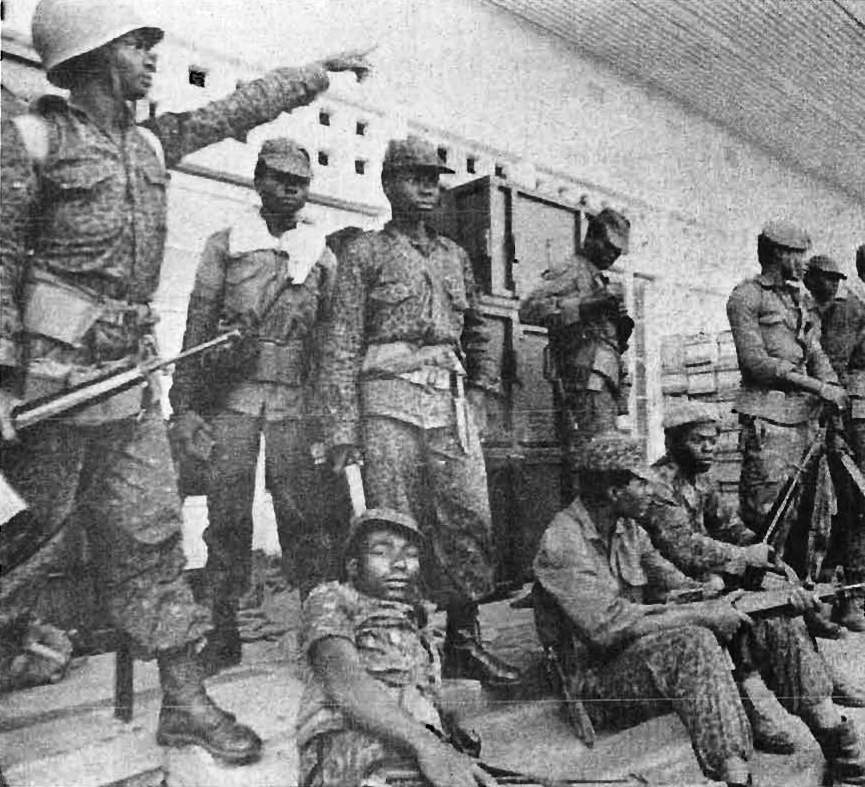
Capture of Lubumbashi
The general fled first. When fewer than 300 rebel fighters attacked Lubumbashi on April 9, 1997, General Peneloa Molanda, commander of the military region, abandoned his post before the fighting had barely begun. His departure set the tone for one of the most lopsided captures of a major African city in the late twentieth century. Within two days, Zaire's second-largest city and the capital of its richest mining province had changed hands, and the 32-year dictatorship of Mobutu Sese Seko had lost its last strategic foothold before the capital Kinshasa.
A Regime Running on Fumes
By the mid-1990s, Marshal Mobutu's dictatorship, established in 1965, was collapsing under the weight of its own corruption. His oligarchic system had ruined the country. Western allies who had once propped him up during the Cold War had stopped writing checks. Meanwhile, a catastrophe across the border reshaped the region's politics: Paul Kagame's Rwandan Patriotic Front had overthrown the Hutu regime responsible for the 1994 genocide against the Tutsis. The Interahamwe extremists who carried out the killings fled into eastern Zaire. Rwanda decided to pursue them across the border and allied itself with Congolese rebels grouped around Laurent-Desire Kabila, a longtime opposition figure from Katanga Province. The resulting Alliance des forces democratiques pour la liberation du Congo, the AFDL, swept through eastern Zaire with startling speed.
The Copper Prize
Lubumbashi was no ordinary target. The city served as capital of Katanga Province, then known as Shaba, the heart of Zaire's copper and cobalt mining industry. It was the country's second-largest city and the AFDL's last major objective before Kinshasa. The province also carried deep political significance: it was Kabila's home region and had a long autonomist tradition, having seceded in 1960 to form the independent state of Katanga before being forcibly reintegrated in 1963. Capturing Lubumbashi would give Kabila both economic leverage and symbolic authority. The mineral wealth concentrated there attracted not just rebels but the attention of international mining companies watching the war's progress with intense commercial interest.
A Three-Pronged Assault
The AFDL attack came from an unexpected direction. Rather than advancing from Likasi to the northwest or Kasenga to the northeast, the main rebel force struck from Kipushi on the Zambian border. The assault force was remarkably small -- fewer than 300 fighters. But they were reinforced by the Tigres Katangais, exile fighters under Sylvain Mbumba who had flown to Ndola in Zambia and been transported to the battle by Zambian army trucks. According to the South African newspaper The Sunday Independent, as many as 1,000 Zambian soldiers also participated. The defenders, the FAZ's 21st 'Leopard' infantry brigade of some 800 men plus units of the Civil Guard and Presidential Special Division, had heavy mortars and rocket launchers but no will to use them. Soldiers from the 21st Brigade defected to the rebels, pointing out the positions of the Presidential Guard's heavy weapons. Only the DSP troops, encircled at the airport 10 kilometers from the city center, held out until the evening of April 10 -- and even they mutinied when their officers attempted to escape.
Deals Before the Dust Settled
The speed with which business followed the battle was remarkable. Mobutu's routed soldiers and local residents looted the city, though civilian casualties remained low. The population welcomed the rebels enthusiastically. Within a week, on April 16, the AFDL signed a contract with America Mineral Fields to manage the city's mines. Two days later, the head of De Beers' Kinshasa office traveled to meet Kabila. Representatives from Goldman Sachs and First Bank of Boston followed. In early May, a US congressional delegation led by Representative Cynthia McKinney visited the rebel leader. The message was clear: whoever controlled Katanga's copper and cobalt would find no shortage of international partners.
The Announcement from Lubumbashi
The fall of Lubumbashi accelerated the collapse of Mobutu's regime. The rest of Katanga Province fell easily to the rebels. On May 16, 1997, one month after the city's capture, Mobutu fled his palace in Kinshasa. The next day, AFDL forces entered the capital. Kabila chose to make his presidential announcement not from Kinshasa but from Lubumbashi, declaring himself president of the newly renamed Democratic Republic of Congo. The choice was deliberate: Lubumbashi was his home ground, and Katanga was the source of the wealth that would sustain -- or undermine -- whatever government came next. The capture of the city had lasted barely two days. The consequences would unfold for decades.
From the Air
Located at 11.69S, 27.50E. Lubumbashi is the second-largest city in the DRC, visible from altitude as a major urban area in southeastern Congo near the Zambian border. Lubumbashi International Airport (FZQA) serves the city. The Kipushi border crossing with Zambia, through which the main rebel attack came, lies to the south. Likasi is approximately 120 km to the northwest. Elevation approximately 1,230 meters.