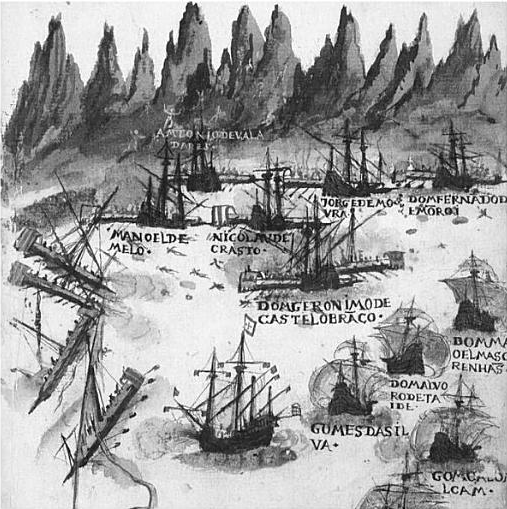
Capture of Muscat (1552)
The commander who besieged Muscat in 1552 was better known for his maps than his battles. Piri Reis, the Ottoman admiral and cartographer whose world map of 1513 remains one of the most studied documents in the history of exploration, led a fleet of galleys from Suez toward the Persian Gulf with orders to break Portuguese dominance of the Indian Ocean. Muscat, held by Portugal since Albuquerque burned it in 1507, stood directly in his path.
Empire Against Empire
By the mid-16th century, the Indian Ocean had become a chessboard for European and Ottoman ambitions. The Portuguese held a string of fortified trading posts from Goa to Hormuz, enforcing monopoly on the spice trade. The Ottomans, having captured Aden in 1548, controlled the Red Sea approaches and were pushing toward the Persian Gulf. The two empires' interests collided at every major harbor along the Arabian coast. Muscat -- still recovering from its destruction 45 years earlier -- sat at one of the critical intersections, the point where Gulf trade routes met those from India and East Africa.
Eighteen Days Under the Guns
Piri Reis, joined by the Ottoman naval commander Seydi Ali Reis, approached Muscat with a substantial fleet. The Portuguese garrison numbered only 60 soldiers under the command of Joao de Lisboa, sheltered inside the recently built Fort Al-Mirani. The Ottomans dragged a piece of artillery to the top of a ridge overlooking the fort -- a position that nullified the fort's seaward defenses. For 18 days, the garrison endured bombardment while running out of food and water. De Lisboa negotiated surrender terms, but the Ottomans took the defenders captive rather than releasing them. The fort's fortifications were destroyed before the fleet moved on.
The Wider Contest
The fall of Muscat was one move in a larger campaign. The Ottomans ultimately secured control of the coasts of Yemen, Aden, and Arabia as far north as Basra, creating a corridor that facilitated their trade with India while blocking Portuguese attacks on the Hijaz and the holy cities of Mecca and Medina. But their grip on the Omani coast proved temporary. The Portuguese recovered Muscat and, after Ottoman galleys briefly occupied the city again in 1581, retook it permanently in 1588. The Ottomans' reach exceeded their ability to hold territory so far from Constantinople, and the Portuguese -- despite their own overextension -- maintained their forts until the Omani tribes finally expelled them in 1650.
Aftermath Across Oceans
The ripples of the 1552 siege spread far beyond Muscat. The following year, Ottoman forces raided Portuguese positions along the Pearl Fishery Coast of South India near Tuticorin, assisted by Marakkar Muslims from Malabar. Seydi Ali Reis, attempting to return his galleys from Basra to Suez in August 1554, was ambushed by a Portuguese fleet in the Gulf of Oman. The contest for Indian Ocean supremacy would continue for decades, fought in harbors and on open water from the Red Sea to the Malabar Coast. Muscat's 18-day siege was a footnote in that larger story, but it was a footnote written in gunpowder and captive soldiers, and the scarred foundations of Fort Al-Mirani carry the marks of it still.
From the Air
The 1552 siege took place at Old Muscat harbor, approximately 23.61N, 58.59E. Fort Al-Mirani, which the Ottomans besieged, sits on the western headland of the harbor. The ridge from which Ottoman artillery bombarded the fort is visible in the mountainous terrain surrounding Old Muscat. The Ottoman fleet approached from the Gulf of Oman after departing Suez via the Red Sea. Nearest airport: Muscat International (OOMS).