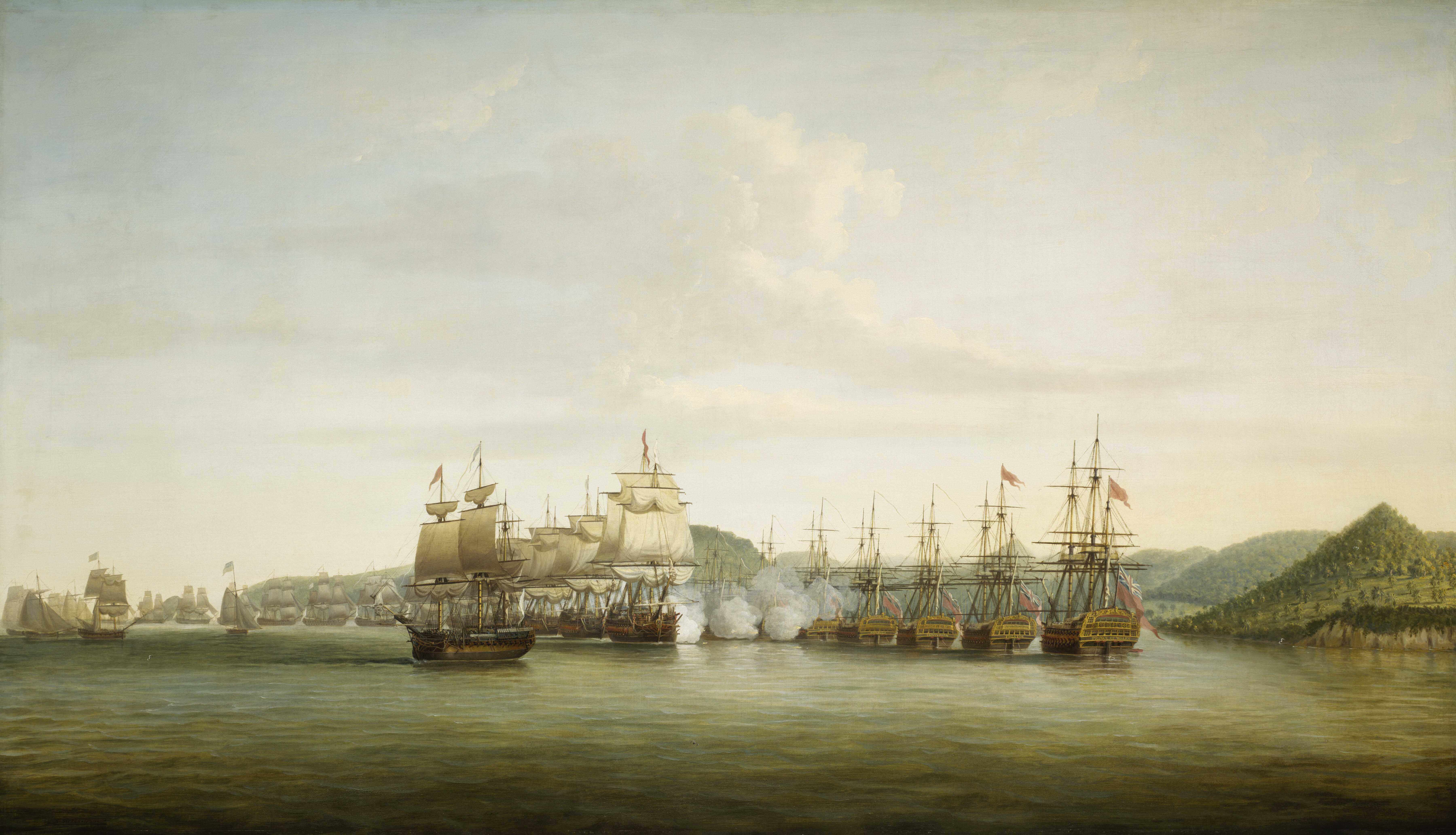
Capture of St. Lucia
The white plumes that became the trademark of Britain's 5th Northumberland Regiment began as battlefield trophies, pulled from the hats of dead French soldiers on a Caribbean hillside. It was December 1778, and the American Revolution had just gone global. France had recognized the fledgling United States, Britain had declared war on France, and the sugar-rich islands of the West Indies suddenly became a second front. St. Lucia -- a volcanic sliver of French territory between Martinique and Barbados -- sat at the center of this imperial chess match. What followed was a ten-day campaign of amphibious landings, naval engagements, and infantry assaults that would hand Britain one of its most strategically important Caribbean outposts.
The Caribbean Domino
The chain of events that brought British warships to St. Lucia began in February 1778, when France signed the Treaty of Alliance with the United States. Britain declared war on France the following month, and by September the French governor of Martinique, the Marquis de Bouille, had already struck first -- surprising and capturing the British-held island of Dominica. The loss stung. On November 4, Commodore William Hotham sailed from Sandy Hook, New Jersey, with five warships, a bomb vessel, frigates, and a convoy of 59 transports carrying 5,000 soldiers under Major General Grant. Their destination: the Leeward Islands, where Admiral Samuel Barrington commanded Britain's naval forces. The two forces rendezvoused at Barbados on December 10. Barrington wasted no time. Two days later the fleet sailed for St. Lucia, intending to seize it as a forward base for monitoring French operations across the region.
An Island Taken in a Day
The British arrived on December 13, and the invasion unfolded with startling speed. Brigadier General William Medows landed at Grand Cul-de-Sac with 1,400 troops -- flank companies from several regiments and the 5th Foot. They scaled the heights on the bay's north side and captured an abandoned gun before the French could organize a defense. Brigadier General Prescott followed with four more regiments and roughly 2,000 additional men. By December 14, Medows had taken Morne Fortune -- the fortified hilltop commanding the island's capital, Castries. The French governor, Claude-Anne Guy de Micoud, had evacuated into the jungle without firing a shot. Britain occupied the harbor at Carenage Bay without a single casualty. But Admiral Barrington knew what was coming. Word had reached him of a French fleet racing south, and he spent the entire evening of December 14 repositioning his transports behind his battle line. By the next morning, his defenses were set -- and the French fleet under Admiral d'Estaing had arrived.
Bayonets and White Feathers
What happened next was a mismatch. The French troops -- relatively green and poorly prepared -- advanced in formation against British infantry hardened by years of fighting in the American colonies. The British were entrenched and waiting. Three times the French attacked; three times they were repulsed. After the third assault, Brigadier General Medows, wounded and aware that ammunition was running low, addressed his men with a line that would enter regimental lore: "Soldiers, as long as you have a bayonet to point against an enemy's breast, defend the colours." The fourth attack never came. The disparity in casualties was staggering: the French lost 400 killed and 1,100 wounded, while British losses amounted to 25 killed and 255 wounded. In the aftermath, soldiers of the 5th Regiment collected white feathers from the hats of fallen French troops and wore them as battle trophies -- a gesture of soldierly pride that eventually became an official part of the 5th Northumberland Regiment's uniform. It is a tradition whose origins are soaked in the human cost of that hillside.
A Bargaining Chip Between Empires
Defeated at sea and on land, and facing the imminent arrival of yet another British fleet under Admiral John Byron, the French garrison surrendered on December 28. The remaining troops embarked that night, and the fleet returned to Martinique by December 30. St. Lucia proved its strategic worth almost immediately, serving as a critical resupply base for the British fleet throughout the rest of the war in the Lesser Antilles. It was instrumental in the British victory at the Battle of the Saintes in 1782, where Admiral Rodney dealt the French a crushing naval defeat. Yet the island's fate was never solely about military geography. During the 1783 peace negotiations, Britain traded St. Lucia back to France in exchange for the return of Dominica -- the same island whose capture had triggered the whole campaign. The Caribbean's colonial history is full of such cycles: islands seized, islands returned, peoples governed by flags they did not choose.
From the Air
Located at 13.88°N, 60.97°W on the island of St. Lucia in the Lesser Antilles. The key landmarks of the 1778 campaign are visible from altitude: Grand Cul-de-Sac Bay on the western coast where British troops landed, Morne Fortune (the fortified hilltop south of Castries), and Carenage Bay to the north. Castries, the capital, sits at the foot of Morne Fortune with its deep natural harbor. The Pitons are visible to the south along the coast. Nearest airports: George F. L. Charles Airport (TLPC) on the Vigie peninsula north of Castries, and Hewanorra International Airport (TLPL) at the southern tip of the island. Expect tropical maritime conditions with cumulus buildups in the afternoon.