Capture of Tucson (1862)
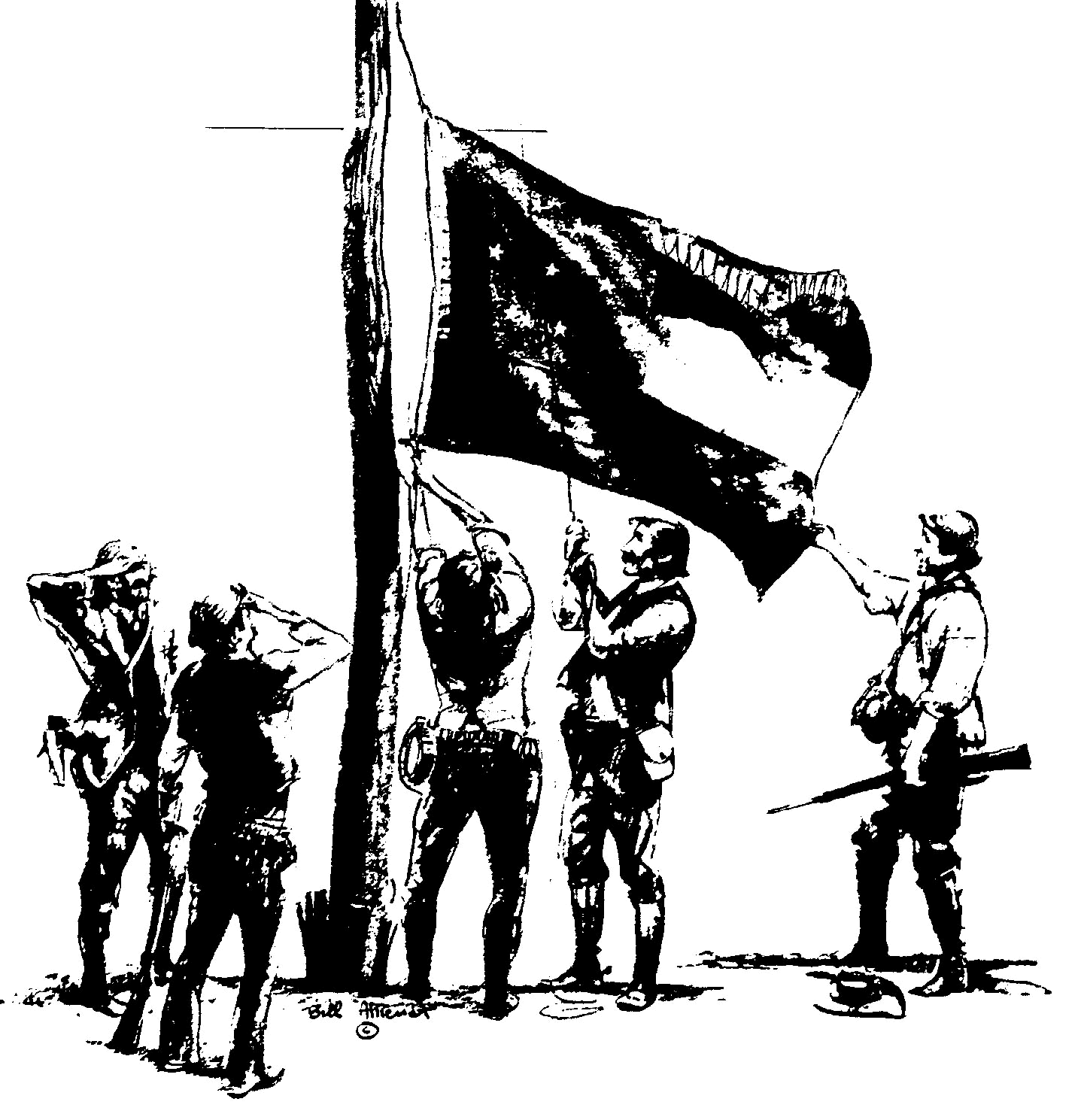
Lieutenant James Henry Tevis had been watching the wrong road. For days, the young Confederate officer and his ten-man observation force expected Union troops to approach Tucson from the west, following the Butterfield Overland Mail route from Fort Yuma. Instead, on the morning of May 20, 1862, Lieutenant Juan F. Guirado and his California Volunteers appeared suddenly from the north, riding down through the Cañada del Oro canyon. The surprise was complete. Tevis barely escaped capture, spurring his horse south and then east toward Mesilla, while Captain Emil Fritz and Company B of the 1st California Cavalry Regiment entered Tucson from the east. After 80 days under the Confederate flag, the Stars and Stripes returned to Tucson without a single shot fired. The Civil War had come to Arizona and departed with a whimper, but the consequences would reshape the Southwest.
Caught Between Wars
Before the Confederates or the Californians arrived, Tucson faced a different enemy. Apache warriors had fought a grinding war across the region, leaving the small settlement surrounded by hostile territory. The old Spanish presidio walls offered the only protection for the few hundred residents who remained. When Union troops withdrew to fight in the east and the Butterfield mail stations closed, Tucson found itself alone. The arrival of about 100 Confederate cavalrymen in February 1862 offered some hope of military support. Captain Sherod Hunter and his Arizona Rangers established a garrison, raised the Confederate flag on March 1, and attempted to forge an alliance with the Pima people. Among the Confederate reinforcements rode Jack Swilling, who would later found Phoenix in 1867.
An 80-Day Nation
The Confederate occupation of Tucson lasted just over two months, but it represented something larger than a military garrison. The Confederate Territory of Arizona, established in February 1862 with an east-west boundary, fulfilled a dream that Anglo-Arizonans had pursued for years: separation from distant New Mexico Territory. Tucsonans had petitioned for territorial status throughout the 1850s, only to watch the proposal die in Congress as Northern and Southern representatives argued over whether to divide the land east-west or north-south. The Confederacy chose the east-west line. When Union forces arrived, they brought with them the eventual promise of a different Arizona Territory, one with the north-south boundary that defines the state today.
The California Column
Colonel James Henry Carleton led over 2,000 California Volunteers on an epic march across the desert from Fort Yuma. These were not regular Army soldiers but volunteers who had joined to fight a war being waged thousands of miles away. Instead, they found themselves crossing some of the harshest terrain on the continent to chase a handful of Confederate cavalrymen. The Battle of Picacho Peak in April 1862 provided their only real combat, a skirmish that killed three Union soldiers and became the westernmost battle of the Civil War. By mid-May, Carleton's column had occupied abandoned Fort Breckinridge northeast of Tucson, and Captain Hunter ordered the evacuation of the town he could not hope to hold.
The Retreat That Never Ended
Captain Hunter's withdrawal to Mesilla marked the beginning of the end for Confederate Arizona. His company joined Lieutenant Colonel Philemon Herbert's battalion of Arizona Cavalry, officially transitioning from militia to Confederate Army soldiers. But the Battle of Glorieta Pass in New Mexico had already broken the back of General Sibley's campaign, and the Arizonans found themselves fighting a rearguard action. When they finally withdrew into Texas, they were among the last Confederate soldiers to leave the territory. The dream of a Confederate Southwest died in the desert, though it took until spring 1866 for the California Column to be relieved by Regular Army troops.
Arizona Born from Conflict
The Confederate occupation achieved what years of petitioning had not. The Union created Arizona Territory in 1863 with Tucson as its capital, using the north-south boundary that persists today. Mesilla, Pinos Altos, and other towns that had been part of Confederate Arizona remained in New Mexico Territory. More importantly, the California Column's presence provided the military protection Tucsonans had desperately needed against Apache raids. The volunteers who came to fight rebels stayed to fight a longer war against warriors who had been defending their homeland for decades. The capture of Tucson, bloodless though it was, marked the moment when Arizona's future shifted from Confederate dreams to American territory.
From the Air
The site of the 1862 capture is in downtown Tucson at 32.22°N, 110.93°W. The original presidio walls are long gone, but the Presidio San Agustin del Tucson reconstruction marks the historic location. Tucson International (KTUS) is 8nm south. Davis-Monthan AFB (KDMA) is 6nm southeast. The Cañada del Oro, where Union forces surprised the Confederates, runs northwest of the city. Picacho Peak, site of the April 1862 battle, is visible 40nm northwest along I-10.