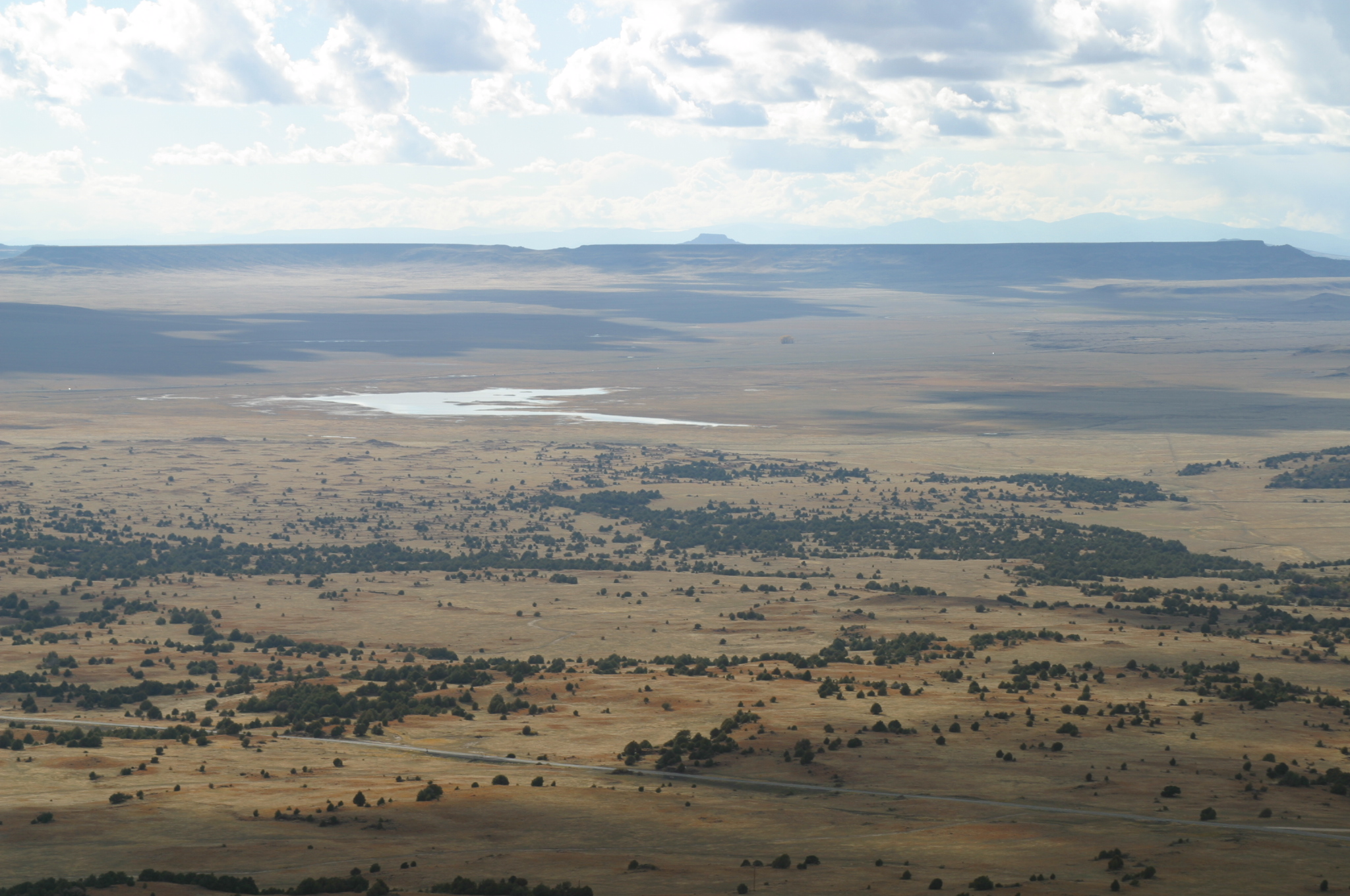
Capulin Volcano
In May 1971, Apollo 16 astronauts John Young and Charlie Duke climbed a cinder cone in northeastern New Mexico to study volcanic geology before walking on the Moon. Their instructor, William R. Muehlberger, had chosen Capulin Volcano for its textbook perfection: a symmetrical cone rising 305 meters above the surrounding plains, its 1.7-kilometer crater still sharply defined after roughly 60,000 years of wind and weather. The volcano that helped train men for another world remains one of the most accessible and visually striking volcanic landforms in the United States.
Born in Fire, Named for Fruit
Capulin Volcano last erupted approximately 56,000 to 62,000 years ago, according to cosmogenic helium and argon-argon dating techniques applied in the mid-1990s. Earlier estimates had placed the eruption as recently as 4,000 to 10,000 years ago, but modern radiometric methods pushed the date back significantly. The volcano is part of the Raton-Clayton volcanic field, a chain of extinct cones and lava flows scattered across the high plains of northeastern New Mexico. Its name comes from the Spanish word for chokecherry, Prunus virginiana, a native shrub that grows on the cone's slopes. Lava flowed from the volcano in three primary directions, with later eruptions originating from the boca, a vent at the cone's base that formed intermittent lava lakes.
A Road to the Rim
A two-mile paved road spirals from the base of the volcano to a parking lot at the rim, making Capulin one of the few volcanoes in the world you can drive up. From the top, the Sangre de Cristo Mountains line the western horizon and the surrounding volcanic field stretches in every direction. Four hiking trails fan out from different elevations: the Lava Flow Trail, a one-mile loop along the southern base; the Boca Trail, 1.7 miles around the western base where collapsed lava tubes remain visible; the Crater Rim Trail, a one-mile loop around the entire top; and the Crater Vent Trail, a short 200-yard descent into the crater itself. President Woodrow Wilson designated Capulin as a National Monument on August 9, 1916, and Congress changed its name from Capulin Mountain to Capulin Volcano National Monument in 1987.
Custodians of the Cone
The monument's first custodian was Jessie Foote Jack, a local rancher who used her husband's political connections to secure the position in 1916. Jack valued the volcano as prime grazing land, and the custodian title gave her family sole rights to run cattle on its slopes. She served until 1921, becoming the first female custodian in the National Park Service. Her successor, Homer Farr, took over unofficially at her request and held the position from 1923 to 1955. Farr built the road to the rim, secured funding during the Great Depression, and obtained a Civil Works Project to stabilize the road and construct retaining walls. The infrastructure visitors enjoy today is largely his legacy.
Where the Plains Meet the Mountains
Capulin sits at the intersection of the Great Plains grasslands and Rocky Mountain forests, creating a unique ecotone that supports 73 species of birds. Spotted towhees, Bullock's orioles, mountain bluebirds, and Steller's jays nest on the cone, while wild turkeys, ospreys, and roadrunners patrol the lower ground. Mule deer are the most common large mammals, though black bears, cougars, pronghorn, and elk all pass through. From late June to early August, a phenomenon called hill-topping blankets the rim trail with thousands of ladybugs congregating on trees and bushes. The monument also holds a botanical rarity: Solidago capulinensis, the Capulin goldenrod, a plant found nowhere else on Earth.
The Darkest Skies
Capulin Volcano holds International Dark-Sky Association Gold Tier certification, placing it among the darkest night skies in the entire country. The monument's remote location in Union County, far from any major city, means light pollution is nearly nonexistent. On clear nights, the Milky Way arches overhead in vivid detail, and constellations that vanish in urban skies stand out with startling clarity. The combination of volcanic geology by day and pristine stargazing by night makes Capulin a destination that rewards visitors who stay past sunset, standing on a 60,000-year-old cinder cone beneath a sky that has not changed since the last eruption.
From the Air
Capulin Volcano is located at 36.78N, 103.97W in northeastern New Mexico. The symmetrical cinder cone is unmistakable from the air, rising prominently above the surrounding grassland. The spiral road to the rim is visible from altitude. The Raton-Clayton volcanic field includes several other cones in the vicinity. The Sangre de Cristo Mountains are visible to the west. Nearest airports: Raton Municipal/Crews Field (KRTN) 30nm northwest, Clayton Municipal Airpark (KCAO) 30nm east, Las Vegas Municipal (KLVS) 65nm southwest.