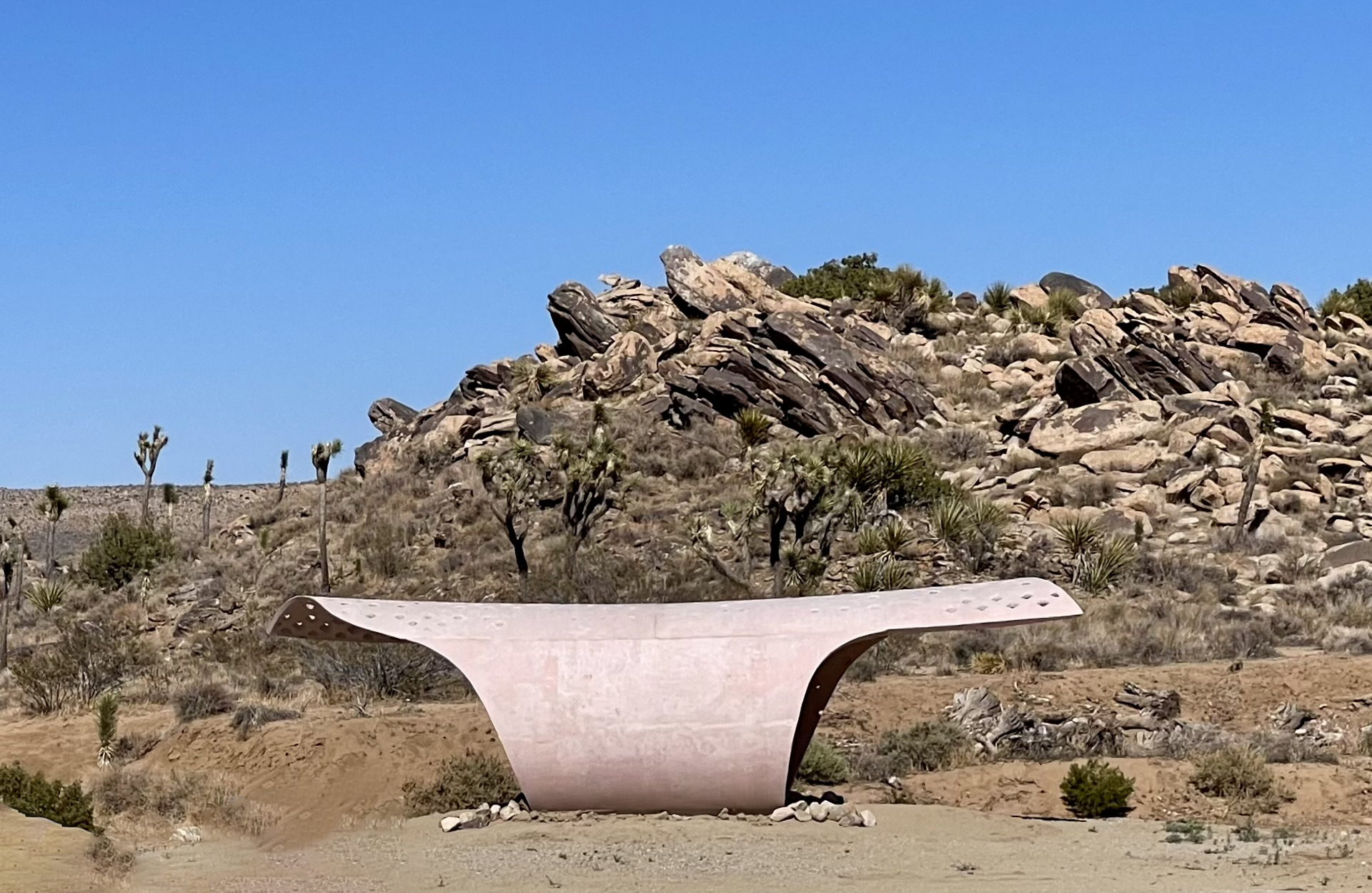
Carapace Pavilion
The cholla cactus does not look like a structural inspiration. Its skeleton of interlocking geometric channels seems too delicate, too cellular, too much like something that would collapse if you breathed on it. But cholla skeletons are surprisingly rigid — their diagrid geometry distributes loads efficiently — and when architecture students at the University of Southern California set out to design a new kind of shade pavilion for Joshua Tree National Park, the cholla gave them their structural logic.
Three Years from Concept to Canyon
The Carapace Pavilion is the result of a partnership between the US National Park Service, USC's School of Architecture, Clark Pacific Precast, and the PCI Foundation. Faculty Douglas E. Noble and Karen M. Kensek guided several hundred students through a three-year design-and-fabrication process that was, by the architects' account, 99% paperless. A graduate student wrote the custom software scripting tool that enabled the parametric design — the use of algorithms to optimize geometry against structural and environmental performance criteria. The pavilion was fabricated off-site to minimize disturbance during construction, transported to the national park as a single truck load within maximum legal dimensions, and installed in one day on June 20, 2022.
Concrete as Thin as You'd Dare
The material choice was ultra-high-performance concrete, or UHPC — a formulation so strong that the shell of the Carapace Pavilion achieves two inches of thickness in places without conventional steel rebar reinforcement. UHPC gets its strength from extremely fine ingredients, including silica fume and steel microfibers that are mixed into the matrix. The result is a concrete that behaves more like a high-performance composite than the familiar sidewalk material. The anticlastic shape — curved in opposite directions simultaneously, like a saddle — contributes structural stiffness that makes those thin sections possible. Five panels of three different types were all cast in a single mold using one deck at the precast plant, a fabrication efficiency that reflects the same geometric ingenuity as the design itself.
Calibrated to Rock
The pavilion's concrete was color-calibrated to match the existing rock formations at its Joshua Tree site — not a gray utility structure dropped into a landscape, but something attempting to grow from it. The design was inspired by the distinctive monzogranite boulders of Joshua Tree, and the reference is legible in the pavilion's organic profile and its way of sitting in the terrain. A raised-bed foundation and earth anchors were used to avoid disturbing native cultural artifacts known to exist in this area of the park. The park service has installed the external concrete shell as a functioning shade pavilion while evaluating the experimental design for its eventual primary purpose: replacing vault toilet buildings throughout the national park system with something built to the same performance standard.
A Structure That May Outlast Everything Around It
The awards have accumulated: an AIA Los Angeles Design Citation in 2021, two PCI Design Awards in 2022, a SARA California Design Award in 2023. But the specification that most precisely captures what the Carapace Pavilion represents is simpler: it is designed for a 100-year zero-maintenance lifespan. In a national park system that struggles with deferred maintenance backlogs measured in billions of dollars, a structure that genuinely requires no upkeep for a century would represent a different philosophy of public investment. Whether the full prototype — shade pavilion plus vault toilet interior — will be replicated across the park system depends on evaluations still underway. For now, it stands in Joshua Tree, casting shadow over desert granite, the cholla cactus rendered in concrete.
From the Air
Located at 34.008°N, 116.118°W in the eastern portion of Joshua Tree National Park near the Cholla Cactus Garden area, the Carapace Pavilion is too small to identify from cruising altitude but sits within the distinctive Joshua tree habitat visible as a textured landscape from 5,000–8,000 feet. The park's interior roads and visitor facilities are visible from lower altitudes. Twentynine Palms (KTNP) is approximately 12 miles to the northeast. Palm Springs International (KPSP) is approximately 35 miles to the southwest. The rock formations of the park are most dramatically visible in low-angle morning or late-afternoon light.