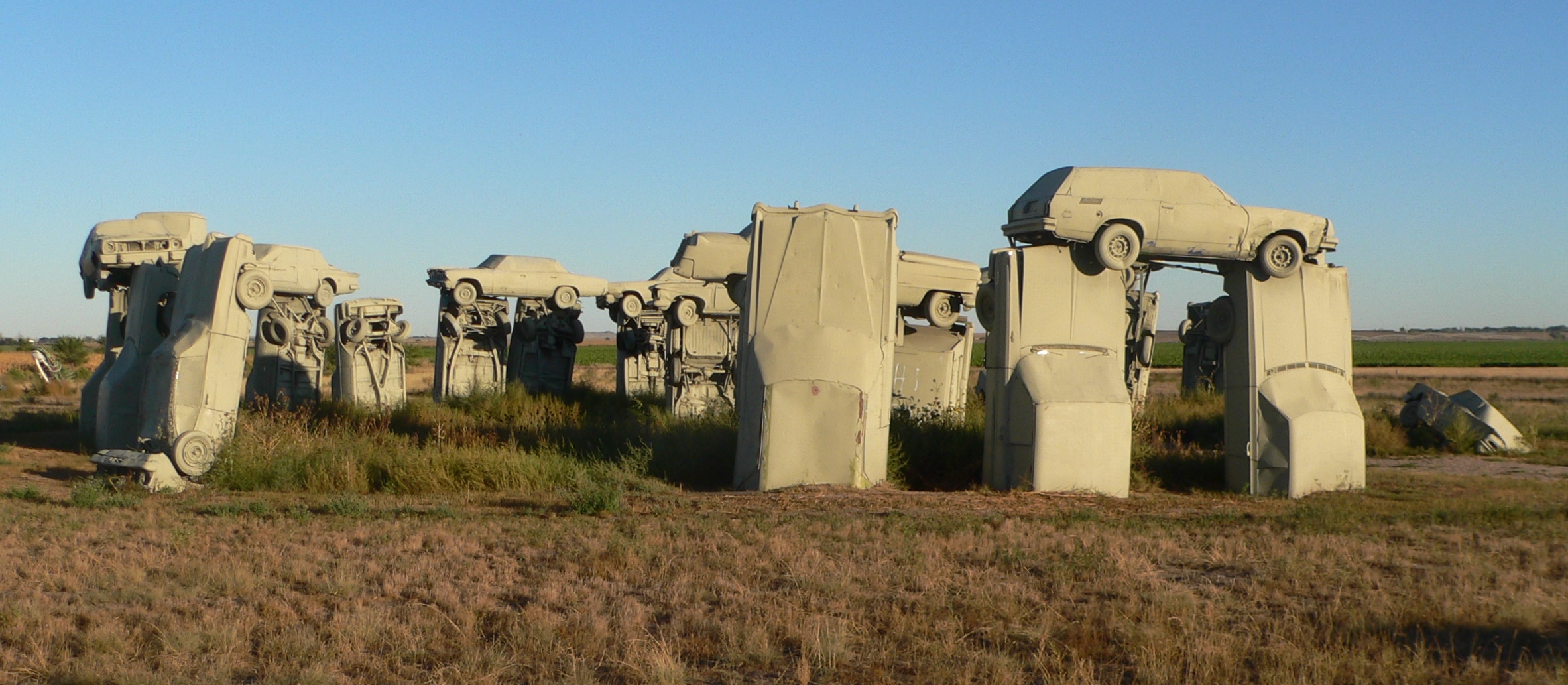
Carhenge
In the high plains of western Nebraska, just north of the town of Alliance, stands a monument that makes perfect sense if you don't think too hard about it. Carhenge is a replica of England's Stonehenge, built to the same dimensions and alignments, constructed entirely from 38 vintage American automobiles. The cars are painted gray to match the ancient stones, planted trunk-down in pits, with additional cars forming the lintels on top. Creator Jim Reinders built Carhenge in 1987 as a memorial to his father; local authorities initially tried to have it demolished as a nuisance. Public opinion intervened, and Carhenge became the most beloved piece of roadside Americana in Nebraska - a destination for tourists, eclipse viewers, and anyone who appreciates the peculiar American impulse to build things simply because we can.
The Construction
Jim Reinders, an engineer who had studied Stonehenge while living in England, conceived of Carhenge for his father's memorial. He gathered family members and 38 automobiles - mostly American sedans from the 1950s and 1960s - and constructed the monument in June 1987 on the Reinders family farm. The cars are arranged precisely according to Stonehenge's dimensions: the heel stone, the outer circle, the inner horseshoe, all reproduced in automotive form. Cars were buried trunk-down five feet into the Nebraska soil, with others welded atop to form the trilithons. The completed monument was spray-painted gray, unifying the various car colors into a cohesive stone-like appearance.
The Controversy
Alliance's city officials were not amused. They saw Carhenge as an eyesore, a junkyard masquerading as art. Reinders was ordered to remove the cars. He refused. A zoning dispute ensued. But public opinion turned decisively in Carhenge's favor - visitors arrived immediately, finding the monument delightful, and media coverage was uniformly positive. The city relented. A nonprofit was formed to maintain the site. Carhenge became Alliance's primary tourist attraction, drawing visitors from around the world. The city that tried to demolish it now promotes it enthusiastically. Sometimes eccentricity wins.
The Car Art Reserve
Carhenge inspired further car-based art. The surrounding Car Art Reserve features additional sculptures created from automobile parts: a spawning salmon, a carved chest, a dinosaur skeleton, and various abstract works. Some were created by Reinders; others were contributed by artists who found the site inspirational. The reserve transforms a single eccentric monument into a sculpture garden celebrating automotive creativity. The pieces range from whimsical to impressive, unified by their automotive medium. Each visitor has their favorites; the main attraction remains the original Carhenge, but the reserve extends the experience.
The Eclipses
Carhenge's location put it in the path of the 2017 total solar eclipse, drawing thousands of visitors who wanted to see totality over the automotive monument. The site became one of the most photographed eclipse locations in America. The combination of astronomical alignment (Carhenge, like Stonehenge, is oriented to the summer solstice) and celestial event created an irresistible draw. Alliance expected 2,000 visitors and got 10,000. The 2024 eclipse, while not total at Alliance, still drew significant crowds. Carhenge has become associated with celestial observation, fulfilling in automobile form the astronomical purpose of its ancient inspiration.
Visiting Carhenge
Carhenge is located 2.5 miles north of Alliance, Nebraska, on Highway 87. The site is free to visit, open 24 hours. A visitors center sells souvenirs and provides information. The site is unstaffed much of the time; visitors explore at their leisure. Alliance has basic services - motels, restaurants, fuel. The nearest larger city is Scottsbluff (60 miles west). Denver International Airport is 275 miles south. Interstate 80 passes 60 miles south. The site is best photographed at dawn or dusk; summer solstice sunrise aligns with the heel stone, as at Stonehenge. The high plains can be extremely hot in summer and cold in winter - dress accordingly.
From the Air
Located at 42.14°N, 102.86°W in the Nebraska panhandle. From altitude, Carhenge appears as a circular arrangement of gray objects north of Alliance - the pattern unmistakably Stonehenge-like even from above. The surrounding terrain is flat high plains - agricultural land, scattered ranches, the grid of rural roads. Alliance is visible as a small town to the south. The Sandhills begin to the east. Scottsbluff is 60 miles west. The isolation is striking - Carhenge sits in vast open country, a monument to human whimsy in the middle of nowhere.