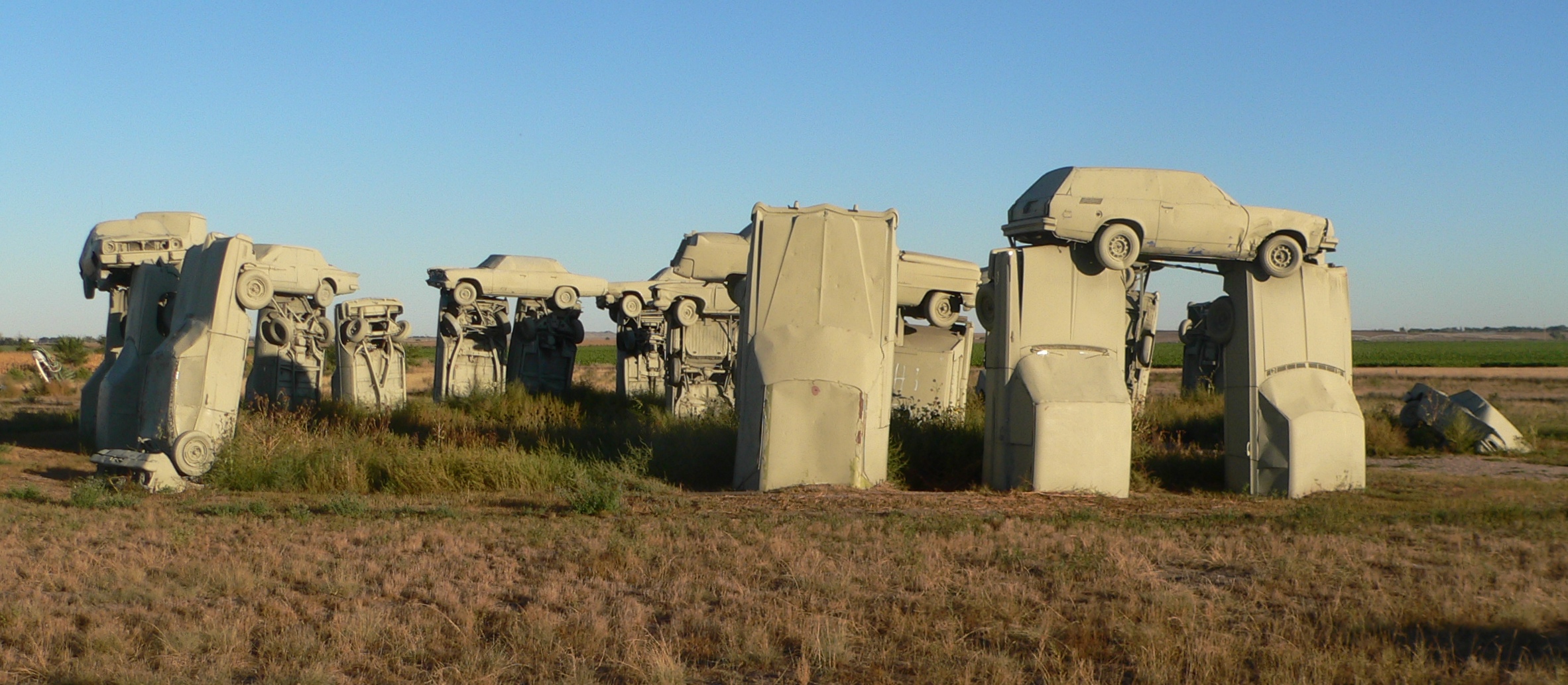
Carhenge: Stonehenge, But Make It American
Jim Reinders wasn't trying to be profound. When his father died in 1982, Reinders wanted to build a memorial - and his family had a lot of old cars, and he'd always liked Stonehenge. So in 1987, he and relatives positioned 39 vintage automobiles in a Nebraska field, replicating the English monument's layout at roughly the same scale. The cars stand upright, buried trunk-down, spray-painted gray to suggest ancient stone. The effect is absurd, reverent, completely American: a monument to the impulse that makes roadside attractions possible. Carhenge draws thousands of visitors annually who photograph themselves among the automotive megaliths, celebrating the beautiful pointlessness of it all.
The Construction
Jim Reinders studied Stonehenge during years working in England, measuring the monument's dimensions and understanding its astronomical alignments. When he returned to Nebraska, he applied that knowledge to automobiles. The 1987 construction used 39 cars from family members and junkyards, mostly American models from the 1950s through 1970s. Locals helped bury the cars vertically, stack others horizontally as lintels, and position everything to match Stonehenge's layout. The central 'heel stone' is a 1962 Cadillac. The whole thing was spray-painted gray, unifying the different vehicles into something resembling ancient stone. From a distance, if you squint, it works.
The Controversy
Alliance, Nebraska, wasn't thrilled initially. The city council considered the sculpture an eyesore, demanding its removal. Reinders offered to donate it to the city; the city refused. Public opinion shifted as visitors began arriving - curious travelers attracted by the sheer weirdness of a car-henge in the Great Plains. By 2013, the city had accepted the donation, recognizing that Carhenge was becoming a legitimate tourist attraction. What seemed like a joke became an economic asset. Alliance learned what Route 66 towns had discovered decades earlier: American tourists love absurdity, especially absurdity committed to with total sincerity.
The Expansion
Carhenge now anchors the 'Car Art Reserve,' a sculpture garden featuring additional automotive artworks. A 'Fish' made of car parts. 'Ford Seasons,' showing a partially buried sedan for each season. A 'Spawning Salmon' made of car hoods. The reserve accepts submissions from artists working in automotive materials. The surrounding prairie provides backdrop; the sculptures provide content. The site has evolved from single monument to outdoor museum, all unified by the theme of cars-as-art-material. Jim Reinders died in 2021, but his creation continues, the strangest thing for miles in any direction.
The Experience
Visiting Carhenge is free. There's no admission booth, no gift shop (well, a small one), no interpretive signage explaining what Stonehenge meant to the druids. It's just cars standing in a field, arranged in a circle, painted gray. Visitors walk among them, touch them, photograph them against Nebraska's enormous sky. The experience is whatever you bring to it: ironic appreciation, genuine wonder, family photo opportunity, meditation on mortality and automobiles. The site is open 24 hours; visiting at sunrise or sunset produces dramatic shadows. Carhenge doesn't try to be profound. It just is what it is: dedication made visible.
Visiting Carhenge
Carhenge is located 2.5 miles north of Alliance, Nebraska, on US-385. Admission is free. The site is open 24 hours, though the gift shop has limited hours. Alliance is in the Nebraska Panhandle, roughly 60 miles south of South Dakota and 350 miles from Denver. The drive from anywhere is long; Carhenge is not near other attractions except the Nebraska Sandhills, which are beautiful in their emptiness. The town of Alliance offers basic services. Scottsbluff, 50 miles southeast, provides more options. The summer solstice draws crowds for sunrise alignment viewing. Winter visits offer isolation and drama. The site rewards pilgrimage; you have to want to be there to get there.
From the Air
Located at 42.14°N, 102.86°W in the Nebraska Panhandle, 2.5 miles north of Alliance. From altitude, Carhenge is visible as a circular arrangement of gray objects in an otherwise empty agricultural landscape - recognizable to anyone who knows Stonehenge's layout, baffling to anyone who doesn't. The surrounding terrain is classic Great Plains: flat to rolling, agricultural, enormous. Alliance appears as a small city to the south. The isolation is the point: Carhenge demands effort to reach, which filters visitors to those who genuinely want the experience. The cars look like stones from altitude. The joke works at every scale.