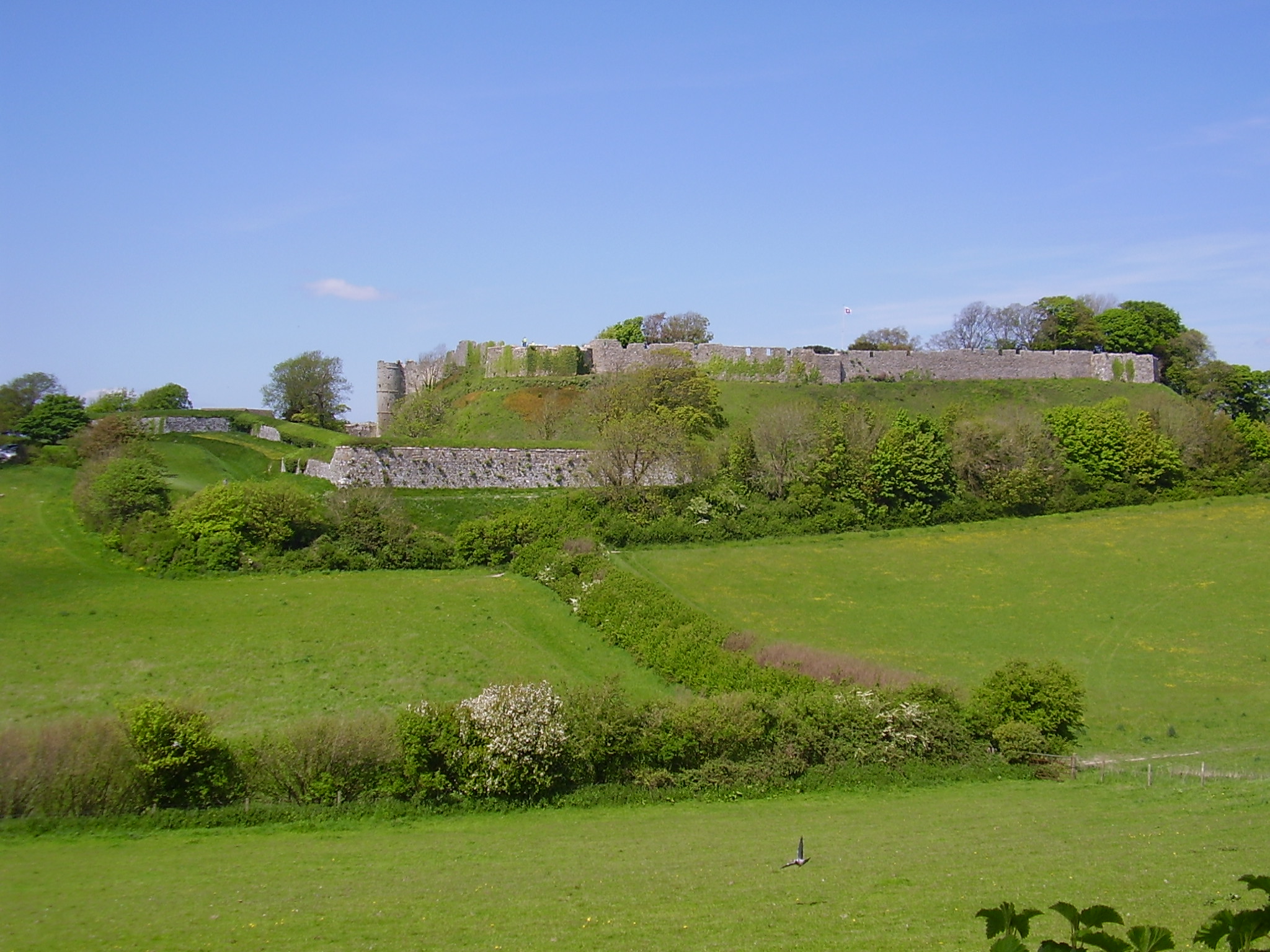
Carisbrooke Castle
Charles I tried to escape from Carisbrooke Castle in 1648. He got his head through the bars of his window but his body would not follow. Within a year he was dead, executed at Whitehall. The window and the room where he spent fourteen months as prisoner are still there, inside the strongest castle on the Isle of Wight -- a place whose history stretches from Roman ruins beneath the foundations to the earthworks an Italian engineer designed against the Spanish Armada.
Layers Beneath the Stone
The hilltop above Carisbrooke village has been fortified for at least 1,500 years. A ruined wall suggests a Roman building stood here in the late imperial period. The Anglo-Saxon Chronicle records that Wihtgar, cousin of King Cynric of Wessex, died in AD 544 and was buried on this site. By the 8th century, an Anglo-Saxon stronghold occupied the hilltop, and around AD 1000 a defensive wall was raised against Viking raids. The Norman arrival brought stone and permanence. From 1100, the Redvers family held the castle and improved it over two centuries with stone walls, towers, and a keep, until Countess Isabella de Fortibus sold it to Edward I in 1293. From that point forward, Carisbrooke belonged to the crown, its governance entrusted to a series of wardens.
The King's Prison
When Charles I fled to the Isle of Wight in November 1647, seeking refuge during the Civil War, he found not sanctuary but captivity. The Parliamentary governor confined him to Carisbrooke, where he was held for fourteen months. The Constable's Chamber became his bedroom -- a large room in the castle's medieval section that today still contains his bed. Charles attempted escape in the spring of 1648 but was defeated by the iron bars of his window, a humiliation that sealed his fate. His captivity ended only when he was taken to London for trial and execution in January 1649. In 1904, the chapel of St Nicholas within the castle walls was rebuilt and reconsecrated as a national memorial to the doomed king.
Armada Earthworks and Island Defenses
The castle's most dramatic physical transformation came in the 1580s, when the threat of the Spanish Armada prompted Elizabeth I to order massive new fortifications. Sir George Carey, appointed Governor of the Isle of Wight in 1583, oversaw the work designed by the Italian engineer Federigo Gianibelli. Enormous earthworks were thrown up around the medieval walls, creating a ring of bastioned defenses that the French had failed to breach during their 1377 attack, when local hero Peter de Heyno reportedly shot the French commander. The outer gate, completed in the 1590s, still bears the date 1598 and the arms of Elizabeth I. Seventy-one steps lead up to the keep today, and from its summit you can see across much of the island -- though unlike many English castles, Carisbrooke does not dominate its countryside so much as watch over it.
Echoes Across the World
Princess Beatrice, Queen Victoria's youngest daughter, served as the last Governor of the Isle of Wight to use Carisbrooke as an official residence, occupying the main rooms until the 1940s. She left her mark in the Constable's Chamber, which she used as a dining room and decorated with her collection of stag and antelope heads -- a curious counterpoint to the bed of the executed king. The castle's influence reached far beyond the Solent: James Macandrew, one of the founders of the New Zealand city of Dunedin, visited Carisbrooke and was so taken with it that he named his estate Carisbrook, a name that eventually passed to Dunedin's main sporting venue. Today, managed by English Heritage, the castle received over 131,000 visitors in 2019, including those who come to see the famous donkey wheel -- a deep well whose treadmill, cited by Wyndham Lewis as a metaphor for the way machines impose a way of life on human beings.
From the Air
Located at 50.69N, 1.31W on the Isle of Wight, near Newport. The castle sits on a hilltop south of Carisbrooke village and is visible from moderate altitude. Nearest airport is Sandown/Isle of Wight (EGHN). Approach from the Solent for dramatic views of the island's northern coast. Best viewed at 1,500-2,500 ft AGL.