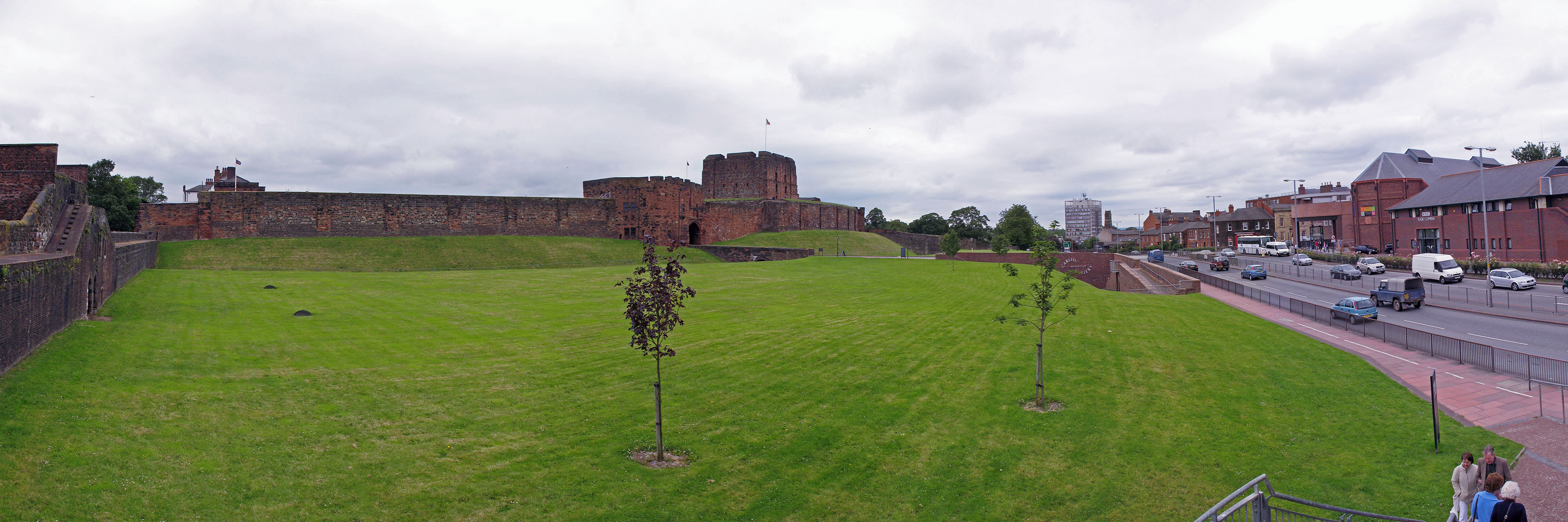
Carlisle Castle
Some accounts say it is Camelot. The claim is unprovable, of course, but the impulse behind it is understandable. Carlisle Castle has occupied this site near the ruins of Hadrian's Wall for more than nine centuries, and the ground beneath it held a Roman fort, Luguvalium, as early as 72 AD. Few fortresses in Britain can claim a longer continuous role in the story of these islands. Built, besieged, rebuilt, and fought over by kings, queens, and rebels from William Rufus to Bonnie Prince Charlie, it stands today as a monument to the stubborn violence of the Anglo-Scottish border.
Where Empires Drew Their Lines
William II of England ordered the first castle built here in 1092, a timber motte-and-bailey erected on the Roman foundations. At that time, Cumberland was still considered part of Scotland, and the act of claiming Carlisle triggered centuries of attempted reconquest. Henry I replaced the timber with stone around 1122, constructing the keep that still stands. It is one of only 104 tower keep castles recorded in England, most concentrated along the Welsh border. But Carlisle's keep was not built for Welsh wars. It watched the north, where Scottish armies would test its walls again and again. In 1296, John Comyn led a Scottish host across the Solway to attack the castle, and Robert de Brus successfully held it. In 1315, Scottish forces laid siege for ten days before withdrawing, lacking the resources to starve the garrison out.
Prisoners and Queens
Henry VIII modernised the castle for artillery, hiring the German engineer Stefan von Haschenperg to redesign its defences for the age of gunpowder. But the castle's most famous resident arrived not as a commander but as a captive. In 1568, Mary, Queen of Scots was imprisoned in the Warden's Tower for about two months (May to July) after fleeing Scotland. The castle would see more conflict during the English Civil War, when Parliamentary forces besieged it for eight months in 1644. Its last siege came during the Jacobite Rising of 1745-1746, making Carlisle the final English fortress to endure such an assault. After the rising failed, the castle's military role gradually shifted from active defence to administration and recruitment.
Garrison of Memory
The army never entirely left. Under the Cardwell Reforms of 1873, the castle became the depot for the 34th Cumberland and 55th Westmorland Regiments, which merged in 1881 to form the Border Regiment. Army Reserve units still use parts of the castle today, stationed within the Burma Block alongside medics, engineers, and intelligence personnel. The castle houses Cumbria's Museum of Military Life, which traces the history of the region's infantry regiments and local militia. Its collection spans centuries of border warfare, two world wars, and peacekeeping operations, connecting the castle's ancient purpose as a military stronghold to the soldiers who served from it in living memory.
The Stone Endures
Managed today by English Heritage and listed as a Scheduled Ancient Monument since 1996, Carlisle Castle remains remarkably intact for a fortress that has survived over nine hundred years of active use. The keep's walls still bear the marks of its many masters, from Norman masons to Tudor engineers. Visitors can trace the castle's evolution from its twelfth-century stone core through its artillery modifications, Civil War scars, and Victorian-era regimental additions. Standing on the keep's roof, looking north across the border country that made the castle necessary, it is easy to understand why generations of storytellers have reached for the name Camelot. The real history needs no embellishment, but the comparison speaks to something true about the place: this has always been a castle that mattered.
From the Air
Located at 54.90N, 2.94W in the city of Carlisle, at the northern edge of the Lake District. The castle is clearly visible from the air, situated on elevated ground near the confluence of the rivers Eden, Caldew, and Petteril. Hadrian's Wall runs to the north. Nearest airport: Carlisle Lake District (EGNC), approximately 5 nm east. Best viewed at 1,500-3,000 ft AGL for a clear perspective of the castle's defensive position.