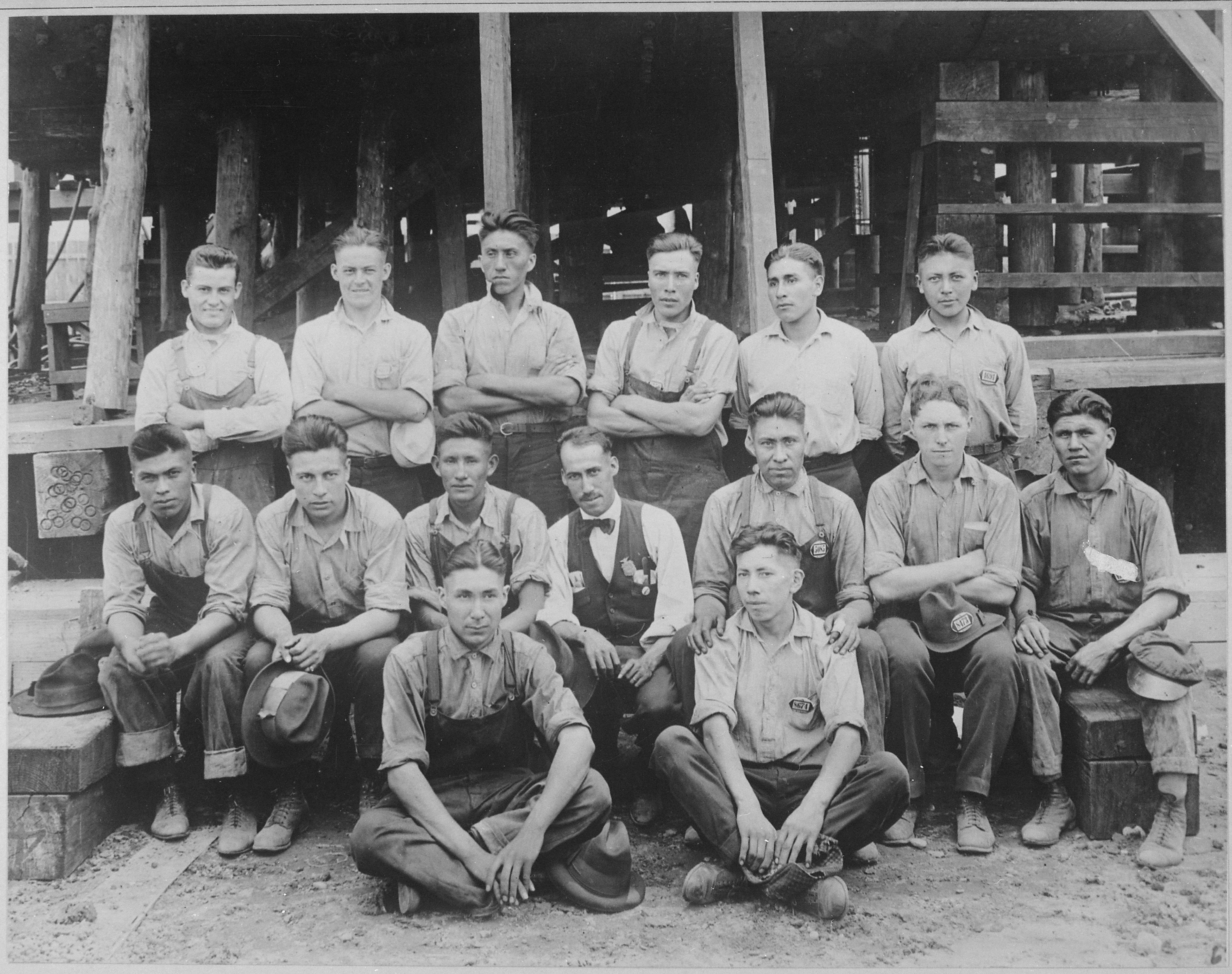
Carlisle Indian Industrial School
The before-and-after photographs tell the story the school wanted told. On the left, children in traditional clothing, hair long, expressions guarded. On the right, the same children in European dress, hair shorn, eyes directed at the camera with practiced stillness. These photographs were propaganda, distributed widely to demonstrate the "success" of the Carlisle Indian Industrial School. What they actually document is the systematic erasure of identity -- 7,800 children from 140 Native American tribes, processed through a former military barracks in Carlisle, Pennsylvania, between 1879 and 1918. The school's founder, Lieutenant Richard Henry Pratt, stated its purpose with brutal clarity: "Kill the Indian in him, and save the man."
The Soldier's Experiment
Richard Henry Pratt was a career army officer who had commanded Black troops during the Civil War and later supervised Native American prisoners of war at Fort Marion in St. Augustine, Florida. There, he became convinced that education could accomplish what military campaigns could not -- the complete assimilation of Native peoples into white American society. In 1879, with government authorization, Pratt converted the empty Carlisle Barracks -- a military post dating to the 1750s -- into the nation's first federally funded off-reservation Indian boarding school. The War Department transferred the property to the Department of the Interior. That first year, Pratt recruited students from the Lakota Sioux at Rosebud and Pine Ridge reservations. Many parents, having just survived the devastation of the Plains Wars, saw few alternatives. The children boarded trains east, some as young as five.
The Machine of Assimilation
At Carlisle, students were stripped of their Native names and assigned English ones. Their hair was cut. They were forbidden to speak their own languages. The curriculum combined basic academics with industrial training -- boys learned trades like blacksmithing, printing, and farming; girls studied domestic skills. An "outing program" placed students with white families during summers, immersing them further in Euro-American culture. The school operated on a military model: uniforms, formations, strict discipline. Students who spoke their native languages were punished. Letters home were monitored and sometimes censored. Many children arrived already weakened by reservation conditions and fell ill in the crowded dormitories. Tuberculosis, trachoma, and influenza swept through the student population. Others succumbed to homesickness and psychological distress that defied the school's ability -- or willingness -- to address.
A Cemetery Grows
At least 186 individuals were buried in the school's cemetery between 1880 and 1918 -- students, prisoners of war, and the child of a teacher. Eight of those graves could never be identified. As the campus expanded, administrators relocated the burial ground to a smaller area at the campus edge, treating the dead children as an inconvenience to institutional growth. Beginning in 2017, the U.S. Army began a repatriation program to return remains to tribal families upon request. Each disinterment is a ceremony of grief renewed, families receiving children sent away generations ago who never came home alive. The cemetery that the school tried to minimize has become the most powerful testament to what Carlisle inflicted -- rows of small white headstones bearing names from dozens of tribes, children who traveled hundreds or thousands of miles from home and were buried in Pennsylvania soil.
Jim Thorpe's Complicated Glory
Carlisle's most famous student arrived in 1904, a sixteen-year-old Sac and Fox athlete named Jim Thorpe. Under coach Glenn "Pop" Warner, Thorpe became the greatest athlete of his era -- winning gold medals in the pentathlon and decathlon at the 1912 Stockholm Olympics and leading the Carlisle football team to an 18-15 upset of Harvard before 25,000 spectators, scoring every Carlisle point himself: a touchdown, an extra point, and four field goals. Thorpe's brilliance brought the school national attention and a narrative of Native achievement that Pratt's successors eagerly promoted. But Thorpe's story also embodies Carlisle's contradictions -- the school that sought to erase Native identity produced the most celebrated Native American in the country, a man whose greatness was inseparable from the culture the institution tried to destroy.
What the Monument Remembers
In December 2024, President Joe Biden designated the site as the Carlisle Federal Indian Boarding School National Monument, co-managed by the U.S. Army and the National Park Service in consultation with Native American tribes. The property remains part of Carlisle Barracks, now home to the U.S. Army War College. The old school buildings still stand among the military facilities, their stone walls holding the memory of children who marched in formation where soldiers once drilled. The monument designation ensures that the federal government's own role in this history cannot be quietly forgotten or reframed. Carlisle was not an aberration -- it was the model. More than 350 similar boarding schools followed across the country. What began here shaped generations of Native American families, and the reckoning with that legacy has only just begun.
From the Air
Located at 40.206N, 77.171W in Carlisle, Cumberland County, Pennsylvania. The former school campus is within the Carlisle Barracks military installation, visible as a cluster of historic stone buildings among the army post's structures. The cemetery with its rows of white headstones is at the campus periphery. Carlisle Airport (N94) is 1nm southeast of town. Nearest commercial airport: Harrisburg International (KMDT), approximately 20nm east. The Cumberland Valley stretches east-west with the Appalachian ridgeline visible to the north and west. The Carlisle Barracks parade ground and the distinctive rectangular layout of the military post are identifiable from 2,000-3,000 feet AGL. Approach from the south for the best perspective on the barracks campus and its relationship to the town of Carlisle.