Carlsbad Caverns: The Underground Cathedral of a Million Bats
Jim White was sixteen when he first saw the cloud rising from the desert. In 1898, following what he thought was smoke, he found not fire but bats - hundreds of thousands of them spiraling from a hole in the ground each evening. He descended with a homemade ladder into darkness so complete that his lantern seemed to shrink against it. What he found defied description: rooms the size of cathedrals, formations that looked like frozen waterfalls, a silence broken only by dripping water. He spent decades trying to convince anyone to believe him. When they finally did, Carlsbad Caverns became one of America's first cave parks, and Jim White became its first ranger. The bats still spiral each sunset, and the formations still grow, drop by drop, in the unchanging dark.
The Chambers
The Big Room is the largest chamber in North America accessible by foot: 8.2 acres, ceiling heights reaching 255 feet, a mile-long path circling its edge. The formations bear names that barely capture their strangeness: the Rock of Ages, the Bottomless Pit, the Giant Dome that rises 62 feet. Stalactites descend from above; stalagmites rise to meet them. Columns form where they join. The chemistry is simple - sulfuric acid dissolved limestone over millions of years - but the results are anything but. Each formation represents centuries of mineral accumulation, calcium carbonate deposited drop by drop. Touch them and you contaminate them; oils from skin can stop growth permanently. The paths are lit; everything else remains as it was when Jim White's lantern first disturbed the dark.
The Bats
Each evening from April through October, Brazilian free-tailed bats emerge from the cave's natural entrance. The flight begins at sunset and continues for hours as hundreds of thousands of bats spiral upward in counter-clockwise columns, heading out to consume tons of insects across the Chihuahuan Desert. The spectacle drew Jim White's attention; it still draws visitors who gather at the amphitheater above the entrance. Rangers provide interpretation as the first bats appear, individual dots becoming stream becoming river becoming dark cloud against the sunset sky. The bats return near dawn, dropping into the cave at speeds approaching 25 miles per hour. The colony's size has declined - pesticides, habitat loss, white-nose syndrome - but the emergence remains one of America's great natural spectacles.
The Descent
Two ways reach the Big Room: an elevator drops 750 feet in one minute, or the Natural Entrance Trail descends a mile through switchbacks. The walking route is worth the effort. You descend into the earth, daylight shrinking to a distant glow, temperature dropping steadily to the cave's constant 56 degrees. The formations begin gradually, then overwhelm. The Devil's Spring, the Whale's Mouth, the Iceberg Rock - each named formation passed on the descent. By the time you reach the Big Room, you've traveled so far from sunlight that the idea of surface seems abstract. The return climb ascends 750 feet, a workout that reminds you how deep you went. Most take the elevator up.
The Wild
The developed portions of Carlsbad Caverns represent a fraction of the system. Over 120 caves honeycomb the Guadalupe Mountains; Lechuguilla Cave, accessible only to researchers, is among the world's deepest and most ornate. Ranger-led tours explore undeveloped sections of Carlsbad - crawling through muddy passages, squeezing through tight spots, experiencing the cave as Jim White did. Slaughter Canyon Cave, part of the park but separate, offers lantern-lit tours through undeveloped chambers. The wildness is genuine; drop your light and the dark is absolute. The caves are still being discovered; new passages are found regularly. What Jim White found was one entrance to a underground world still being mapped.
Visiting Carlsbad Caverns
Carlsbad Caverns National Park is located in southeastern New Mexico, 20 miles from the town of Carlsbad. The visitor center sits at the cave entrance; self-guided tours of the Big Room are available throughout the day. Tickets required; reserve online during peak season. The Natural Entrance walk takes about an hour; the Big Room loop adds another 1.5 hours. Evening bat flights (May-October) begin at sunset; arrive early for amphitheater seating. Ranger-led tours of undeveloped areas require advance reservation and varying fitness levels. Temperature is constant 56°F regardless of surface weather; bring a jacket. El Paso is the nearest major airport (150 miles). The experience combines spectacle with intimacy - the vast chambers and the individual drops that built them, the river of bats and the unchanging silence below.
From the Air
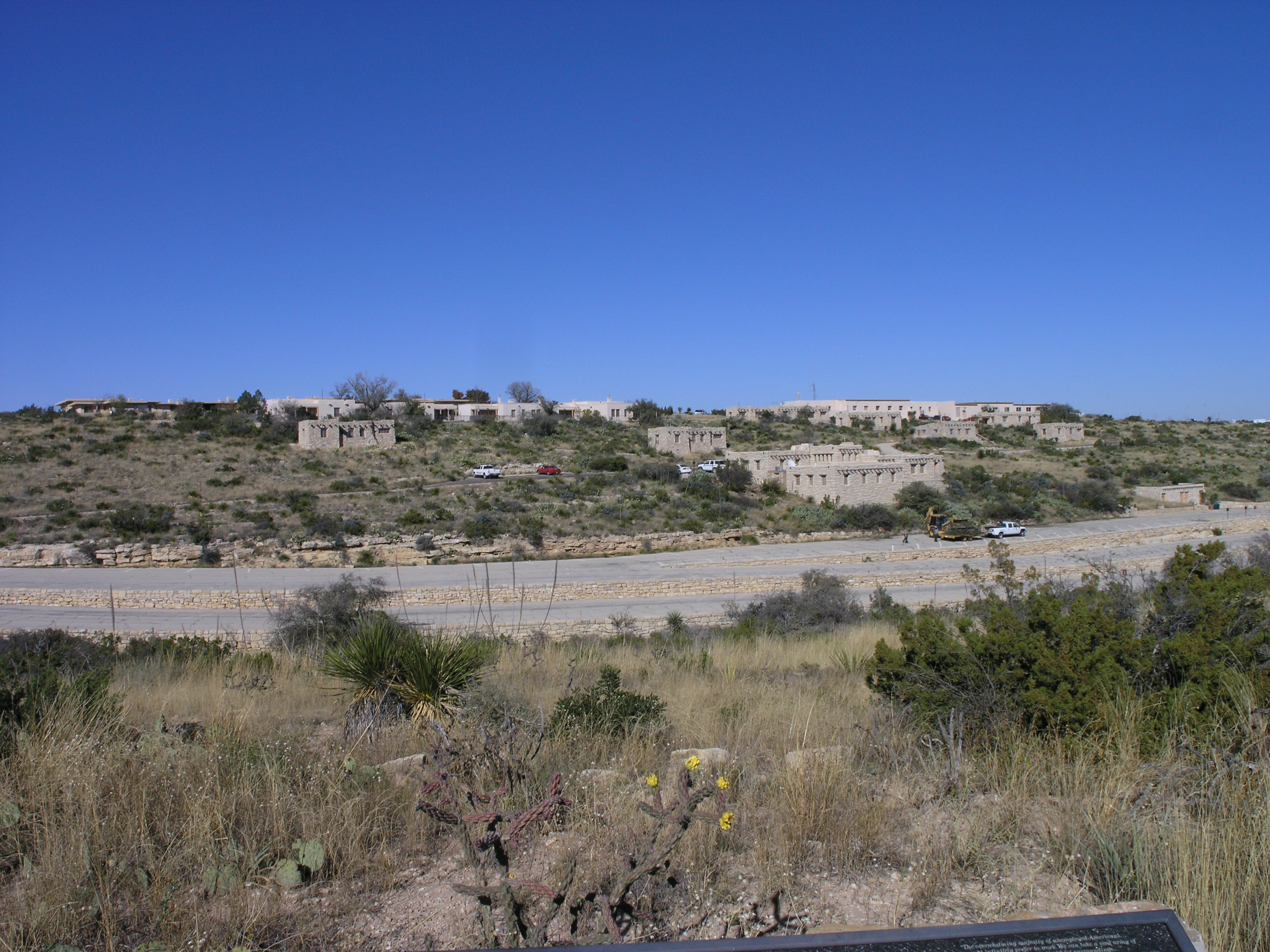
Located at 32.17°N, 104.44°W in the Guadalupe Mountains of southeastern New Mexico. From altitude, Carlsbad Caverns National Park appears as rugged terrain at the edge of the Chihuahuan Desert - the surface giving no hint of the chambers below. The visitor center and entrance are visible at Walnut Canyon's head; the bat flight amphitheater overlooks the natural entrance. The Guadalupe Mountains extend to the southwest, their limestone riddled with caves. White's City, a small tourist development, clusters at the park entrance. Carlsbad, New Mexico, spreads in the Pecos River valley to the northeast. What appears from altitude as unremarkable high desert hides one of North America's greatest caves - a subterranean wilderness where formations older than human civilization continue growing, drop by drop, in absolute darkness.