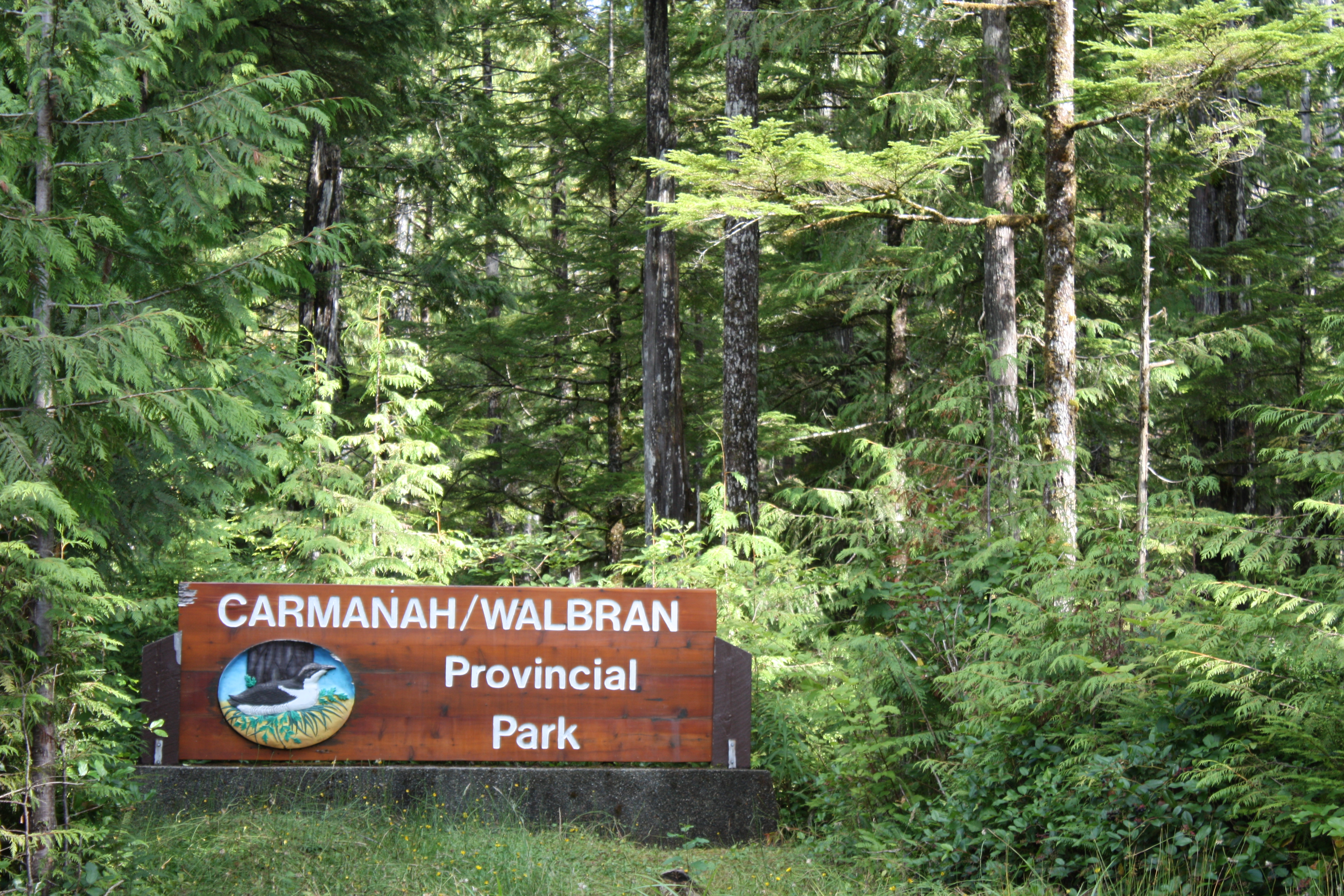
Carmanah Walbran Provincial Park
In 1988, the chainsaws were about to enter the Carmanah Valley. MacMillan Bloedel, the logging company that held the timber rights, was preparing to clear-cut the lower watershed -- a valley that contained the tallest Sitka spruce in the world and western red cedars more than a thousand years old. Two conservationists, Randy Stoltmann and Clinton Webb, were camped out in the grove. Peter McAllister, chair of the Sierra Club of Western Canada, was helicoptered in to make the case directly to MacMillan Bloedel executives. He found that the company did not even know what their chainsaws were about to destroy. McAllister won a four-week moratorium. It was enough.
Cathedral of Green
Carmanah Walbran Provincial Park protects some of the most extraordinary Pacific temperate rainforest remaining on Earth. The park sits on the southwestern coast of Vancouver Island, immediately adjacent to Pacific Rim National Park Reserve's West Coast Trail, within the traditional territory of the Ditidaht First Nation. Giant western red cedars -- some well over a thousand years old -- tower alongside coast Douglas-fir, western hemlock, and groves of Sitka spruce that reach heights found nowhere else. Canada's tallest tree, the Carmanah Giant, is a Sitka spruce measuring 95.836 meters, estimated to be around 400 years old, growing along the lower reaches of Carmanah Creek. The forest here holds twice the biomass of a tropical rainforest. In the canopy, where the year-round mild and humid climate creates ideal conditions, extensive communities of epiphytes drape the branches in moss and fern.
The Fight for the Valley
Randy Stoltmann first saw the towering spruce of the Carmanah Valley in the early 1980s. By 1985, he was calling for the grove's protection as a National Park Centennial gift to Canada, while the Western Canada Wilderness Committee lobbied for a 500-acre landmark park. But it took the imminent threat of logging to catalyze a campaign. When McAllister's four-week moratorium gave the Sierra Club room to maneuver, they commissioned an environmental assessment, alerted the premier and cabinet, and took the fight international at the Sierra Club's annual meeting in San Francisco. National Geographic sent photographers. Jim Blair's triple-page foldout of Mount Paxton -- clear-cut down to the sea near Kyuquot -- showed the world what industrialized logging was doing to Vancouver Island's ancient forests.
Blockades and Chainsaws
The campaign was not polite. Civil disobedience led by the Ditidaht kwaabaaduw7aa7tx hereditary chief Peter Knighton, alongside conservationists and members of the Western Canada Wilderness Committee, stretched well into the early 1990s. Logging company workers were caught cutting trees "accidentally" inside the riparian zone -- the protected buffer along waterways -- to harvest the most valuable old-growth timber. The confrontation between economic interests and ecological preservation played out tree by tree, arrest by arrest, in a remote valley accessible only by gravel logging roads from Port Alberni, Lake Cowichan, or Port Renfrew. Carmanah Pacific Provincial Park was finally established in 1990. Five years later, the remainder of the Carmanah Valley and the lower Walbran River drainage were added to create the current park.
A Park in Disrepair
Winning protection was only the first battle. By 2014, the extensive boardwalk trail system that allows hikers to explore the park without damaging its delicate ecosystem had fallen into dangerous disrepair. BC's provincial government repeatedly cut funding to BC Parks, leaving too few rangers to maintain trails or prevent cedar poachers and illegal loggers from targeting ancient trees in unprotected portions of the Walbran Valley. In 2012, an 800-year-old red cedar was stolen. In 2013, 900-year-old trees were clear-cut in the Upper Walbran. The park website warns visitors about unmaintained trails while stating that maintenance is "ongoing" -- a bureaucratic tension that captures the precarious state of old-growth protection on Vancouver Island. Access to the Carmanah Giant itself is currently limited by the condition of the boardwalk that protects the root systems of the trees it was built to showcase.
Twice the Biomass of a Jungle
Three distinct ecological subzones converge within the park. Along the coast, the spruce fringe forest is dominated by Sitka spruce adapted to withstand the magnesium salts of sea spray, alongside leatherleaf polypody fern and evergreen huckleberry. Inland, the submontane zone supports the park's giants: hemlock, Douglas-fir, redcedar, and spruce growing in some of the most productive conditions on the Pacific Coast. Marbled murrelets -- small seabirds that nest exclusively in old-growth forest -- have been found breeding here, one of the species whose survival depends on trees that take centuries to reach nesting size. The forest itself is a carbon vault, holding more biomass per hectare than any tropical rainforest. Protecting it is not merely aesthetic. It is ecological infrastructure on a planetary scale.
From the Air
Carmanah Walbran Provincial Park is centered around 48.65°N, 124.65°W on Vancouver Island's southwest coast, adjacent to the West Coast Trail. From 3,000-5,000 feet, the contrast between the park's dense old-growth canopy and surrounding clear-cut logging areas is starkly visible. The Carmanah Creek valley runs northwest to the coast. Nearest airport: Port Alberni (CBS8). Access is by gravel logging roads only. Expect persistent low cloud and rain in this temperate rainforest environment.