Carmo Convent
The sky is the ceiling. That is the first thing visitors notice inside the Carmo Church in Lisbon, where pointed Gothic arches soar upward and frame nothing but clouds. The stone roof collapsed on the morning of 1 November 1755, when one of the most powerful earthquakes in recorded history struck the Portuguese capital. The church was never rebuilt. Instead, it stands today exactly as the earthquake left it, the most visible scar of a catastrophe that killed tens of thousands and reshaped European thought about God, nature, and the vulnerability of civilization.
A Warrior's Offering
The convent was founded in 1389 by Nuno Alvares Pereira, the Constable of Portugal and one of the most celebrated military commanders of the Middle Ages. Pereira had led Portugal's armies to decisive victories against Castile, securing the nation's independence. But in his later years, the warrior turned mystic. He donated his wealth to the Carmelites, entered the convent himself as a simple friar, and took the name Nuno de Santa Maria. Construction proceeded slowly: the church's presbytery and apse were completed by 1407, and the residential cells by 1423, when Carmelite friars from Moura in southern Portugal moved in. In its prime, the Carmo Church was said to be the most imposing Gothic building in Lisbon, its architecture influenced by the great Monastery of Batalha being built concurrently by King John I.
All Saints' Day, 1755
By the mid-18th century, the convent housed 126 clerics and a library of approximately 5,000 volumes. On the morning of 1 November 1755, as congregations across the city gathered for the All Saints' Day Mass, the earthquake struck. The great stone vault of the nave collapsed, crushing everything beneath it. The library was completely destroyed. The surviving clerics fled, first to Cotovia, then to Campo Grande, never to return. What remained was a skeleton of soaring arches and empty windows open to the weather, a ruin so striking that the city eventually chose to preserve rather than rebuild it. The rose window above the main portal survived only in fragments, and five flying buttresses that had been added to the south wall in 1399, after an earlier construction collapse, still brace the structure against forces that no longer press inward.
Revolution at the Convent Gate
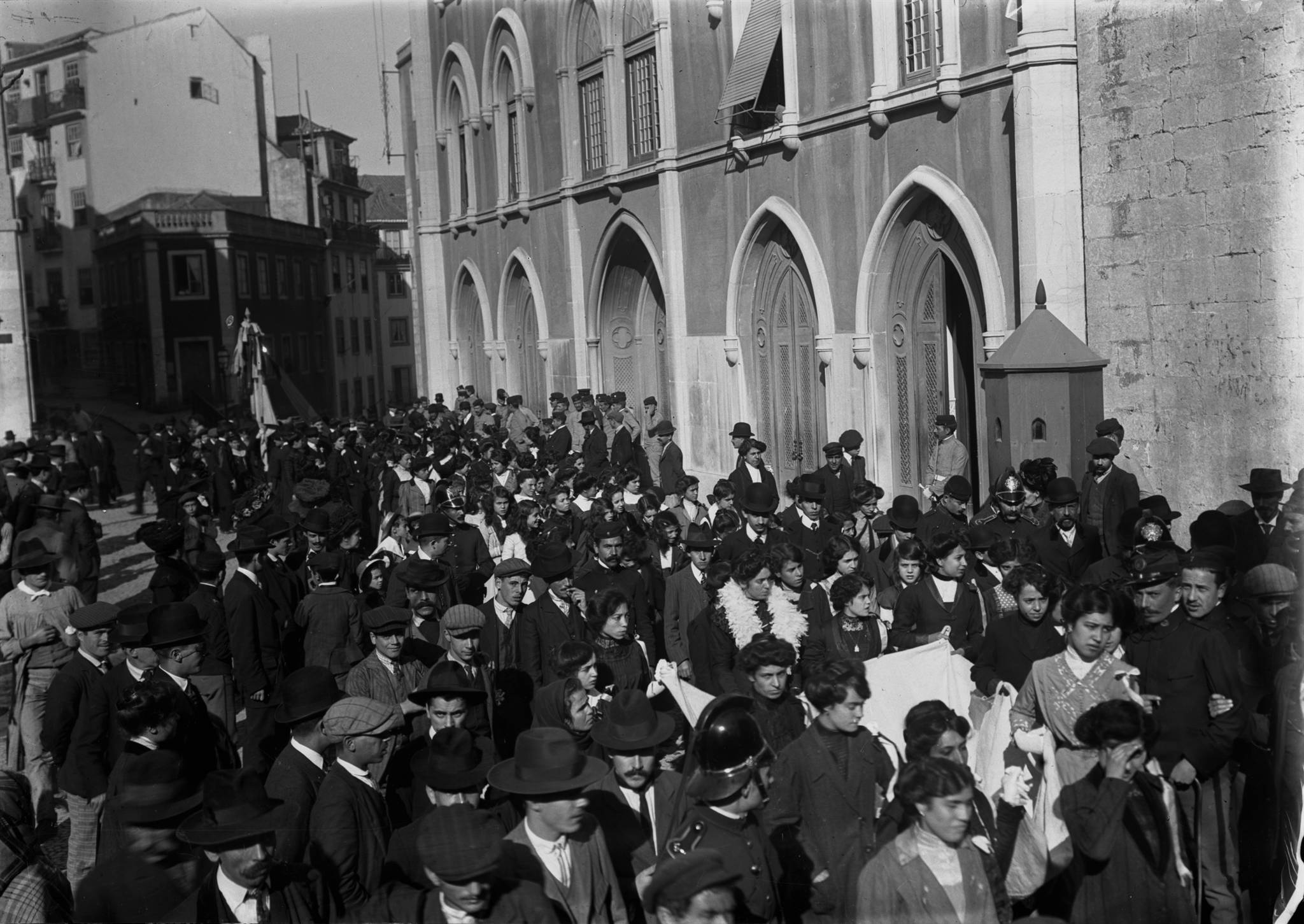
The Carmo's second great historical moment came on 25 April 1974. By then, the convent buildings around the ruined church had been converted into the headquarters of the Republican Guard. When military rebels launched the Carnation Revolution to topple the Estado Novo dictatorship, they surrounded the compound. Inside, the regime's last prime minister, Marcelo Caetano, held out with loyal forces. Outside, soldiers tucked red carnations into their rifle barrels. Caetano eventually surrendered to General Antonio de Spinola, the future democratic president. The peaceful transfer of power at this earthquake-scarred site became one of the defining images of Portugal's return to democracy.
Bones and Kings Under Open Sky
Today the roofless nave serves as the Carmo Archaeological Museum. Visitors walk among Gothic tombs, Roman artifacts, and Moorish azulejos under the open sky. The tomb of Fernao Sanches, a 14th-century illegitimate son of King Dinis I, is carved with scenes of boar hunting. The magnificent tomb of King Ferdinand I, who reigned from 1367 to 1383, was transferred here from the Franciscan Convent of Santarem. A statue thought to represent Afonso Henriques, Portugal's first king, stands among the collection. The setting transforms what could be a conventional museum into something more contemplative: the artifacts of centuries of Portuguese history displayed within the shell of a building that reminds visitors how quickly centuries of work can be undone.
From the Air
Located at 38.712N, 9.140W in the Chiado neighborhood of central Lisbon, on a hill overlooking Rossio Square. The roofless Gothic arches are distinctive from the air. Nearest airport is Lisbon/Humberto Delgado (LPPT), approximately 7 km north. The nearby Santa Justa Lift and Sao Jorge Castle serve as visual references. Best viewed at 2,000-4,000 ft AGL.