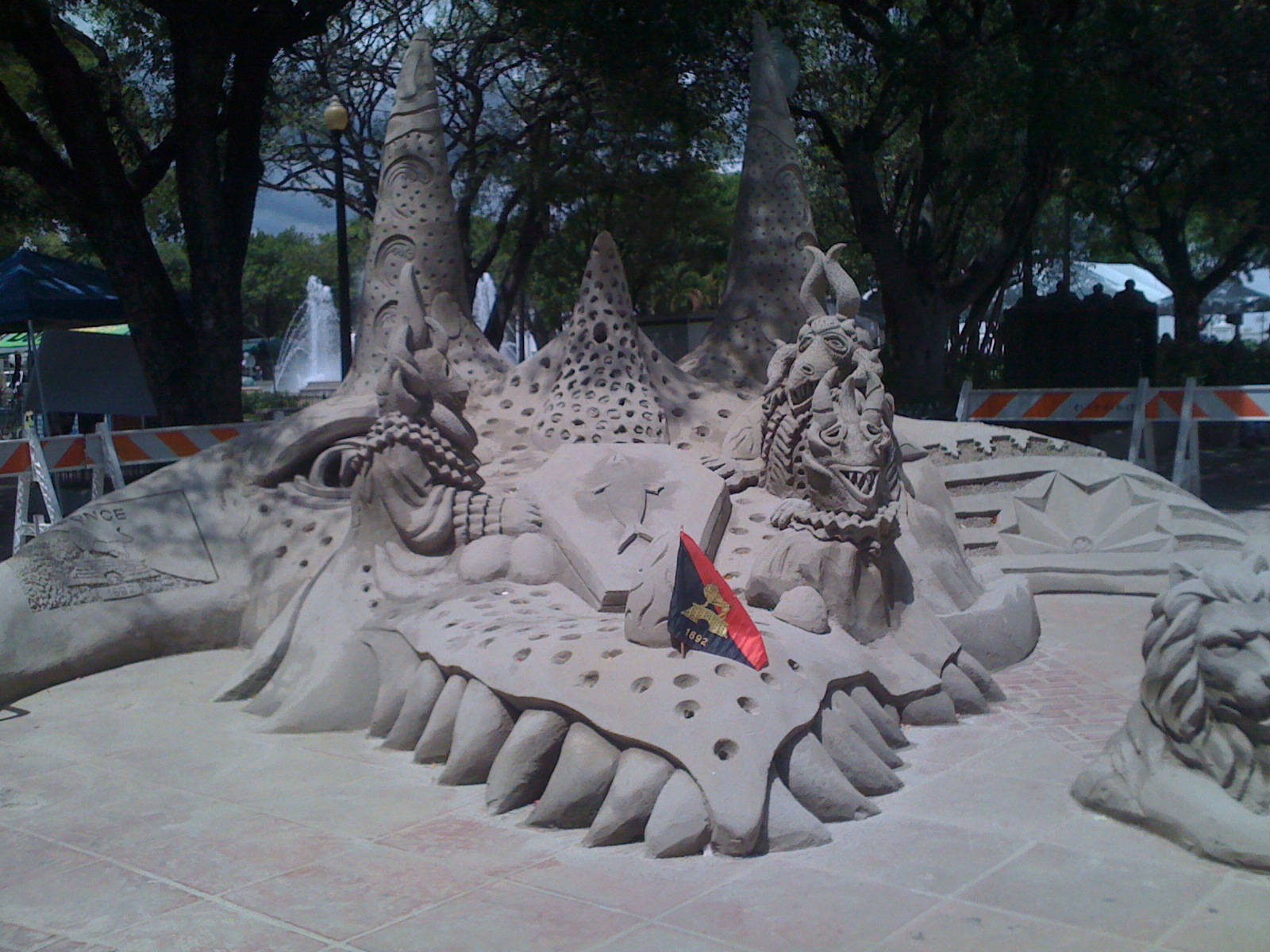
Carnaval de Ponce
They will hit you with a bladder. This is not a threat but a promise, as reliable as the February sun over Ponce. The vejigantes - costumed figures in elaborate papier-mache masks bristling with horns - carry inflated cow bladders through the streets and swing them at anyone within reach. It is a tradition that dates to at least 1858, when a Spaniard named Jose de la Guardia organized the first documented masquerade dance in Ponce. The Carnaval de Ponce has continued every year since, growing from a private masked ball into a week-long public celebration that draws an estimated 100,000 people to Puerto Rico's second-largest city. The Smithsonian Institution traces the celebration's roots even further back, to perhaps 250 years ago. However you date it, the Carnaval Ponceno runs parallel to the world's great pre-Lenten festivals - the Mardi Gras of New Orleans, Venice's Carnival, Rio's massive samba parades - but with a character entirely its own, shaped by the particular cultural alchemy of Ponce.
From Barcelona to Bomba
The carnival's origins reveal a story of cultural migration and transformation. According to the Office of Cultural Development of the Municipality of Ponce, the influence of the Nice Carnival extended to Barcelona, and immigrants from Barcelona brought that tradition across the Atlantic to Ponce. But what arrived was only a seed. Over generations, Poncenos grafted their own identity onto the European framework, infusing the celebrations with Afro-Antillean percussion, bomba rhythms, and a theatrical energy rooted in Caribbean rather than Mediterranean sensibility. The masquerade dance that Jose de la Guardia started in 1858 remained the Carnaval's core through the 19th century. It was not until the 1950s that the municipal government formalized the tradition by adding a parade. By the early 1960s, floats representing civic institutions, schools, universities, banks, and neighborhoods had transformed the Carnaval into a citywide spectacle. What began as an imported European amusement had become something unmistakably Ponceno.
The Devil's Many Horns
The vejigante masks are the Carnaval's most recognizable symbol, and they belong entirely to Ponce. Developed by local artisans in the early 20th century, the masks are built from newsprint paper mixed with homemade glue, shaped and painted into wild, fantastical faces sprouting multiple horns - sometimes a dozen or more, curving and twisting in every direction. The vejigante costume traditionally represents the devil or evil, a figure rooted in medieval Spanish morality plays where masked demons chased Christians through the streets. In Ponce's hands, the character became something more playful and more complex - part menace, part comedian, wielding that inflated cow bladder like a slapstick weapon. The sophistication of Ponce's masks has made them coveted by collectors and elevated them into a symbol of Puerto Rico itself. A 1990 New York Times feature on Puerto Rican carnival masks focused largely on Ponce's artisans, whose work bridges folk art and fine craft.
Seven Days of Revelry
The modern Carnaval follows a precise week-long calendar, beginning on the Wednesday before Ash Wednesday and building toward its climax. Wednesday opens with the Vejigantes Party, a preview of the masked chaos to come. Thursday brings the King Momo Entrance Parade, introducing the symbolic ruler of the festivities. Friday and Saturday belong to ceremony: the crowning of the Child Queen, a tradition since 1973, and the Adult Queen, a custom dating to 1959. Sunday is the main event - the Grand Parade, when floats, bands, vejigantes, and thousands of spectators fill the streets around Plaza Las Delicias. Monday's Ball Dance offers a more formal celebration. And Tuesday, the final day, belongs to death and resurrection. The Burial of the Sardine is a mock funeral procession, complete with a song: "The Carnival is dead now, they are burying him; throw just a little dirt in, so he can rise again." The ritual, begun in 1967, ensures that even the Carnaval's ending contains the promise of return.
A Carnival That Travels
In June 1995, the Carnaval de Ponce left its home city for the first time. Over 200 entertainers, folk artists, and musicians traveled to New York City for the Puerto Rican Day Parade, marching down Fifth Avenue alongside the Banda Municipal de Ponce and the Carnival's Queen and Child Queen. In the week before the parade, Ponce's artisans toured New York's communities, teaching children to build traditional vejigante masks from newsprint and glue - carrying forward the craft tradition in diaspora. The export worked both ways: it introduced the mainland Puerto Rican community to Ponce's distinctive celebration and reinforced the Carnaval's status as more than a local festival. A local news weekly declared it "Puerto Rico's National Carnival" in 2012. The municipal government invests close to $100,000 annually in the festivities, which generate roughly $500,000 in economic activity - modest numbers that belie the Carnaval's outsized cultural importance to a city that calls itself La Perla del Sur, the Pearl of the South.
From the Air
Located at 18.00°N, 66.62°W in downtown Ponce, Puerto Rico, centered around Plaza Las Delicias and the surrounding streets. The Carnaval parade route follows major downtown avenues visible from the air as the dense colonial-era street grid of Ponce's historic center. Nearest airport is Mercedita Airport (TJPS/PSE), approximately 5 km south. Ponce is Puerto Rico's second-largest city, located on the southern Caribbean coast. The celebration takes place annually in February or March, ending on Fat Tuesday. From altitude, the downtown area is identifiable by the twin-towered Cathedral of Our Lady of Guadalupe on the main plaza. Best aerial approach from the south over the Caribbean to see the full coastal city layout.