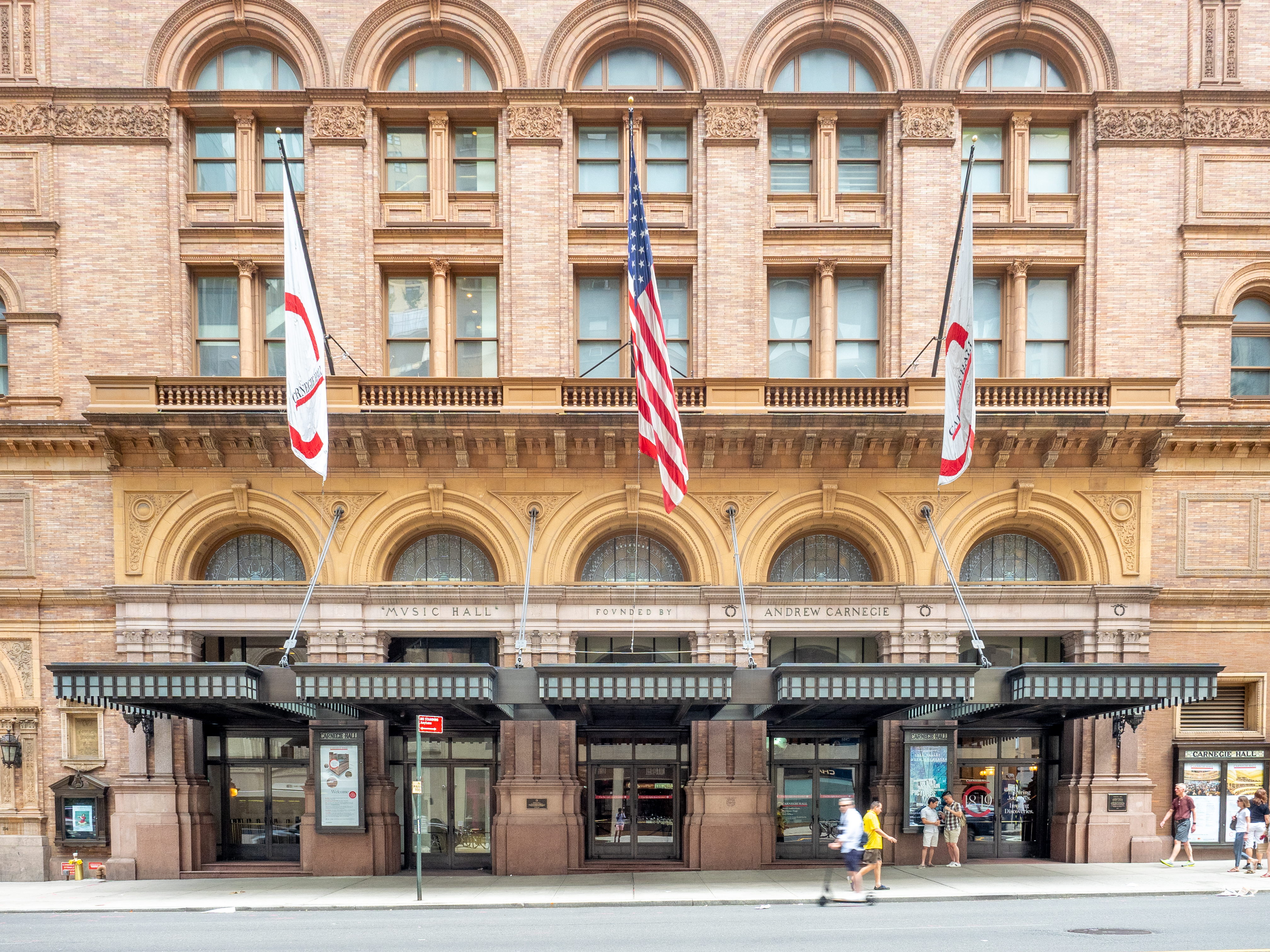
Carnegie Hall: Practice, Practice, Practice
"Could you tell me how to get to Carnegie Hall?" a tourist supposedly asked violinist Jascha Heifetz on Fifty-seventh Street. "Practice!" The joke has circulated since at least 1955, and Carnegie Hall's archivist Gino Francesconi favors a version involving violinist Mischa Elman, not Heifetz. But the punchline endures because the building it names has been the summit of musical ambition for over 130 years. Tchaikovsky conducted on opening night in 1891. Sissieretta Jones became the first African American to sing there less than a year later. Judy Garland recorded her Grammy-winning live album on its stage. And when New York City tried to demolish it in the 1950s, violinist Isaac Stern launched a public campaign that saved the building, the acoustics, and the joke.
A Steel Baron's Gift to Sound
Andrew Carnegie made his fortune in steel, but his passion was music. In 1889, he commissioned architect William Burnet Tuthill to design a concert hall on the east side of Seventh Avenue between 56th and 57th Streets, two blocks south of Central Park. Tuthill was only 34 and relatively unknown, but he was an amateur cellist and singer, which may have won him the commission. Richard Morris Hunt and Adler & Sullivan contributed to the design. Built in the Italian Renaissance Revival style, the hall's walls measure over three feet thick in places, and its floor slabs are made of cement and hollow tiles. Carnegie poured his own money into the project, and the venue opened on May 5, 1891, with a five-day music festival. Tchaikovsky himself conducted several pieces during the opening celebrations. The hall was originally called simply "the Music Hall" before taking Carnegie's name.
Three Stages Under One Roof
Carnegie Hall is not one auditorium but three. The Stern Auditorium, the largest, is a five-story hall seating 2,790 people, renowned for acoustics that musicians describe as warm, balanced, and forgiving. Below ground on Seventh Avenue sits the 599-seat Zankel Hall, opened in 2003 after a renovation that music critic Anthony Tommasini praised for its flexibility, though he noted the builders did not quite succeed in insulating the space from passing subway trains. The 268-seat Joan and Sanford I. Weill Recital Hall on 57th Street rounds out the complex. Together, the three venues host about 250 performances each season. Carnegie Hall has never had a permanent resident orchestra since the New York Philharmonic departed in 1962 for Lincoln Center, yet it remains fully booked year after year.
The Night the Wrecking Ball Lost
By the 1950s, Carnegie Hall's future looked grim. The New York Philharmonic was planning its move to the new Lincoln Center complex, and without a resident orchestra, the building seemed destined for demolition and redevelopment. Violinist Isaac Stern refused to accept that outcome. He organized a citizens' committee and lobbied the New York State Legislature, which in 1960 passed a bill allowing the city to purchase Carnegie Hall. The city bought the building from Robert E. Simon Jr., whose family had owned it since 1925, and created the Carnegie Hall Corporation, a nonprofit, to manage it. The hall was designated a National Historic Landmark and placed under the protection of the New York City Landmarks Preservation Commission. A steam-cleaning of the facade and a minor interior renovation took place in 1960, and the building entered its second century with its acoustics and its identity intact. The main auditorium was renamed the Isaac Stern Auditorium in 1997, honoring the man who saved it.
From Dvořák to the Beatles
Carnegie Hall was desegregated from its opening night, a fact that set it apart from other major American venues. Sissieretta Jones sang there on June 15, 1892, less than a year after the doors opened. Jazz arrived in 1912 when James Reese Europe's Clef Club Orchestra performed a proto-jazz concert on the stage. The Benny Goodman Orchestra gave a legendary sold-out swing concert on January 16, 1938, with Count Basie and members of Duke Ellington's band as guests. The first world premiere at Carnegie Hall was Dvořák's Symphony No. 9, "From the New World," performed on December 16, 1893. Leonard Bernstein made his major conducting debut there on November 14, 1943, substituting for an ill Bruno Walter in a concert broadcast by CBS. Rock and roll arrived when Bill Haley and His Comets played a benefit concert on May 6, 1955, and the Beatles performed two shows on February 12, 1964, after promoter Sid Bernstein convinced Carnegie officials the concert would further international understanding between the United States and Great Britain.
Renovations and Reverberations
Carnegie Hall has been renovated multiple times, each effort a balancing act between modernization and preservation. The most ambitious overhaul came in the 1980s under architect James Polshek, with the Landmarks Preservation Commission approving the work in 1985. Plaster decorations were restored, the lobby was lowered to street level and doubled in size, and a recording studio was built on the fifth floor directly above the main hall. Construction had to be scheduled around performances, and materials had to match the originals as closely as possible. There was no freight elevator. In 1986, architect César Pelli's Carnegie Hall Tower rose on the adjacent lot, a modern glass skyscraper that now looms over its historic neighbor. The Judith and Burton Resnick Education Wing opened in 2014, and the American Institute of Architects gave the project an award in 2017. Through it all, the acoustics that Tuthill designed in 1889 have survived, still drawing musicians who say the hall makes them sound better than they are.
From the Air
Carnegie Hall (40.7650N, 73.9800W) sits on the east side of Seventh Avenue between 56th and 57th Streets in Midtown Manhattan, two blocks south of Central Park's southern edge. The Italian Renaissance Revival building is dwarfed by the adjacent Carnegie Hall Tower but recognizable by its reddish-brown facade and arched windows. Nearby airports: KLGA (LaGuardia, 12km NE), KJFK (John F. Kennedy, 22km SE), KEWR (Newark Liberty, 14km W), KTEB (Teterboro, 16km NW). Best viewed at 2,000-3,000 feet AGL on a Midtown approach. Central Park to the north and Times Square to the southwest provide orientation landmarks.