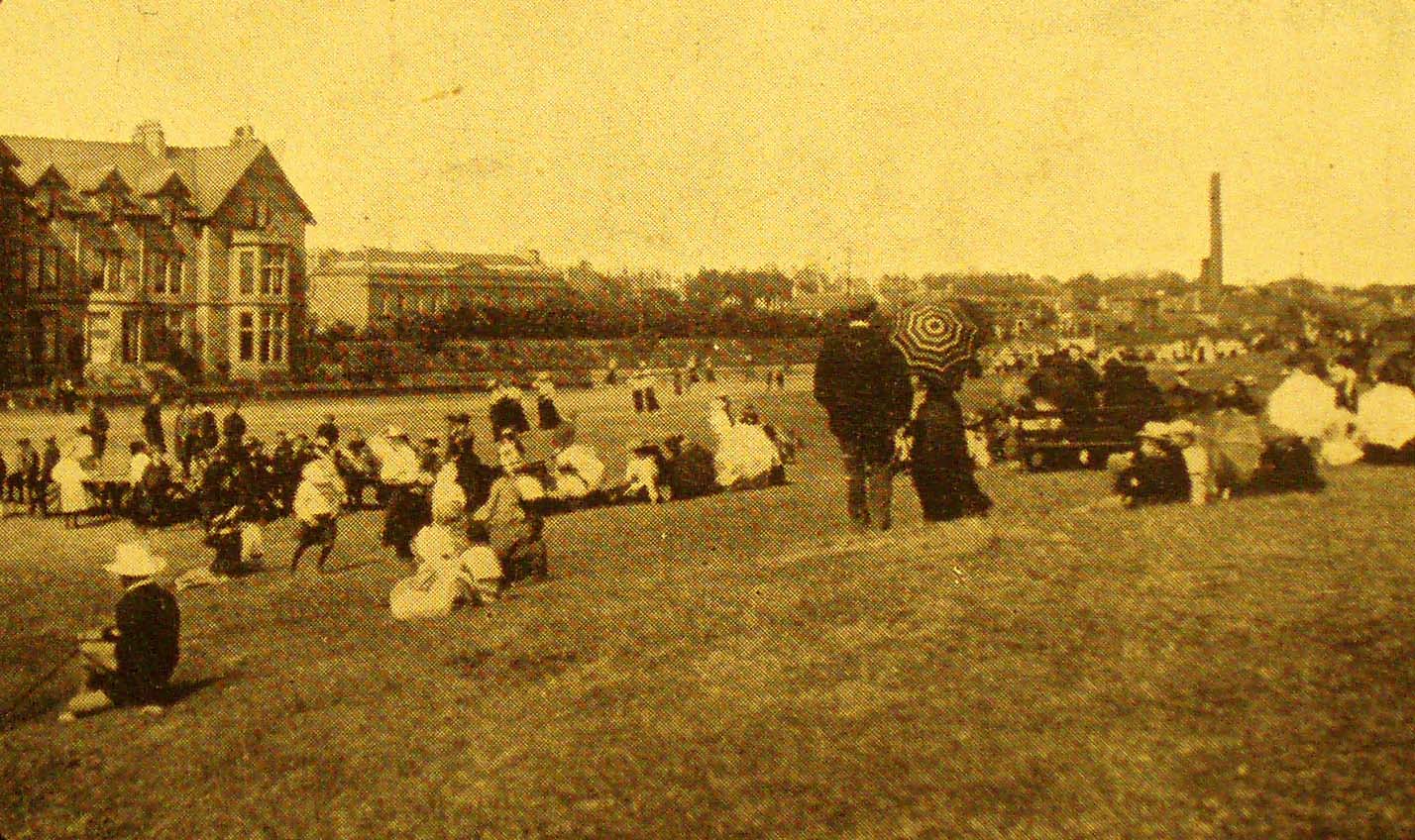
Carnoustie Golf Links
Jean van de Velde needed only a double bogey on the final hole to win the 1999 Open Championship. He was three shots clear. What followed was one of the most spectacular collapses in sporting history: a drive into the rough, an approach into the Barry Burn, a bunker shot, and finally a putt that forced a playoff he would lose. Carnoustie had done what Carnoustie does. The course they call 'Car-nasty' does not give anything away, and it takes back what it can.
Shaped by the Land
Golf has been played at Carnoustie since at least 1527, making it one of the oldest documented courses in the world. The original layout was a simple ten-hole affair designed by Allan Robertson, widely considered the first professional golfer, and opened formally in 1842. Old Tom Morris, the patriarch of Scottish golf, extended it to eighteen holes in 1867. James Braid redesigned the course in 1926, giving it essentially the configuration it holds today. But the real architect of Carnoustie is the land itself. The course sits on classic linksland along the Angus coast, where sandy soil, low dunes, and the burn that winds through the property create a landscape of natural hazards. The Barry Burn crosses the fairways repeatedly, most infamously at the 17th and 18th holes, where it turns simple approach shots into nerve tests.
Eight Opens and Counting
Carnoustie has hosted eight Open Championships, from Tommy Armour's victory in 1931 to Francesco Molinari's in 2018. Each has reinforced the course's reputation as the hardest in the Open rotation. Ben Hogan won here in 1953, the only time he competed in the Open, capping a year in which he also won the Masters and the US Open. The Scots called it 'Hogan's Alley' after his precise course management. Tom Watson won in 1975. Padraig Harrington survived a double-bogey finish to win a playoff in 2007. But it is the 1999 championship that defines Carnoustie in the popular imagination - van de Velde standing in the Barry Burn with his trousers rolled up, his three-shot lead dissolving in real time, the course extracting its price in the most public way possible.
The Burn and the Wind
What makes Carnoustie so difficult is the combination of its hazards. The Barry Burn is the most visible threat, a serpentine waterway that crosses multiple fairways and demands precise placement on nearly every hole. But the burn is only the beginning. The rough at Carnoustie is genuinely penal - thick Angus fescue that swallows golf balls and punishes anything off-line. The bunkers are deep, steep-faced, and strategically placed to catch shots that might be safe on other courses. And then there is the wind. Carnoustie sits on a flat stretch of coast fully exposed to whatever the North Sea sends in, and the prevailing wind can add two clubs to any shot. When the wind blows and the fairways dry out and the rough grows long in summer, Carnoustie becomes one of the hardest tests in world golf.
A Town's Course
Unlike many championship venues, Carnoustie Golf Links was publicly owned by Angus Council for over a century and managed by a trust - though in 2025 it transferred to a private investment group, the first change of ownership in 135 years. For most of its history, anyone could book a tee time, and the green fees were a fraction of what comparable private courses charge. The local population has long used the links as a matter of daily life, not special occasion. Three courses occupy the site: the Championship Course, the Burnside Course, and the Buddon Links. The town of Carnoustie wraps around the northern edge, its houses looking directly onto the fairways. This is not a gated enclave. Dog walkers cross the Buddon Links in the early morning, and children play on the paths that wind between the holes. Carnoustie has hosted more significant golf than almost any other venue in the world, and yet it remains accessible in a way that few championship courses manage.
Car-Nasty's Continuing Legacy
The course that won World's Best Golf Course in 2019 has also been one of golf's great exporters. In the nineteenth century, Carnoustie-trained professionals emigrated in such numbers to America, Australia, and elsewhere that the town became known as a nursery for the game. Families like the Smiths produced multiple professionals who took the techniques and traditions of Scottish links golf to courses around the world. The influence ran both ways: Carnoustie's exposure to international competition through the Open Championship kept it evolving, with subtle modifications to bunkering, green contours, and tee positions maintaining its challenge against ever-improving equipment and athleticism. The Barry Burn remains unimpressed by modern technology. It has no sympathy for distance or precision. It simply waits.
From the Air
Carnoustie Golf Links is located at approximately 56.494°N, 2.724°W on the Angus coast, northeast of Dundee. The Championship Course is visible from the air as a broad green links stretching along the coastline, with the Barry Burn clearly traceable as a dark winding line across the fairways. The town of Carnoustie borders the course to the north. Nearest airport is Dundee Airport (EGPN), approximately 11 miles southwest. Edinburgh Airport (EGPH) is about 60 miles south. The course is best viewed at 1,500-2,500 feet.