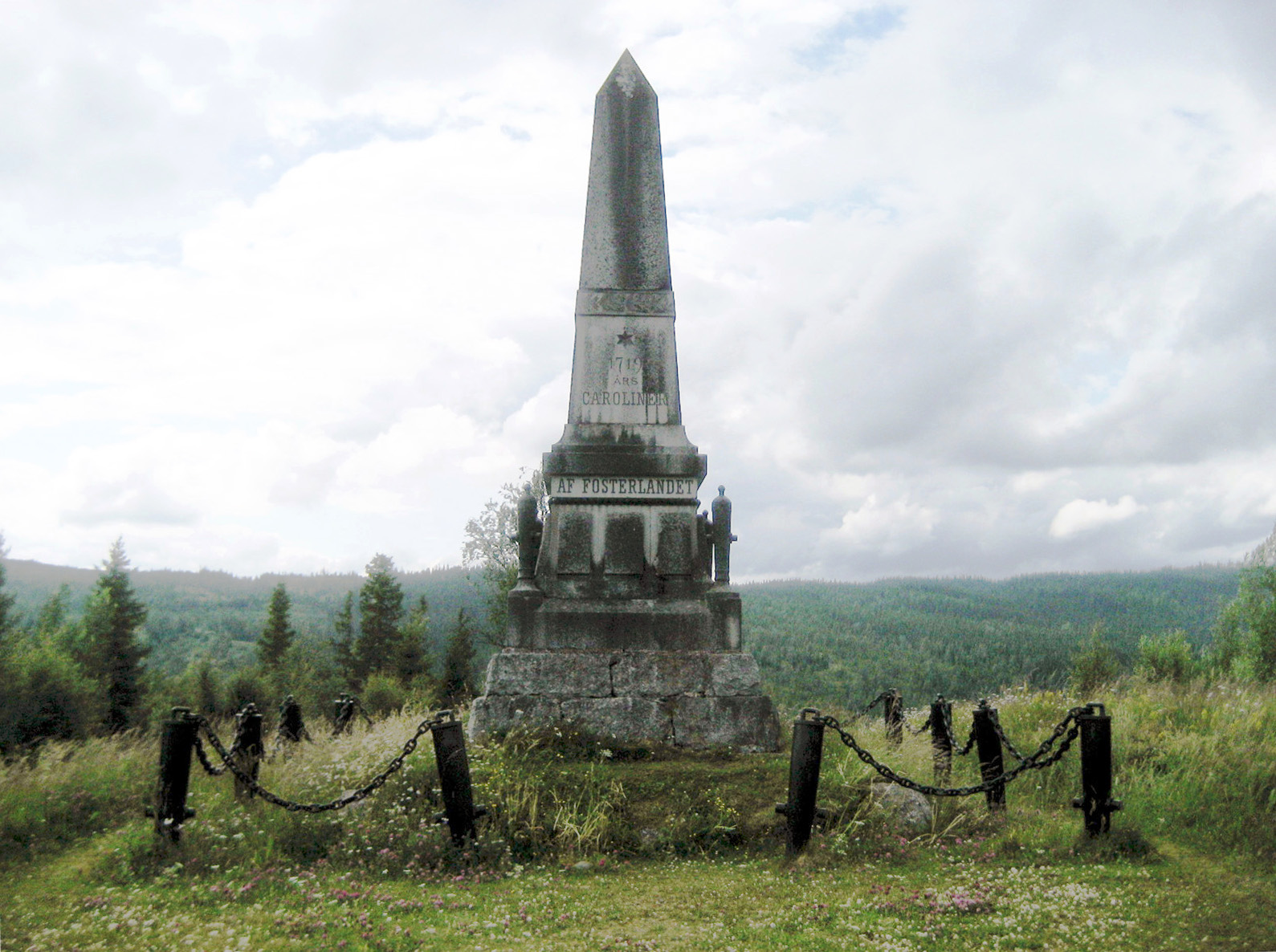
Carolean Death March
They hacked a hole in the ice of the Ena river and watched which way the water flowed. In that direction lay Sweden, lay rescue, lay survival. It was 13 January 1719, and the soldiers of Carl Gustaf Armfeldt's army were scattered across the Tydal mountain range in a blizzard that had not stopped for two days. Behind them on the slopes of Øyfjellet lay hundreds of their comrades, frozen in the positions where they had fallen. The Carolean Death March was not a battle. It was a mountain that refused to let an army pass.
A Campaign Already Lost
The disaster began months before the blizzard struck. In 1718, Charles XII of Sweden ordered Lieutenant-General Armfeldt to lead a diversionary attack from Jämtland toward Trondheim as part of a broader campaign against Denmark-Norway during the Great Northern War. Sweden had already lost its eastern territories to Russia and was fighting from weakness. Armfeldt assembled 10,000 soldiers at Duved and marched into Norway, but the defenders of Trondheim held firm. After four months of failed campaigning, his army had shrunk to roughly 6,000 men. They were exhausted, starving, and wearing clothing that had been threadbare before the march began. Resupply from Sweden was impossible because of bad weather, so the soldiers lived off the Norwegian countryside, causing immense suffering to local civilians. Then, on 11 December, Charles XII was killed at the siege of Fredriksten. Every Swedish force in Norway was ordered to retreat.
Into the Mountains
Armfeldt received word of the king's death on 7 January 1719, while his force of about 6,000 men was at Haltdalen in Gauldal. He chose the shortest route back to Sweden: over the mountains to Tydalen, then across the Tydal range to the fort at Hjerpe. The winter had been mild so far, with little snow, so skis seemed unnecessary. On 8 January, the army marched the 30 kilometers to Tydalen. About 200 men died of exposure on the way. By 11 January, nearly 5,800 soldiers had gathered at the farms of Ås and Østby. A vanguard of fourteen skiers was sent ahead to prepare for the army's arrival in Sweden. On the morning of 12 January, the main force set out from Østby, guided by a Norwegian named Lars Bersvendsen Østby. The distance to the village of Handöl, across the border in Jämtland, was about 55 kilometers. In fair weather, two days' march. The weather did not stay fair.
The Blizzard on Øyfjellet
That afternoon, a violent northwesterly blizzard tore across the mountains. Wind drove the light snow horizontal, erasing visibility and dropping the temperature to lethal depths. Armfeldt ordered camp on the northern slope of Øyfjellet, near Lake Essand. In desperation, soldiers burned whatever they could find: dwarf birch, heather, their own musket stocks, their sleds. It was not enough. An estimated 200 men froze to death the first night. The storm continued through the next day. The army fractured. Some units pushed toward the Swedish border, reaching the Ena river and hacking through the ice to determine which direction flowed toward safety. Draught horses collapsed and died. Equipment was abandoned across the mountainside. On 14 January, Armfeldt and the first troops reached Handöl. Others straggled in on the 15th and 16th. About 3,000 soldiers remained on the mountain, dead where they had stopped. Another 700 died on the continued march down to Duved. Of the roughly 2,100 who survived, 600 were permanently crippled. Over two-thirds of the dead were Finnish soldiers.
What the Mountain Kept
On 18 January, Norwegian Major Emahusen followed the Swedish army's trail up the mountain. What he found was a frozen tableau: hundreds of dead Caroleans, horses still harnessed to loaded sleds with their drivers clutching the reins in a death grip, riderless horses wandering among the bodies. Norwegian locals took what they could use: swords, rifles, six small cannons, boots and coats stripped from the dead. Musket barrels were repurposed as fireplace hardware and grindstone axles. The dead remained where they had fallen. Today, a stone monument erected in 1911 stands near Handöl, marking where over 600 Caroleans were buried. In the village of Brekka Bygdetun in Tydal, the outdoor theater production Karolinerspelet reenacts the death march every other January. In Røros, the large-scale outdoor production Elden dramatizes the broader history of the region, performed on the slag heaps with live horses. The mountain crossing that killed thousands of soldiers in 1719 has become part of the landscape's memory, a story told in stone, theater, and the terrain itself.
From the Air
Centered at 63.02°N, 11.82°E in the Tydal mountain range on the Norwegian-Swedish border in Trøndelag. The route of the death march crosses from Tydalen in Norway to Handöl in Åre Municipality, Sweden, passing over Øyfjellet and near Lake Essand. Key landmarks visible from altitude include the mountain plateau, the lake, and the valley leading to Handöl. Nearest airports: Trondheim Airport Værnes (ENVA) approximately 120 km northwest, Røros Airport (ENRO) approximately 70 km south. Altitude recommendation: 6,000-10,000 feet for views of the mountain crossing route. Extreme weather possible; monitor mountain conditions.