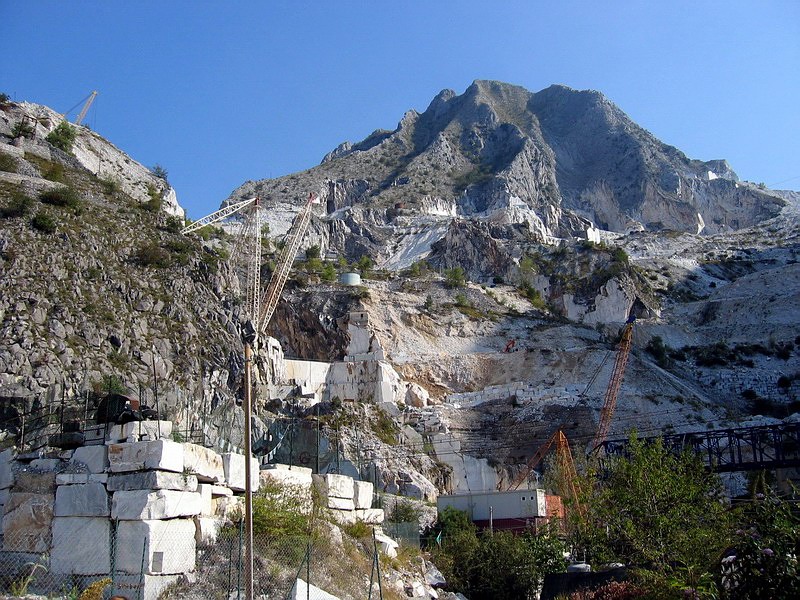
Carrara
The word itself gives everything away. Carrara derives from the pre-Roman element kar -- stone -- filtered through Latin carrariae, meaning quarries. This Tuscan town, perched on the Carrione River about 100 kilometers northwest of Florence, has been defined by a single material for over two thousand years. Romans quarried the white and blue-grey marble from the Apuan Alps above the town and shipped it from the nearby harbor of Luni. Michelangelo came here to select blocks for his David. The quarries are still working today, their enormous white gashes visible from space in satellite imagery. But Carrara's other great export is less tangible and far more explosive: the town became the cradle of Italian anarchism, its quarry workers building a revolutionary tradition that shaped international politics.
Stone from Before Rome
Settlement in the area dates to the ninth century BC, when the Apuan Ligures inhabited the region. The current town grew from a borough built to house workers in the marble quarries that Romans established after conquering Liguria in the early second century BC. From the beginning, Carrara existed to serve the stone. Marble was hauled down from the mountains and loaded onto ships at Luni, at the mouth of the Magra River, bound for Rome and the wider Mediterranean. The quarries have never stopped operating. Twenty-two centuries of continuous extraction have carved amphitheaters into the mountainsides, creating landscapes that look almost extraterrestrial -- vast white bowls and sheer walls where the mountain has been peeled back layer by layer. The marble itself varies from pure white to blue-grey, with the finest grades still commanding extraordinary prices for sculpture and architecture worldwide.
A City Passed Between Powers
Carrara's strategic position and valuable quarries made it a prize that changed hands repeatedly. Byzantines held it, then Lombards. Emperor Otto I gave it to the Bishops of Luni, who held on until the town asserted its independence as a city-state in the early 13th century. During the Guelph-Ghibelline conflicts, Carrara typically sided with the Ghibellines. The bishops reclaimed it in 1230, lost it in 1313, and the city passed through the hands of Pisa, Lucca, Florence, and the Visconti of Milan in rapid succession. The Malaspina family eventually established their seat here in the second half of the 15th century, and Carrara and Massa formed a duchy that lasted until the 19th century. Napoleon's sister Elisa Bonaparte ruled briefly. During Italian unification, the town was a center of Giuseppe Mazzini's revolutionary activity. This pattern -- of outside powers claiming the stone and the people who cut it resisting -- would define Carrara's political character.
The Anarchist Quarrymen
At the end of the 19th century, something crystallized among the quarry workers. The stone carvers had always been set apart -- their craft demanded skill, their working conditions were brutal, and their radical beliefs reflected both the independence of artisans and the solidarity of laborers. According to a New York Times article from 1894, revolutionaries expelled from Belgium and Switzerland arrived in Carrara in 1885 and founded the first anarchist group in Italy. The ideology took root in the quarries with extraordinary depth. The anarchist marble workers organized labor in both the quarries and the carving sheds, and they were the driving force behind the Lunigiana revolt of January 1894. By 1968, an estimated 90 percent of the population of the city and surrounding region identified as anarchist. That year, the Congress of Carrara founded the International of Anarchist Federations, one of the main contemporary anarchist organizations. The town remains a center of anarchist thought and organization, its identity shaped as much by the politics of its workers as by the marble they cut.
Marble and Memory
The 12th-century cathedral, built entirely of local marble, anchors the old town. Nearby stands the Ducal Palace -- the Palazzo Cybo Malaspina -- now housing the Fine Arts Academy, built over Lombard fortifications and incorporating both a 13th-century castle and a Renaissance palace. The Baroque church of San Francesco, the Church of the Suffragio with its marble portal sculpted by Carlo Finelli, and the Sanctuary of the Madonna delle Grazie alla Lugnola mark the layers of architectural accumulation. But it is the quarries themselves that define Carrara's visual identity. Monte Sagro rises above the town, its flanks scarred white where marble has been extracted. The quarries have produced sculptors too: Pietro Tacca, who trained here in the late 16th century, went on to create some of Florence's most celebrated bronze sculptures. More recently, the town has produced footballers Gianluigi Buffon and Giorgio Chinaglia, and tennis player Lorenzo Musetti -- evidence that Carrara's exports have finally diversified beyond stone and radical politics.
From the Air
Located at 44.083N, 10.100E at the foot of the Apuan Alps in northern Tuscany. The marble quarries above the town are spectacularly visible from the air -- enormous white scars on the mountainsides that can appear to be snow from a distance. Best viewed at 3,000-5,000 feet AGL. Nearest airports: Pisa International (LIRP/PSA, 55 km south) and Marina di Massa airfield. The Carrione River valley leads from the quarries through the town toward the Ligurian Sea coast.