Carreg Cennen Castle
In the south-east corner of the inner ward, worn stone steps descend into darkness. A vaulted passage leads to a natural cave that burrows deep into the limestone cliff, where a freshwater spring rises from the rock. This hidden water source sustained the castle's defenders during the driest months, when rainwater cisterns ran low. It also captures something essential about Carreg Cennen Castle: what you see from a distance -- a dramatic ruin crowning a sheer precipice in the Brecon Beacons -- is only part of the story. The deeper you go, the more the place reveals.
Rock Above an Ancient River
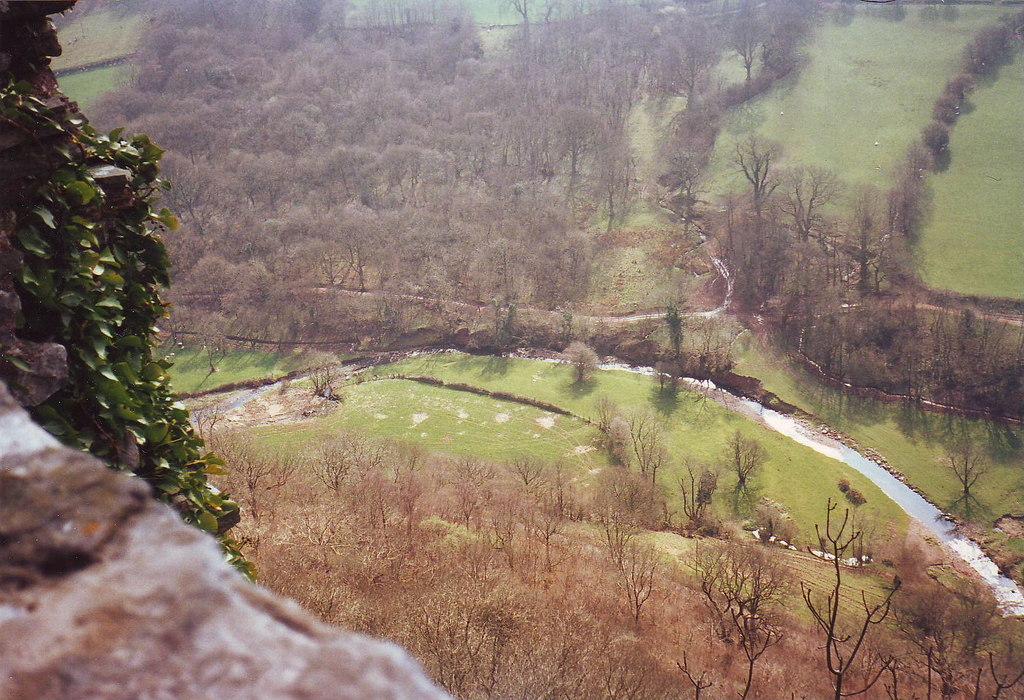
The name says it plainly: Castell Carreg Cennen means castle on a rock next to the river Cennen. The rocky outcrop is an isolated block of Carboniferous Limestone trapped between two geological faults, part of the Carreg Cennen Disturbance that stretches from Pembrokeshire to Shropshire. While the surrounding countryside rests on Old Red Sandstone, this single limestone block juts upward, creating the sheer cliffs that made the site irresistible to castle builders. Human remains found in a cave inside the rock date activity here to prehistoric times, and Roman coins from the 1st and 2nd centuries have been recovered, though no permanent Roman occupation is likely. The limestone itself shaped everything that followed -- the cliff provided natural defences, the cave provided water, and the drama of the landscape attracted builders, besiegers, and eventually painters.
Welsh Princes and English Barons
The first masonry castle was probably built by the Lord Rhys, ruler of the Welsh kingdom of Deheubarth, and his dynasty held it for roughly 50 years. Its first documented mention comes in 1248, when Brut y Tywysogion records a family betrayal: Rhys Fychan's own mother, Matilda de Braose, offered the castle to the English to spite her son. Rhys seized it back before they could take possession. For three decades, the castle changed hands between rival Welsh claimants fighting over Deheubarth. In 1277, when Edward I began his conquest of Wales, the local lords sided with the English and handed it over. They switched sides during the 1282 rebellion, seizing it back, but by 1283 it was in English hands again -- this time granted to John Giffard, the commander at Cilmeri where the last native Prince of Wales, Llywelyn ap Gruffudd, was killed.
Siege, Slighting, and 500 Men
Giffard and his son rebuilt the castle into the form visible today: six towers of different shapes, a twin-towered gatehouse, three drawbridges over deep pits, and a range of apartments including the King's Chamber with its carved stone fireplace and traceried windows commanding views to the south. In July 1403, Owain Glyndwr brought 800 men to besiege Carreg Cennen. The defender was Sir John Scudamore, who would later marry one of Glyndwr's own daughters. The siege lasted months and inflicted severe damage, but the castle held. More than five hundred pounds -- an enormous sum -- was spent on repairs between 1414 and 1421. During the Wars of the Roses, the castle became a Lancastrian stronghold under Gruffudd ap Nicolas. After the Yorkist victory at the Battle of Mortimer's Cross in 1461, Gruffudd's sons surrendered. The Yorkists brought 500 men to systematically demolish the castle, ensuring it could never serve as a stronghold again.
A Castle by Accident
J. M. W. Turner painted Carreg Cennen in 1798, drawn by the same drama that had attracted Welsh princes and English kings. Ownership passed to the Vaughan and Cawdor families, and the second Earl Cawdor began renovations in the 19th century. In 1932, the castle entered the guardianship of the Office of Works. Then, in the 1960s, a remarkable accident occurred: Lord Cawdor's legal team, drafting the deeds for the sale of Castell Farm at the base of the hill, mistakenly included the castle itself as part of the farm property. The Morris family, who purchased the farm, suddenly found themselves the owners of a medieval castle. Today it remains privately owned by their descendants, maintained by Cadw, and accessed by visitors via a steep climb from the farmyard where a threshing barn has been converted into tearooms. Below the cliff, the River Cennen follows the line of the geological fault that created the rock, flowing through a valley that has not changed much since the Lord Rhys first looked down from these walls.
From the Air
Located at 51.85N, 3.94W in Carmarthenshire, within the Brecon Beacons National Park. The castle is dramatically visible from the air, perched atop a limestone cliff above the River Cennen valley. Best viewed at 2,000-3,000 ft for the full effect of the cliff. Nearest airports: Swansea (EGFH), approximately 20 nm south; Pembrey (EGFP), approximately 15 nm southwest. The Black Mountain range of the Brecon Beacons rises to the north and east.