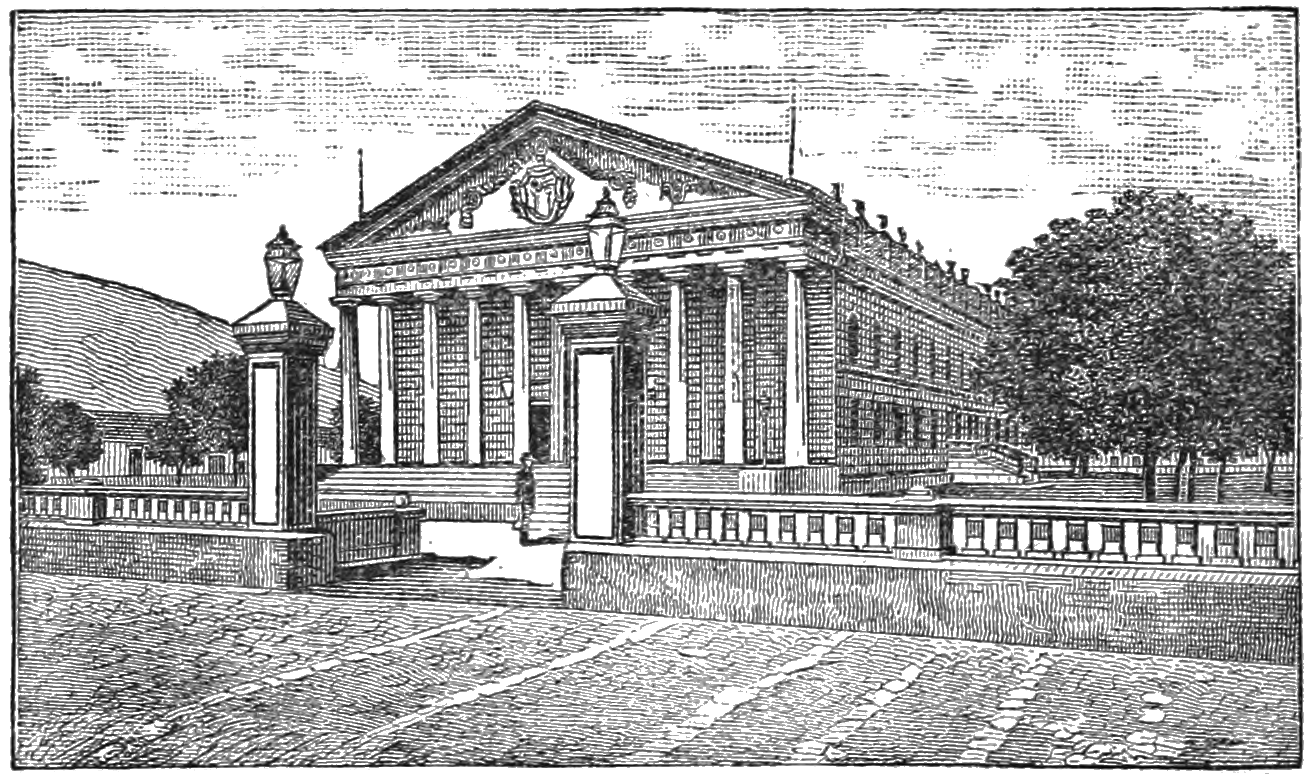
Carrera Theater (Guatemala)
It began, as so many grand buildings do, with a love of opera and a woman's persuasion. In the early 1850s, Rafael Carrera — the conservative strongman who had fought his way from illiterate peasant rebel to president-for-life of Guatemala — decided his young republic deserved a theater worthy of its ambitions. The idea was not entirely his own. His mistress, Josefa Silva, was an enthusiastic opera fan, and her influence helped push Carrera toward a project that would become the first monumental public building erected in Guatemala's republican era. The site he chose was the Old Central Square in Guatemala City, a plaza that had already witnessed the founding stone of the new capital in 1776, and that would now become the stage for something altogether more dramatic.
From Decree to Greek Facades
The idea of a theater on the Old Central Square was not new. In 1832, liberal governor Mariano Galvez had issued a decree to build one on that very site. But Guatemala's politics in the 1830s made construction impossible. Civil war between liberals and conservatives consumed the country, Galvez was overthrown, and the theater remained an unfulfilled promise. Twenty years later, the political climate had changed. Carrera had consolidated power, and Guatemala was enjoying a rare stretch of peace and prosperity. In 1852, Juan Matheu and Manuel Francisco Pavon Aycinena presented Carrera with a new plan. Once approved, Carrera commissioned Matheu and Miguel Ruiz de Santisteban to oversee the work. Engineer Miguel Rivera Maestre began the project but quit after a few months, and German architect Jose Beckers took over. Beckers designed the Greek-style facades and added a lobby, giving the building a classical grandeur that travelers would later compare favorably to the finest theaters in Spanish America.
Orange Trees and Political Coats of Arms
By 1884, the theater had become the centerpiece of the Old Central Square. Appleton's Guide to Mexico and Guatemala described it as "similar in size and elegance to any of the rest of Spanish America," surrounded by rows of orange trees, sculptures, and fountains that perfumed the air and drew visitors to linger. But the building also wore its politics on its facade. Under Carrera's conservative government, the theater bore the conservative coat of arms. After the Liberal Reform of 1871 swept the conservatives from power, the building was renamed the National Theater, and the coat of arms was chiseled away, replaced with new sculptures and inscriptions. The orange trees disappeared in the 1892 remodel, giving way to modern gardens and a bust of poet Jose Batres Montufar. That same year, the Italian community in Guatemala donated a statue of Christopher Columbus — Cristobal Colon in Spanish — which was placed beside the theater. The plaza and the building became known as the Colon Theater, their third name in four decades.
A Building That Outlived Its Builders
The theater's successive identities — Carrera, National, Colon — tracked Guatemala's lurching political transformations with an almost comic precision. Each new regime redecorated the facade to match its ideology, as if the building were a canvas that could be repainted with every revolution. General Manuel Lisandro Barillas Bercian ordered the most extensive remodel in the 1890s, timed to celebrate the 400th anniversary of Columbus's arrival in the Americas. The building stood through it all: conservative rule, liberal revolution, anniversary celebrations, and the long autocratic presidency of Manuel Estrada Cabrera, who governed Guatemala from 1898 to 1920 with an iron hand and a taste for self-aggrandizement.
The Earthquakes Win
On the night of December 25, 1917, the first of a series of devastating earthquakes struck Guatemala City. By early January 1918, successive tremors had destroyed much of the capital's public and private buildings. The Colon Theater was among the casualties. Its walls cracked, its Greek facades crumbled, and the building that had once been the proudest structure in republican Guatemala was reduced to a ruin. It sat in that state for six years. Estrada Cabrera's government was too incompetent to organize demolition, and after the 1920 revolution that finally deposed him, the country was consumed by political instability — including a 1921 coup by General Jose Maria Orellana against president Carlos Herrera. Not until 1923 was the wreckage finally cleared. In place of the theater where opera once filled the Old Central Square, a street market was built. Nothing of the original structure survives today, but the story of its construction, its many reinventions, and its ultimate destruction mirrors the turbulent first century of Guatemalan independence.
From the Air
The former site of the Carrera Theater is located at approximately 14.643°N, 90.513°W, in the historic center of Guatemala City near the Old Central Square. From 3,000–5,000 feet AGL, the dense urban grid of the city center is visible, with the nearby Parque Central and the Metropolitan Cathedral serving as landmarks. La Aurora International Airport (MGGT) is approximately 4 km to the south. The highland valley setting of Guatemala City sits at roughly 4,900 feet elevation, with volcanic peaks visible to the west and south on clear days.